
How to Validate a Business Idea in 5 Steps (Before You Spend Money)
A five-step process to test demand, interview buyers, and decide go, pivot, or stop before you spend money on a business idea.


You have a business idea, a little savings, and a friend who said “I’d totally buy that.” None of that is evidence yet. To validate a business idea, you collect proof in five steps: write the problem down, check that demand and competitors exist, interview people who have the problem, test an offer that asks for a real commitment, and decide against thresholds you set before you looked at the results. Most of it costs time, not money. The whole sequence takes roughly three to five weeks, and the first three steps can be done for free.
This guide is for founders and small-business owners who want a clear yes, no, or “change it” before they pay for inventory, a developer, or a lease. It works for services, local shops, physical products, and software alike. If you’re building a tech startup, our startup idea validation guide covers a seven-step sprint aimed at tech startups.
What does it mean to validate a business idea?
Business idea validation is the process of collecting evidence that a specific group of people has a problem they already try to solve, and will pay for a better way to solve it, before you commit money to building the thing.
Notice what’s missing from that definition: opinions. “Great idea!” is a compliment, not data. Evidence is what people have done (tried workarounds, searched, paid) or will do right now (pay a deposit, join a waitlist with real contact details). This is the core of product validation, and it’s the cheapest insurance a new business can buy.

The risk is real. CB Insights’ March 2026 review of 431 VC-backed companies that shut down since 2023 put poor product-market fit at 43%. Running out of capital was higher at 70%, though the report treats that as the final cause, not the root one. Two caveats: the sample is venture-backed companies only, and many shut down for more than one reason, so the percentages overlap. A corner-shop bakery isn’t a VC-backed startup. The lesson still travels: building before you’ve checked demand is an expensive way to learn.
How do you validate a business idea, step by step?
Five steps, each answering one question. Run them in order, because each one decides whether the next is worth your time. The time boxes below are our suggestions, not industry benchmarks.

| Step | Question it answers | Cheapest method | Evidence that passes | Suggested time |
|---|---|---|---|---|
| 1. Define | Who has what problem? | One-sentence hypothesis | You can name the person and the situation | 1 day |
| 2. Size demand | Does anyone want this, and who already serves them? | Search data, Census data, competitor reviews | Real demand and a gap you can name | 2 to 3 days |
| 3. Interview | Is the problem painful enough that people already try to fix it? | 10 to 12 customer conversations | Past behavior, not polite opinions | 1 to 2 weeks |
| 4. Test the offer | Will strangers respond to a specific promise at a specific price? | Landing page, pre-order, or deposit | Commitments from people you don’t know | 1 to 2 weeks |
| 5. Decide | Go, pivot, or stop? | Thresholds set in advance | Results compared to your own pre-set bar | 1 day |
Step 1: What problem are you solving, and for whom?
A validation hypothesis is one sentence that names your target market, a situation, and a pain, which together become your value proposition once you’ve tested them: “Independent physical therapists lose hours each week to insurance paperwork, and the tools they use don’t fix it” (a made-up example, so swap in your own). If you can’t write that sentence, the idea isn’t specific enough to test yet.
Start from the problem, not the product. “An app for dog owners” can’t be validated. “Dog owners who travel often can’t find last-minute sitters they trust” can, because you know who to talk to and what to ask them.
Write down your riskiest assumption too. Usually it’s one of three: the problem is real, customers care enough to pay, or you can reach them affordably. Every later step exists to test one of those.
Step 2: Is there real demand, and who is already serving it?
Demand research is the desk work you do before talking to anyone: checking search interest, market size, and the competitors customers already use. The U.S. Small Business Administration’s market research guide suggests using existing sources for general data and surveying or interviewing customers for specifics, and it points to U.S. Census Bureau data for demographics and market data.
Then read your competitors’ reviews. One-star and three-star reviews are free interviews: they list what customers hate in their own words. A crowded market is usually good news, because it means people pay for something in this space. An empty market deserves suspicion. Ask why nobody serves it.
Two outcomes matter here. You find a gap you can describe in a sentence, or you find out the total addressable market is too small to support you. Both are cheap to learn now.
Step 3: How do you interview customers without getting polite answers?
Customer interviews work when you ask about the past, not the future. “Would you use this?” invites a nice lie. “Tell me about the last time you dealt with this” gets a story. Rob Fitzpatrick’s 2013 book The Mom Test built a whole method on that rule: talk about their life instead of your idea, ask for specifics, and treat compliments as noise.
How many conversations? A 2006 study by Guest, Bunce and Johnson in Field Methods found that saturation, the point where new interviews stop surfacing new themes, arrived within the first 12 interviews in a 60-interview study of a fairly uniform group. Later work on cross-cultural samples found 20 to 40 were needed, so treat 10 to 12 as a floor for one narrow customer segment, not a rule. Our guide to customer discovery covers recruiting, and the user interview questions list gives you a starting script.
Can’t reach ten buyers this week? A synthetic panel is a fast first pass. AI user research interviews AI personas matched to your target buyer and returns a report in under 30 minutes.
Step 4: How do you test an offer before you build it?
An offer test puts a specific promise and price in front of strangers and watches what they do. Your minimum viable product doesn’t have to be a product: a landing page or pre-order page is enough, and early adopters are the people most likely to respond. The classic example is Buffer. Founder Joel Gascoigne wrote up how he went from idea to paying customers in seven weeks by starting with a two-page site, then adding a pricing page between the two pages to see whether people would still leave their email. He emailed everyone who did.
You can copy that shape with whatever fits your idea:
- A landing page with a clear offer and an email or deposit button (see landing page testing for how to read the results).
- A pre-order or paid pilot for ten customers.
- Two versions of your headline, compared before you spend on ads, using a message testing platform.
Selling a physical product? Pre-orders and sample requests are your strongest signal, and our guide to testing ecommerce product ideas shows how. Articos also has a page for ecommerce and DTC research.
The key rule: signups from friends don’t count. You want commitments from people who owe you nothing.
What did synthetic founders say they trust when they validate an idea?
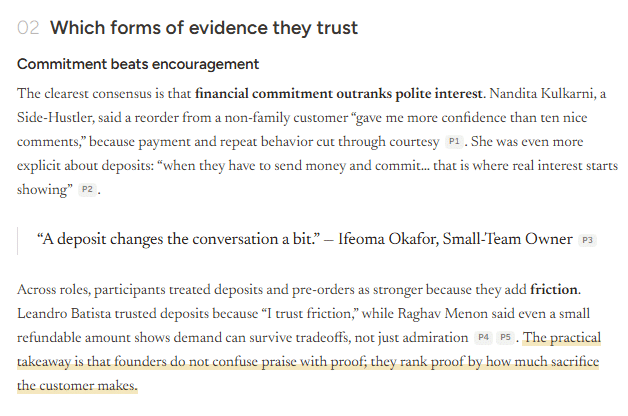
We tested the evidence ladder above with an Articos user interview study: synthetic first-time founders and small-business owners, each weighing an untested service, local shop, or physical product. The hypothesis we gave the study was the common assumption that founders trust compliments and interviews more than deposits and pre-orders. The panel disagreed. The report’s summary says founders trust commitment signals most, skip formal interviews often, and treat failed pre-orders as a cue to diagnose and narrow. It scores “commitment signals drive real confidence” at 9 of 9, and “ten noes trigger diagnosis and narrowing” at 9 of 9.

The quotes show why. Nandita Kulkarni, a side-hustler persona, said a reorder from a non-family customer “gave me more confidence than ten nice comments.” Ifeoma Okafor, a small-team owner persona, put it more briefly: “A deposit changes the conversation a bit.”
Treat this as directional. These are synthetic personas describing what they say they trust, which isn’t the same as watching real founders part with money, and the panel is small. One finding is worth acting on: the summary says founders skip formal interviews often, so book your Step 3 conversations before the week fills up.
Step 5: How do you decide to go, pivot, or stop?
A go/no-go decision compares your results to a bar you wrote down before you ran the tests. Without that, every result looks like a win. Set the numbers now. These are rules of thumb we suggest, not industry benchmarks, so adjust them to your price and market.
| Signal | Go | Pivot | Stop |
|---|---|---|---|
| Interviews (of 10) | 6 or more describe the problem unprompted and have already tried to fix it | 3 to 5 do, or they fix it for a different reason than you assumed | Fewer than 3 |
| Offer test | At least 5 strangers pay a deposit, pre-order, or sign a letter of intent | 1 to 4 commit, or interest appears only at a lower price | Zero commitments after a fair test |
| Price check | Buyers accept your price in willingness-to-pay interviews | They accept a price that breaks your margins | They refuse any price that works |
Pivot means change one variable: customer, problem, or price. Not all three at once. And stopping isn’t failure. You just spent a few weeks instead of a year.
Can synthetic research help you validate a business idea?
Synthetic research uses AI personas, built to match your target buyer, as stand-ins for real respondents. It helps most when speed matters and you’d otherwise skip research entirely. You describe the idea, Articos builds a panel (including built-in skeptics), interviews each persona separately, and returns a report where every finding traces back to a persona’s answer. To pressure-test a specific product or feature idea, use the concept testing platform.
Articos reports 86% recall against expert-published research across 46 studies, benchmarked against Baymard Institute and Nielsen Norman Group. Those figures come from the company’s own validation pre-print, not independent review.
Live Calls add a voice layer. You can hold a real-time voice conversation with any persona from your panel and push on a surprising answer, the way you would in a real interview. Live Calls are available on every plan and draw from your credit balance.
The limits are real. Synthetic personas can’t replace real buyers for regulated research, accessibility audits, long-term behavior studies, or the late-stage emotional nuance you only get from a live human. Use a panel to sharpen your questions and find weak spots first, then confirm with real people. If you want to recruit humans, User Interviews is built for that; here’s how it compares with Articos. Comparing broader options? See our best tools to validate a startup idea.
What mistakes ruin business idea validation?
Five come up again and again. Asking friends and family, who protect your feelings. Pitching instead of listening. Counting free signups as proof of demand. Falling in love with the product before confirming the problem. And moving the goalposts after the results come in, which is why Step 5 happens in writing, in advance.
FAQs: validating a business idea
Steps 1 and 2 cost nothing but time: write your hypothesis, mine Census and search data, and read competitor reviews. Customer interviews are free if you recruit through online communities, local businesses, or friends-of-friends who match your buyer (not close friends, who go easy on you). A simple landing page can run on a free or low-cost page builder. For a synthetic first pass, Articos’s 14-day free trial includes 900 credits (about two studies) with no credit card.
Yes. Use synthetic research early, when you need fast direction on which segment, message, or concept to pursue. Use real people to confirm the decision you’re about to spend money on. The synthetic pass makes your human interviews sharper because you arrive with better questions. Our comparison of <a href=”https://www.articos.com/blog/synthetic-users-vs-real-users” target=”_blank” rel=”noopener”>synthetic users vs real users</a> lays out when each one wins.
Aim for 10 to 12 interviews with one narrow customer type, and stop when new conversations stop surfacing new themes. If your idea spans very different segments, plan on more per segment.
Roughly three to five weeks if you run the steps in order and keep each time box tight. Interviews are the slowest part because of scheduling.
Plans are monthly, per the <a href=”https://www.articos.com/pricing” target=”_blank” rel=”noopener”>pricing page</a>: Lite is $29 (1,200 credits, about 3 studies), Starter is $79 (3,000 credits, about 7 studies), and Pro is $199 (8,000 credits, about 20 studies). One study uses roughly 400 credits, which works out to about $10 per study. Credits reset each billing cycle, and top-up packs carry forward.
Business idea validation applies to any venture, including services, local shops, and physical products. Startup validation usually adds product-build tests and investor-facing evidence. The five steps here work for both, and the <a href=”https://www.articos.com/blog/validate-startup-idea” target=”_blank” rel=”noopener”>startup version</a> lays out a seven-step sprint for tech founders.
What should you do next?
Write your one-sentence hypothesis today, then book your first three interviews for this week. Once you have a go, pre-launch validation covers what to check before you ship.


