Product Launch Barriers: 10 Common Ones and Which You Can Test Before Launch
What are the most common product launch barriers?


Your launch date is set, the deck is done, and something still feels unfinished. Product launch barriers fall into two groups. Internal barriers are execution problems: a product that isn’t ready, a sales team that can’t explain it, a team working to different deadlines. Market-facing barriers are demand problems: a misread audience, the wrong personas, pain points the product doesn’t touch, a bad price, a concept buyers don’t get. The market-facing group is the one you can test before launch day. This guide sorts ten common barriers along that line, shows what the failure data says about which ones do the most damage, and ends with a launch readiness checklist. For the wider rollout plan, start with our go-to-market strategy guide.
What are common product launch barriers?
Common product launch barriers include an unready product, thin in-house knowledge, broken communication, resistance to change, demand that outruns supply, a poorly understood market, questionable customer personas, a product that misses real pain points, poor pricing, and a concept too far ahead of the buyer. Product Marketing Alliance (PMA) lists all ten in its guide to launch barriers.
The grouping below is ours, built on that list. The last column is a judgment call, not a measured result.
| Barrier | Type | Testable before launch? | What checks it |
|---|---|---|---|
| Product isn’t ready | Internal | No | Go/no-go review, scope cut, or a later date |
| Lack of in-house knowledge | Internal | Partly | Enablement session, then quiz sales and support |
| Lack of communication | Internal | No | One owner and a shared launch tracker |
| Resistance to change | Internal | Partly | Bring internal champions in before the sprint |
| Demand outruns supply | Operational | Partly | A ramp plan and a waitlist |
| Market not understood | Market | Yes | Audience interviews and research |
| Questionable personas | Market | Yes | Persona validation with the target segment |
| Product misses pain points | Market | Yes | Concept testing |
| Poor pricing | Market | Yes | Price testing |
| Concept too cutting-edge | Market | Yes | Comprehension check in a concept test |
Are launch barriers internal or market driven?
Launch barriers are both, and the two types tend to fail differently. Internal barriers delay a launch that might have worked. Market-facing barriers let a launch go out on time and miss. Internal ones respond to ownership and a tracker. Market-facing ones respond to evidence from the people you’re selling to.
PMA’s survey of product marketers shows the split in practice. Positioning was the main barrier for 45% of respondents, release timing for 23%, and pricing for 18%. Positioning and pricing are market questions. Timing is mostly an execution one. The article doesn’t state the sample size, so read those percentages as direction, not precision.
Internal barriers are easier to spot: a missing asset, a late handoff. Market-facing ones stay hidden until someone tests them.
Why do product launches get delayed?
Product launches get delayed when work assumed to be finished turns out not to be, and the gap surfaces late. The most common version is a dependency nobody tracked. One PMM interviewed by PMA described being ready to launch while other materials weren’t, because teams worked to different deadlines and there was no system tracking the stages before launch.
A second version starts with the market. Pricing or messaging tested only after the build tends to come back wrong, and rewriting either one moves the date. That pattern is an inference from how the barriers line up, not a measured statistic.
The third is a plain readiness gap. Customer-facing teams who can’t explain the product force a postponement or a weak launch. PMA’s fix is a sales enablement session that includes customer success and support, not only sales.
Delay and failure aren’t the same. A launch can slip and still succeed, or ship on time and flop.
What causes most launch delays?
No source we found measures delay causes directly, so the closest evidence is what ends products. CB Insights analyzed 431 VC-backed startups that shut down since 2023, with reasons identifiable for 385. Poor product-market fit appeared in 43% of cases, bad timing in 29%, and unsustainable unit economics in 19% (companies could cite several reasons, so the figures exceed 100%).
Running out of capital was listed most often, at 70%. CB Insights calls it almost always the final cause, not the root problem. Money ran out because the product didn’t find a market first.
Two cautions apply. These are shutdowns of venture-backed startups, so they say little about a mid-size company’s feature launch. And the dataset covers failures, not slips.
Still, the pattern matches PMA’s survey: the barriers named most often are about positioning, timing, and price. All three can be tested earlier than most teams test them. Our guide to product-market fit validation covers that for early-stage teams.
What is pre-launch product validation?
Pre-launch product validation is testing whether a defined audience understands, wants, and will pay for a product before it ships. It covers four checks: does the audience have the problem, do they get the concept, does the message land, and does the price feel fair.
PMA’s methods include surveys, focus groups, win-loss interviews, competitor intelligence, and customer feedback. The bottleneck is almost always finding the right people to ask. Our pre-launch validation guide walks through running it by stage.
Synthetic research removes the recruiting step. An AI user research platform like Articos runs qualitative interviews with a panel of 12 to 50 AI personas matched to your target buyer and returns a structured report in under 30 minutes. Teams use it for concept testing before a build is finished, when a wrong answer is cheapest to fix.
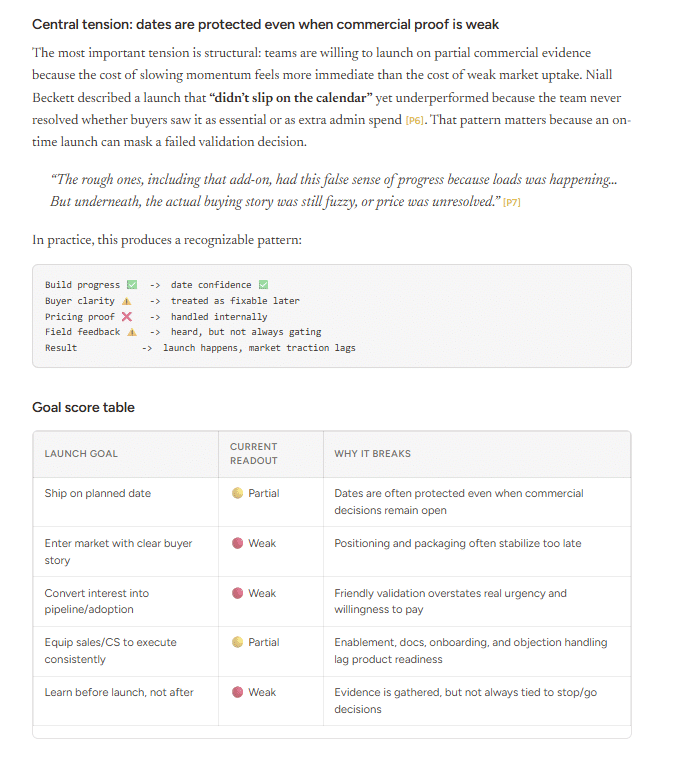
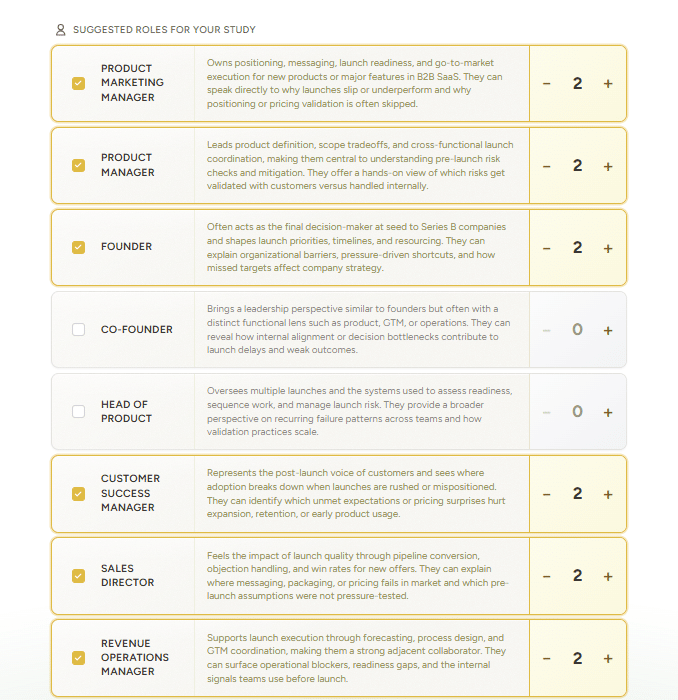
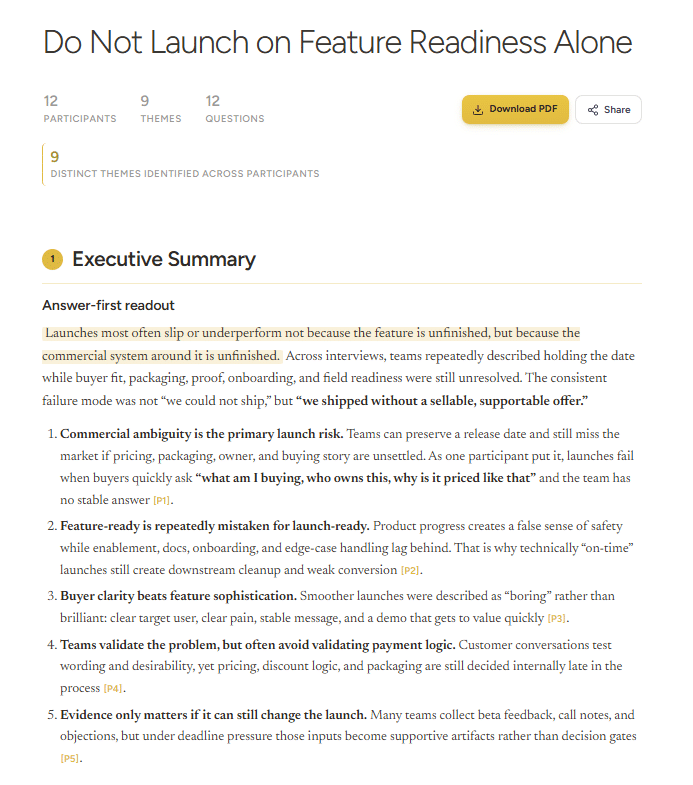
We ran this article’s question through Articos ourselves. The study used 12 synthetic personas at B2B SaaS companies in the US and UK: two each of product marketing manager, product manager, founder, customer success manager, sales director, and revenue operations manager. Asked about launches that slipped or underperformed, the panel’s main finding was that launches miss because the commercial system around the product is unfinished, not because the feature is late. Pricing, packaging, and the buying story were still open when the date arrived. Personas described validating the problem with customers while deciding pricing and discount logic internally, late in the process. One said that underneath all the activity, “the actual buying story was still fuzzy, or price was unresolved.”
This is one synthetic panel, so read it as a directional signal, not a measurement of how all teams behave. It does line up with the split in the table above: the barriers the panel kept returning to were the market-facing ones.
What tools check launch readiness?
Launch readiness gets checked with three kinds of tools: a tracker for internal tasks (a shared project board with one owner per deliverable), a research method for market questions, and a go/no-go meeting that ties them together. A launch readiness checklist is the document that holds all three.
The tracker handles the internal barriers. The research method handles the market-facing ones, whether that’s recruited interviews, a survey panel, or a synthetic study. The go/no-go meeting forces a decision with criteria agreed in advance.
A workable checklist:
- One sentence naming the audience and the problem they’d pay to fix.
- A positioning statement tested with people outside the team.
- Headline and key claims checked through launch messaging tests, not internal votes.
- A price tested with a method that doesn’t ask “how much would you pay?” PMA recommends Van Westendorp’s price sensitivity approach because direct questions pull the number down.
- A concept comprehension check: can a buyer say what it is in their own words?
- Sales, support, and customer success walked through the product.
- One owner and one tracker for every launch asset.
- A ramp plan in case demand beats supply.
If you’re building the sequence around a date, our product launch plan breaks it into phases.
How accurate is synthetic user research for launch decisions?
Articos reports 86% theme recall against published findings from Baymard Institute and Nielsen Norman Group, across 46 studies in 9 domains. Articos publishes that figure itself, and we found no independent review of it. The methodology is documented on the Articos methodology page.
What the number measures matters. It compares the themes a synthetic panel surfaces against themes in published expert research. It doesn’t forecast sales, and it doesn’t replace a real customer saying no to your price.
Synthetic panels sidestep some human response bias, such as politeness bias, and bring their own risks, so panel design matters. Articos builds its panels to push back. Personas are interviewed independently and don’t see your hypothesis, and the panels include skeptics and blockers on purpose. That design targets the main failure mode of AI research, where participants agree with whatever you seem to want.
Treat a synthetic result as strong directional evidence for early decisions. Confirm the high-stakes ones with people.
How do Live Calls help you dig into a launch barrier?
Live Calls let you hold a real-time voice conversation with any persona from your study, which turns a surprising finding into a follow-up you can ask on the spot. Say a pricing study shows hesitation. Instead of re-running it, you call the persona who raised the objection and ask what specifically made them pause.
Live Calls sit next to Talk to Research, which handles written follow-ups after a study finishes. Both draw on the credits in your plan, so there’s no separate fee.
Use them on the barrier you can’t explain. A theme that says “buyers hesitate on price” tells you where to look. A conversation tells you whether the issue is the number, the packaging, or what they assumed it included.
What’s the cheapest or free way to test launch barriers?
The cheapest option is talking to a handful of real prospects yourself, which costs time and no cash. It works well for a first read on one barrier. It gets slow when you need several segments or a fast turnaround.
Among synthetic research tools, Articos offers a free trial: as of October 2026, the pricing page lists 14 days with 900 credits, about two full studies, and no credit card. After that, Starter runs $79 a month and Pro $199 a month. One study costs roughly 400 credits, which works out to about $8 to $10 per study on a subscription. Top-up credit packs are also available.
Starter lists roughly 7 studies a month and Pro roughly 17, with launch-offer bonus credits adding about 3 and 7 on top while the offer lasts. Check the pricing page before you plan around those numbers, since bonus offers change.
Should you combine synthetic and human research instead of choosing one?
Yes. The two answer different questions, and the sequence matters more than the choice. Synthetic research fits early, frequent decisions: concept reactions, messaging, positioning, pricing hypotheses. Human research fits decisions where being wrong is expensive or where you need something a persona can’t give you.
Articos itself lists where real people remain necessary: regulatory work such as clinical trials, highly emotional topics, long ethnographic or diary studies, and technical beta testing. A recruited panel is also the right call when stakeholders need video evidence before a major launch.
A practical order: run synthetic studies while the concept is still changing, narrow to two or three options, then put the finalists in front of recruited participants. If recruiting is the sticking point, our comparison of User Interviews alternatives shows where each approach fits.
Which launch barrier should you test first?
Test the market-facing barrier you’re least sure about. If your positioning is untested, start there, since it was the top barrier in PMA’s survey. If positioning is settled and you haven’t touched price, test price.
For internal barriers, skip research and assign an owner. A shared tracker and a go/no-go date address them directly.
The study above points the same way. Its goal score table rated a clear buyer story, converting interest into pipeline, and learning before launch as weak, and rated shipping on the planned date and equipping sales and customer success as only partial.