Willingness to Pay Interview Questions: How to Run WTP Interviews for Pricing Research
How to run willingness to pay interviews: the questions to ask, how reliable they are, and what to pair them with.


You have a price in mind, and nobody you’ve asked has said it’s wrong. That tells you less than it feels like.
Willingness to pay (WTP) is the maximum price a specific customer will accept for a defined offer. Willingness to pay interview questions are how you find that number before launch, and the ones that work ask what a customer already spends and what they would give up. They finish with a request for commitment instead of a hypothetical number. A bare “Would you pay $49?” tends to collect politeness, and stated values run high: across 83 observations in 28 stated-preference studies, the median ratio of stated to actual value was 1.35.
How do I know what customers will pay?
Customers show what they will pay when they give up something of value, such as a deposit or a signed letter of intent. What they say about price in conversation is weaker evidence.
Rob Fitzpatrick’s The Mom Test describes why. Customer conversations tend to produce compliments, vague promises like “I’d definitely buy that,” and feature ideas, all of which feel like validation and cost the customer nothing. Fitzpatrick treats a commitment as the signal worth chasing: the customer gives up time or money to move the deal forward.
Interviews and surveys estimate customer willingness to pay. A live price test confirms it, and pricing A/B testing needs enough traffic to read the result. Interviews are the cheapest place to start, because they explain why a price feels right or wrong before you spend traffic on it.
How do you run willingness to pay interviews?
A willingness to pay interview follows four steps: learn what the customer spends now, learn what they would give up to solve the problem, show the offer at one real price, then ask for a commitment.
Recruit people who already buy in your category, one segment at a time. An agency and a solo founder anchor on very different budgets, so mixing them blurs the answers. The wider user research process applies here, and the sample size you need depends on how much your buyers differ from each other.
In the interview, spend the first half on the past. Ask when they last bought a solution, what it cost, and who approved it. Then show your offer with a specific price and ask what would stop them from buying today. Close with a commitment ask, such as a paid pilot or an introduction to the budget owner. A customer who turns that down has still given you useful information.
What willingness to pay interview questions work best?
The best willingness to pay interview questions ask about past spending and tradeoffs first and request a commitment last. Use them in this order.
| Stage | Question | What it tells you |
|---|---|---|
| Current spend | What do you pay today to solve this, and what did the last replacement cost? | Reference price and budget size |
| Alternatives | What did you try before, including doing nothing? | Competing options |
| Decision owner | Who signs off on spend like this? | Approval limit |
| Value | What does this problem cost you in a typical month? | Value anchor |
| Reaction | Here is the offer at $X a month. What is your first reaction? | Unprompted price reaction |
| Tradeoff | Which feature would you drop to hold the price at $X? | Feature priorities |
| Objection | What would stop you from buying this today? | Real blockers |
| Commitment | Would you start a paid pilot at $X next month? | Commitment signal |
Skip “How much would you pay?” as an opener. It asks for a number with no reference point, so current spend comes first.
WTP interviews or pricing surveys?
Interviews explain why a price works, and pricing surveys measure how many buyers accept it, so most pricing studies use both. To measure willingness to pay, run interviews first to learn which questions matter, then field a willingness to pay survey to size the range.
| Method | What it asks | What you get |
|---|---|---|
| WTP interview | Open questions on spend, tradeoffs, objections | Reasons, objections, buyer language |
| Van Westendorp | Four price questions per respondent | Acceptable price range |
| Gabor-Granger | Purchase intent at set price points | Demand curve |
| Conjoint | Choices between feature and price bundles | Price value of each feature |
The Van Westendorp price sensitivity meter, introduced in 1976, asks four price questions: too cheap, cheap, expensive, too expensive. Its output is a range. The optimal price point it reports is where the “too cheap” and “too expensive” curves cross, which is not the revenue-maximizing price. Gabor-Granger, developed in the 1960s, covers that gap by showing candidate prices and plotting purchase intent into a demand curve. Conjoint analysis suits feature-heavy products, because it estimates willingness to pay for individual features.
Are WTP interviews reliable?
WTP interviews are reliable for explaining why a price works and unreliable for pinpointing how much, because stated values run above what people pay. Hypothetical bias is the gap between what people say they would pay and what they actually pay.
A meta-analysis of 28 stated-preference studies (Murphy et al., 2005) found a median hypothetical-to-actual ratio of 1.35 across 83 observations, with a skewed tail of much larger gaps. The authors also found that choice-based elicitation was associated with less bias, though they cautioned that few studies and overlapping variables limit firm conclusions.
Two rules follow. Ask customers to choose between concrete options instead of naming a number, and treat any stated price as an upper estimate until a commitment or a live test confirms it. A small qualitative sample can’t produce a demand curve. It produces the objections and wording your survey should test next.
What tools research willingness to pay?
Tools for willingness to pay research fall into three groups: survey platforms that run Van Westendorp or Gabor-Granger studies, recruitment platforms that find real buyers to interview, and synthetic research tools that give a fast first read. Free scripts help too. The open-source R package pricesensitivitymeter, for example, calculates Van Westendorp curves from your survey data.
Articos belongs in the third group. It interviews synthetic personas matched to your buyer profile, and its April 2026 pre-print reports that its findings recovered 86% of the themes in published Baymard Institute and Nielsen Norman Group research across 46 studies (methodology). That benchmark compares themes and says nothing about dollar amounts, so it doesn’t show that a persona can name your exact price.
Use AI user research where early price validation needs objections and wording, such as testing a pricing concept before launch. Use real buyers for the number.
What’s the cheapest or free option?
The cheapest way to research willingness to pay is to interview a handful of current buyers yourself, which costs only your time. A free survey form can collect Van Westendorp answers, though without a target-matched sample the result is a hunch.
| Option | Cost | Best for |
|---|---|---|
| Interview current buyers yourself | Your time | First read on price reactions and objections |
| Articos free trial | $0 for 14 days, 900 credits (about 2 studies), no card | Testing a price page or offer wording |
| Articos Starter | $79/month, 3,000 credits (about 7 studies) | Consultants and SaaS teams with focused questions |
| Articos Pro | $199/month, 8,000 credits (about 20 studies), white-label reports | Agencies researching for several clients |
One study costs about 400 credits, which Articos puts at $7 to $10 per study (see what concept testing costs for the wider range). Launch bonus credits currently add roughly 3 extra studies a month on Starter and 7 on Pro. Check the current plans before you commit; these figures are as of October 2026.
Should I combine synthetic and human research, not choose one?
Synthetic and human research work best in sequence: synthetic personas narrow the field, and real buyers confirm the price. Run a synthetic user interview on your pricing page first, and use its objections to sharpen your real-buyer questions.
We ran this on our own pricing. Nine synthetic personas (SaaS product managers, founders and agency owners) answered the script above, with Starter at $79 a month and Pro at $199 as the two offers. Starter read as a reversible, pay-to-pilot experiment. Pro hit a sharper ceiling because it implied a bigger claim than most personas were ready to grant. Trust limited willingness to pay more than budget did: they would use synthetic output to pressure-test messaging or screen concepts, not to replace real customer contact.
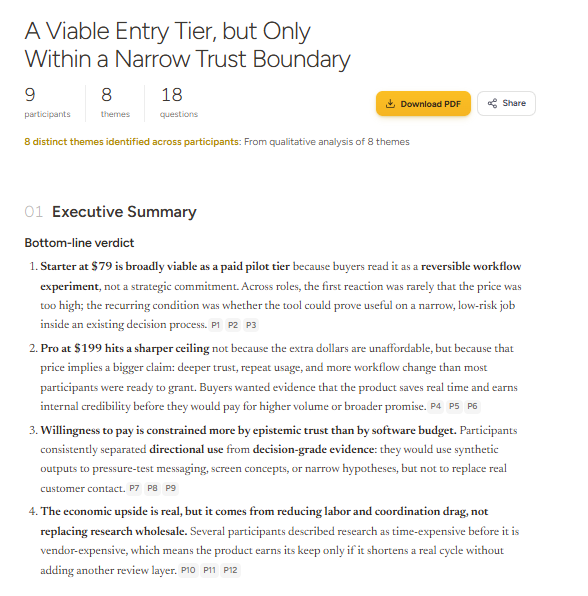
That result is an objection map, not a price. Next, interview real buyers (a platform like User Interviews helps if your list is thin), then finish with a commitment ask or a live price test. Live Calls let you question a persona by voice, and Talk to Research handles written follow-ups after the report.
Book a handful of buyer interviews using the questions above.