
Stakeholder Buy-In for User Research: How to Get It
How to win stakeholder buy in for user research by tying studies to a decision, pricing the cost of guessing, and landing a quick win.


People often present a proposal for research, highlight an important issue to investigate and then state that the product manager doesn’t have capacity to carry out this research. The solution usually does not lie in becoming better at influencing people.
There are 3 key drivers for achieving stakeholder buy in for research. Firstly, link the research to a current decision that needs to be made. Secondly, quantify the risks that the stakeholder can appreciate. Finally, provide quick early success so that further requests are easily accepted. Below are scripts for the top 3 arguments that you will typically face, together with advice on how to maintain commitment following the initial ‘yes’. See our user research approaches guide for information on what to actually do having secured approval for research.
How do I get stakeholder buy-in for user research?
- Gather from stakeholders issues that they are dealing with. Then note down what information they would need to alter their decision.
- Formulate a single line summary of the issue that will be resolved by research including a timescale.
- Calculate the cost of ‘trial and error’ using your rework investment.
- Overcome the time, money and “we already know our users” concerns by proposing a low effort initial task.
- Provide a short-term success within 1 week.
- Maintain a decision log to continually show the benefit.
These first three actions are undertaken prior to carrying out research. Failure to do so means you may become involved in research that has not been requested.
Why is stakeholder buy in so hard to get for user research?
Whereas stakeholders are concerned by the effect that research has on time and cost, researchers are more concerned about research quality. Typically, they do not discuss the same areas.
Nielsen Norman Group carried out a survey of 126 UX professionals in 2024 and found that stakeholder buy-in was the most commonly encountered issue. UXtweak has also surveyed 142 UX professionals to highlight how these issues can present in real life. Product time-line, financial and change aversion were the most commonly cited reasons for non-buy-in; with 18.2%, 15.5% and 15.1% respectively. Of these, change aversion proved the most difficult to address, with 26.1% identifying it as such.
Overall then, although people typically object to research on the grounds of time, cost and change, they seldom do so on the basis of research approach. Someone who is concerned about time will wish to understand the value added by the extended timescale. Addressing this can alter the nature of the discussion.
Who counts as a stakeholder, and what does each one worry about?
A stakeholder is anyone whose decisions, budget, or workload change because of what the research finds. Each role carries a different risk, so the same finding needs a different framing for each.
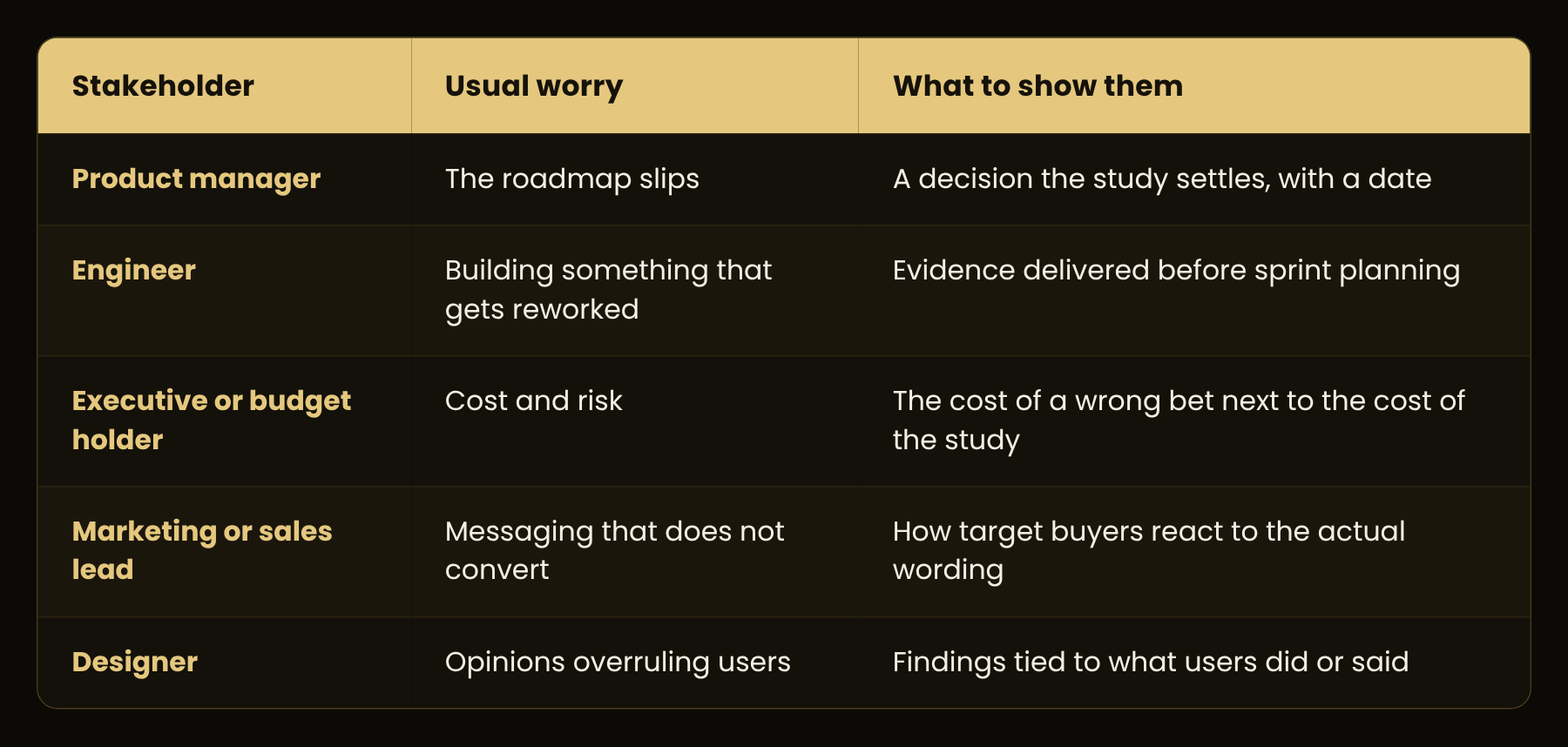
Ask each person directly before you pitch anything. Nielsen Norman Group recommends having stakeholders take part in both research and design, since participation shows the value of the work and keeps the team focused on the people it serves.
How do you get stakeholders on the same page before the study starts?
Before even producing research questions, meet with stakeholders for 20 minutes and ask them to explain the key decision they are facing. Then ask what type of evidence would persuade them to change their minds. Finally, discover what information they would actively choose not to pay attention to. You can then use this information to underpin your research design.
Produce a decision statement and disseminate it. E.g. ‘We will decide at the end of the month if our pricing page should emphasize speed or price. ‘This research will show which of these messages customers understand better.’ Decide in advance what each outcome of the research will cause stakeholders to do. Someone who has approved these actions will find it more difficult to disregard the research outcome.
Tomer Sharon’s book It’s Our Research (Morgan Kaufmann, 2012) is based on the principle that stakeholders should be involved in all stages of the research process – from design through to analysis and delivery. A single page document can easily contain the decision statement, actions and deadline.
How do you convince stakeholders to invest in UX research?
People are happy to fund research if they can relate the investment to something they already understand – in this case, money wasted on building the wrong product or feature. Take one of your latest reworks e.g. an on-boarding process or pricing page which has had to be reworked (possibly more than once). Then calculate the cost as (number of people x number of weeks x cost per person per week). For example, 6 people over 4 weeks at $4,000 per person per week = $96,000. Ask the group to estimate what proportion of this cost could have been avoided had basic research been undertaken. Finally compare this with your research cost, comprising recruitment, software and your time. We show below average costs for user research. And our argument for why research is important can also support your approach.
However, recognize that not all reworks are due to a lack of research. If a stakeholder identifies this, they will dismiss the rest of your argument. Only attribute reworks which can demonstrably be linked to a lack of research. For instance, people may have left a process – a cause which could easily have been identified through brief research.
How do you answer stakeholder objections to research?
Use the same approach for each challenge – firstly recognize it, secondly reinterpret it using data and thirdly suggest a manageable course of action.
‘We don’t have time’
Recognize the time constraint and reduce the scope of the research. For example, this could be limited user interviews or a quick test. An AI-powered Articos study can be completed in less than 30 minutes. So, this largely addresses the time concern. User research can be conducted in 30 minutes and the findings presented at the next standup. Synthetic personas provide guidance but if a decision has significant implications, then combine these with a small number of real customer talks.
‘We don’t have budget’
While recognizing that budgets are limited, refer to the money being spent elsewhere (see above for rework costs). Suggest the most cost effective method of research. Support tickets, sales calls and analytics can all be reviewed at low cost (other than your time) and frequently provide some of the information required without any expenditure.
‘We already know our users’
This is a confidence issue. Challenge this by getting stakeholders to note down what they think users will do in relation to the research topic. Display these alongside the actual findings. People generally dislike being shown to be incorrect and so the difference between the two does the convincing for you.
What is the fastest quick win for earning research credibility?
Identify a point of contention (for example, if there is debate over whether the key message on a homepage should promote a fast service or low cost). Offer to undertake research to advise on which is best. As there are two positions to assess and a timescale, research has a clear remit and an easily identifiable outcome.
Test just one question using one measurement. Run tests of both options against your ideal customer using a concept testing tool. Enter the research finding into the header of your report and return it in the same week.
Enable skeptics to explore further. Articos Live Calls enable participants in a research study to have a voice chat with a virtual character at any time. This allows a doubting stakeholder to investigate further into the research findings. Live Calls are included within all plans and share the same credits allocation as research. If findings are finely balanced then check these with real customers prior to taking any action.
What happens when you test two research-approval pitches?
As part of our testing we looked at which headline would encourage a product or engineering lead to authorize user research. We compared two options – one highlighting the avoidance of rework costs (“Cut rework costs before you build,”) and another around the time taken to get information (“Get answers in 30 minutes, not 6 weeks,”). Again we used simulated personas for product manager, engineering lead and head of product.

While the speed headline was given a 6.8/10, the rework reduction headline was 6.0/10. Articos identified that there was clear direction in favor of the speed headline. It was also felt that the confidence in this direction was mixed. The speed headline outperformed in terms of interest (8 v 7), differentiation (8 v 5) and precision (7 v 4). The rework headline won on value (7 v 6). Further analysis by persona showed that product managers were more inclined to favor the rework headline (6.8 v 6.5). Engineering leads (6.7 v 6.6) and heads of product (6.9 v 6.7) were more attracted to the speed headline.

While both headlines were lacking in certain areas, the most valuable feedback was that participants wanted to know what specific decision would be reduced in risk through the research, together with the people involved and the process. Furthermore, some questioned how much genuinely valuable information could be gained in just 30 minutes and what this information would replace. This is again the decision statement referred to above. As mentioned, simulated personas provide directional feedback. To ensure the best headline is selected, this should then be validated with a real authorizer prior to submitting a budget request.
How do you get stakeholders to act on findings?
While steering the interpretation of your research and making recommendations, back this up with data. Usually, stakeholders fail to read reports in enough depth to understand their key messages.
Encourage stakeholders to analyze data with you. Maze’s 2025 survey showed that within organizations where both UX professionals and stakeholders conduct research, 86% of stakeholders used research data to make decisions on a monthly basis or more frequently. This contrasts with just 42% in organizations with only research professionals undertaking research. Although this is suggestive, it does not establish causation. Moreover, the number of stakeholders in the ‘research-only’ category was quite small (around 12) and the organization sample was biased towards those which were already research-investing.
Stakeholders analyzing data with you can achieve more than simply presenting data in a slide show. Refer to our article on how to present research for different methods of presentation. In addition, our article on synthesizing research explains how to transform data notes into useful insights.
How do you keep stakeholder buy in after the first yes?
Produce easily accessible outputs from your studies. Maintain a decision log which details for each study, the issue under investigation, the decision this affected and then the outcome.
Every month, produce a brief update on decisions which have been affected by research. At the end of a three month period this then provides you with evidence to justify future funding as it is based around decisions not actions. Further still, involve different stakeholders to witness new studies so that engagement can be maintained beyond the initial sponsor base.
Also relate your decision log to your roadmap. During planning sessions research is analyzed and then applied to decision making. For an example of how to do this, please refer to our blog on using customer research within product strategy.
FAQs
Use existing data sources such as support tickets, sales call audio and analyzing data. This costs time but not money. Articos has a no-card 14-day account with 900 credits which is around 2 studies. Although there is no ongoing no-cost version of accounts, paid versions start at just $29 per month and allow around 3 studies. Where considering paid service options, see our UserTesting alternatives page.
Yes. Synthetic is good for quickly providing insight on messaging and ideas. It can also be used to reduce choice ahead of investing in people research. People research should then be used where there is significant impact at stake, in new markets, or for emotive issues. People research will also validate the best choice. See our comparison of synthetic and real users for details of when to use these.
A quick ‘win’ can often shift a stakeholder’s view in a week. More general stakeholder engagement such as allocating money to a research budget tends to emerge across a number of studies and generally a quarter or more of outward decision making. See our page outlining timescales for user research for further detail.
Investigate why they might have changed their view and run the most basic study to explore this. Should they still disagree, note their decision and the risk you identified. Then request that their decision is reviewed again once post-launch metrics are available. Having a paper trail enables an issue to be revisited without creating conflict.
Your next step
A key issue for this week – define this – and then devise a piece of research which will provide an answer to it. For the quickest service, Articos can conduct interviews and produce a detailed analysis report for you.


