Customer Research Strategy: Why Research Rarely Changes Product Decisions
All about getting your customer research strategy right.


Your customer research strategy fails the moment findings land after the product decision is already made. That is the short answer to why leadership shrugs at a study your team spent weeks running. Research changes strategy when it is tied to one named decision, delivered inside the window for that decision, and watched by the people who make the call.
Where a study sits on the product calendar decides most of its influence. Our user research guide covers the methods themselves.
Why does leadership ignore customer research?
Leadership ignores customer research when findings arrive after the decision, in researcher vocabulary, with no executive having watched a session. Each cause has a direct fix.
Timing is the first cause. A traditional study often takes weeks to recruit, field and write up, so it lands after the roadmap is locked and a choice due next sprint gets made without it. The team then files the report as background reading. Our breakdown of how long user research takes shows where those weeks go.
Format is the second. A long readout lists what participants said, while an executive needs to know which of two options to fund. A report with no recommendation leaves nobody owning the next step.
Exposure is the third. An executive who never watches a session has only the researcher’s summary, and in a meeting a summary tends to lose to a confident opinion.
Why does research fail to change strategy?
Research fails to change strategy when it answers a question nobody was about to decide. A study on how users feel about onboarding produces interesting qualitative findings and no action, because no choice was waiting on the answer.
Two patterns repeat. Research gets commissioned to confirm a direction leadership already picked, and when the findings conflict, the direction often wins, helped by confirmation bias and the cost of reversing course. Or a study gets scoped so broadly that no single result settles anything.
Survey data from practitioners matches this. Nielsen Norman Group coded the answers of 126 UX practitioners into five challenges, and lack of stakeholder buy-in was the one reported most often. Respondents described stakeholders who see UX work as a cost.
The fix starts with the question. Write it as a decision with a date, such as “Do we ship guided setup in Q1?” Our guide to writing a research question shows the structure.
Research report or decision-ready insight?
A decision-ready insight is a finding written as a recommendation for one named decision, with the evidence behind it and the cost of waiting attached. A research report lists findings and leaves the decision to the reader.
| Element | Research report | Decision-ready insight |
|---|---|---|
| Opening line | Method and sample size | The decision and the recommendation |
| Evidence | Every theme, equal weight | The two or three findings that change the choice, with quotes |
| Cost of waiting | Not stated | What slips or breaks if the team delays |
| Next step | Implied | Owner, date and effort estimate |
| Length | Dozens of slides | One page, with an appendix |
Customer insight research earns attention once the one-page version exists. The move from findings to “so what” is synthesis, covered in our research synthesis guide. NN/g’s advice to researchers points the same way: use the stakeholders’ own language and explain what the research will do for them.
Does a one-page decision brief get acted on more than a full report?
A one-page decision brief won in our Articos test, with one exception. We ran 13 AI interviews with synthetic product leaders (CPOs, VPs of Product, Heads of Product, product directors, general managers and group product managers) and showed them two versions of the same onboarding drop-off finding: a 40-slide methods-first report, and a one-page brief that opens with the decision, the recommendation and the cost of waiting. The panel judged the brief faster to act on and a better fit for a bounded next-sprint change. The methods-first deck scored higher on credibility for expensive or contentious decisions.

The study’s own recommendation was layers: the decision brief on top, then a chart and two or three quotes, then the methods in an appendix.
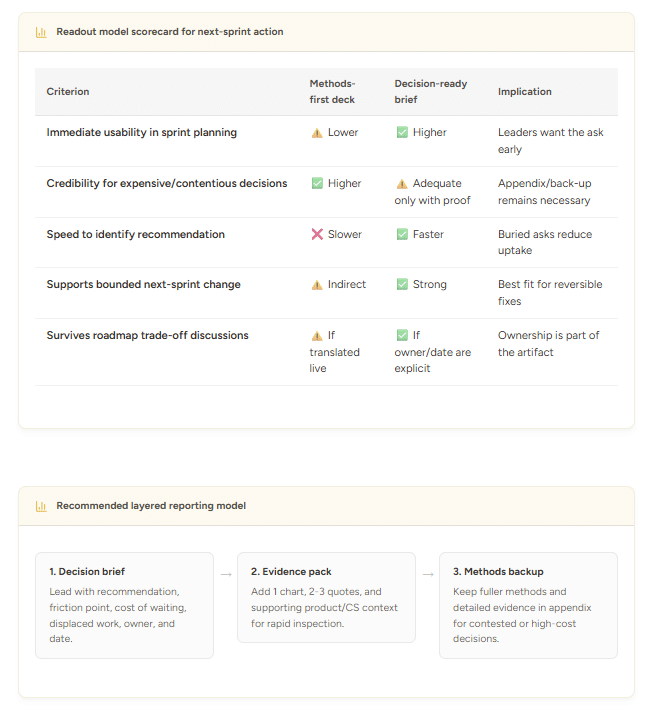
Treat this as directional evidence. The personas are synthetic, the formats were described in the prompt rather than shown as finished documents, and real executives may behave differently. Run the same comparison with five to eight real leaders before you restructure your readouts.
What makes a customer research strategy influence product decisions?
A customer research strategy influences product decisions when each study is tied to a dated decision, stakeholders watch the evidence arrive, and findings land inside the decision window.
Start with a decision calendar. List the choices due this quarter, then attach a study, an owner and a date to each. A two-week sprint needs a study that finishes in days, and a UX research plan keeps the calendar honest.
Next, put stakeholders in the room. Jared Spool’s 2011 exposure-hours research found that teams whose members each spent at least two hours every six weeks watching real users improved their designs far more than teams below that minimum. Inviting one executive to one live session is the cheapest way to involve stakeholders in user research.
Finally, connect customer insights to product work by storing each finding beside the backlog item it affects. Voice of customer research programs make that routine, and our voice of customer guide covers collecting and routing feedback continuously.
What tools activate customer research?
Customer research tools activate research when they shorten the path from question to decision or put stakeholders in front of the evidence. The right category depends on where your bottleneck sits.
| Tool type | What it activates | Main limit |
|---|---|---|
| Repository and analysis tools | Past findings stay searchable at planning time | Needs studies to exist already |
| Video-based testing platforms | Executives watch real users struggle in short clips | Recruiting and review time for every study |
| Survey tools | Numbers at scale | Self-reported answers, little on why |
| Synthetic research platforms | A decision-ready report inside a sprint | No observed behavior; not valid where regulation requires human subjects |
Articos sits in the last row. It is an AI user research platform: you describe the decision, it builds a panel of personas matched to your audience, runs the interviews in parallel and returns a report with themes and recommendations in under 30 minutes. That timing fits a two-week sprint.
After a study, Live Calls open a real-time voice conversation with any persona from the panel, so a skeptical executive can ask the follow-up question directly. Talk to Research handles the same follow-ups in writing. Both draw from the same credit pool as studies.
What’s the cheapest or free option for customer research?
The cheapest customer research is free and costs only time: mining support tickets and sales calls, plus interviews with a handful of customers. On sample size, Jakob Nielsen and Tom Landauer’s model puts the share of usability problems found by five test users at about 85%. That figure holds for comparable users on a single flow, and it needs more participants when your audience splits into distinct groups.
For paid options, Articos offers a 14-day free trial with 900 credits, about two full studies, and no credit card. After that, top-up credit packs are available. Starter costs $79 a month for 3,000 credits (around 7 studies, or about 10 with the current launch bonus credits), and Pro costs $199 a month for 8,000 credits (around 20 studies, or about 25 with the bonus). One study uses roughly 400 credits, which works out to about $7 to $10 per study. Our user testing cost breakdown compares those figures with traditional pricing.
Should I combine synthetic and human research instead of choosing one?
Synthetic and human research work best in sequence: synthetic first to narrow options in minutes, human next where the decision is expensive, regulated or needs video evidence. Early in a sprint, run concept testing on two or three directions to drop the weak ones. Probe one surprising finding with a Live Call. Then take the one or two findings that matter to five to eight real customers. When stakeholders need to watch a real person struggle, video platforms do that well, and Articos’s UserTesting comparison lays out when each approach fits.
Articos reports 86% theme recall against published Baymard Institute and Nielsen Norman Group findings across 46 studies in 9 domains. That figure comes from its own pre-print, so treat it as vendor-reported until someone else replicates it. Synthetic personas cannot produce observed behavior such as click paths, and studies that legally require human subjects, such as clinical trials, need real participants. Ask any vendor how it handles dissent; Articos panels include skeptics and blockers.
This week, list your next three product decisions with dates and attach one study to each.