
40 Micro SaaS Ideas for 2026: Niche, Profitable and Testable in a Week
40 specific micro SaaS ideas for 2026, grouped by buyer, each paired with a fast way to test demand before you build.


A short list of problems narrow enough that you already know who’d pay for the fix, each with a way to find out this week before you build anything, beats another 500-idea database. The 40 micro SaaS ideas below are grouped by the specific person who has the problem, and each one comes with the fastest honest way to test whether it’s worth building. If you’d rather start from a method than a list, our guide to finding startup ideas covers seven problem-first ways to generate your own.
A micro SaaS is a small, focused software product, usually run by one person or a tiny team, that solves one narrow problem for one well-defined buyer well enough that they’ll pay a recurring fee for it. “Micro” describes the scope: a single feature set, a single buyer type, and a build small enough to ship a usable first version in weeks.
What makes a micro SaaS idea “testable in a week”?
An idea is testable in a week when you can get a real yes-or-no signal from your actual buyer before you’ve written any code. That rules out ideas where the buyer is vague (“small businesses”), where the value depends on network effects you don’t have yet, or where you can’t describe the fix in one sentence a stranger would understand.
Four things make an idea fast to test:
- A named buyer, not a market. “The person who manages OSHA training records for a 40-person electrical subcontractor” is testable. “People who need compliance software” is not.
- A problem they already pay to solve badly. A spreadsheet, a part-time hire, or a general tool bent out of shape is evidence the budget exists.
- A single clear job, statable in one sentence. If you need a paragraph to explain what it does, it’s not micro yet.
- A visible willingness-to-pay signal. Are they already paying an agency, a consultant, or a generic tool to approximate this? If nothing currently gets paid for, that’s a yellow flag worth digging into in interviews before you build, though it doesn’t rule the idea out on its own.
Micro SaaS idea categories at a glance
| Category | What ties them together | Best for | Fastest way to test demand |
|---|---|---|---|
| AI workflow tools for specific roles | One tedious task, automated for one job title | Builders comfortable wrapping an LLM around a workflow | Pitch the exact task to 10 people with that job title |
| Niche analytics & reporting | A report someone currently assembles by hand | Builders who like dashboards and data pipelines | Mock up the report in a spreadsheet, show it, ask if they’d pay for it live |
| Compliance & admin automation | A deadline or filing nobody wants to track manually | Builders who can sit with dry, rules-heavy domains | Ask how they track it today; silence or “a shared spreadsheet” is the signal |
| Tools for agencies & freelancers | Something every agency in a niche redoes every month | Builders with agency or freelance experience themselves | Post the concept in the niche’s own community and count replies |
| Vertical tools for e-commerce & DTC | A gap specific to running an online store | Builders who’ve worked in or sold to e-commerce | A concept test against store owners before any interviews |
| Developer & no-code tooling | A rough edge other builders hit constantly | Builders who are also the target user | Dogfood it yourself for two weeks, then ask three peers to try it |
| Content & creator tools | A chore creators do between the fun parts | Builders active in a creator niche already | DM 15 creators in the niche with the one-line pitch |
| Internal ops, HR & finance micro tools | A policy or process small companies enforce by memory | Builders who’ve worked inside SMB ops, HR, or finance | Ask an ops lead to walk you through how they handle it now |
40 micro SaaS ideas, grouped by who’s buying
AI workflow tools for specific roles
These AI micro SaaS ideas use AI to remove one specific, repeated task from one job title’s week. The real risk is whether the task is annoying enough that someone will actually change their workflow for it; the AI itself is the easy part.
- Meeting-notes-to-CRM logger for real estate agents. Turns a recorded showing or buyer call into CRM-ready notes and follow-up tasks, built for agents who currently type this up by hand after hours.
- Contract red-flag scanner for freelance consultants. Flags unusual indemnity, IP, or payment-term clauses in client contracts before a solo consultant signs, without the hourly rate of a lawyer.
- Inbox triage for solo recruiters. Sorts and drafts replies to candidate and client emails by urgency and stage, aimed at independent recruiters running their own desk.
- Shift-note summarizer for home health agencies. Converts caregivers’ free-text shift notes into the structured format agency coordinators need for billing and compliance.
- Competitor price-change watcher for Shopify sellers. Alerts a store owner the moment a named competitor changes price on a matched SKU, instead of them checking manually.
Niche analytics & reporting tools
Every one of these replaces a report someone currently builds in a spreadsheet once a week or month. The test is simple: show them the report, not the software.
- SLA and uptime report generator for IT consultancies. Pulls monitoring data into the client-facing report MSPs currently format by hand every month.
- Micro-influencer campaign ROI tracker for boutique agencies. Matches influencer posts to attributed sales for agencies running dozens of small creator deals at once.
- Churn-risk dashboard for subscription box businesses. Flags which subscribers are likely to cancel next cycle, sized for boxes too small for enterprise retention tools.
- Multi-location review aggregator for dental and chiropractic groups. Rolls up Google and Healthgrades reviews across locations into one weekly digest for the practice manager.
- Ad-spend reconciliation tool for local service franchises. Matches what each franchisee actually spent on local ads against what the brand’s co-op fund reimburses.
Compliance & admin automation
Dry, rules-heavy, and exactly the kind of schlep-blindness territory Y Combinator founder Paul Graham describes in his essay on finding startup ideas: founders instinctively avoid tedious, bureaucratic problems, which is why they stay unclaimed.
- State sales-tax nexus tracker for e-commerce sellers. Tracks which states a seller has crossed an economic nexus threshold in and flags when they need to start collecting.
- OSHA training-expiry tracker for construction subcontractors. Alerts a safety manager before a crew member’s certification lapses, replacing a wall calendar or spreadsheet.
- Document and vote tracker for small HOAs. Gives volunteer HOA boards one place to log votes, store amended documents, and track quorum, without enterprise property-management software.
- Auto-renewal contract alert tool for ops managers. Scans uploaded vendor contracts and warns an ops lead before a renewal or price-escalation window closes.
- W-9 and 1099 collection tracker for agencies. Chases, collects, and files contractor tax forms for agencies that work with dozens of freelancers a year.
Tools for agencies & freelancers
Agency-and-freelancer ideas test fastest inside the niche’s own community, because the buyer already congregates somewhere specific.
- White-label client reporting dashboard for SEO freelancers. Pulls ranking and traffic data into a branded report a solo SEO consultant can send without building it from scratch each month.
- Retainer-hours burn tracker for small design agencies. Shows a studio owner in real time which retainer clients are about to blow through their monthly hours.
- Proposal-to-invoice pipeline for solo consultants. Turns an accepted proposal straight into a scheduled invoice sequence, skipping the gap where consultants forget to bill.
- Client onboarding portal for bookkeeping firms. Gives small bookkeeping practices a single checklist-and-document portal for new clients instead of an email thread.
- Scope-creep flagger for freelance developers. Compares logged hours against the original quote and flags a project the moment it’s running over, before the invoice conversation gets awkward.
Vertical tools for e-commerce & DTC brands
If you’ve run or sold into an online store, this category rewards firsthand pattern recognition. Our guide to testing e-commerce product ideas covers the demand-testing side in more depth, and Articos’s e-commerce research page is built specifically for testing ideas against online store owners and shoppers.
- Post-purchase survey and attribution tool for DTC brands. Asks “how did you hear about us” at checkout and ties the answer back to actual spend, sized for brands too small for enterprise attribution platforms.
- Return-reason analytics for small Shopify stores. Turns free-text return reasons into categorized trends a merchandising team can act on.
- Low-stock-to-reorder alert tool for multi-SKU sellers. Watches sell-through velocity by SKU and tells a small operator when to reorder before they’re out of stock.
- UGC rights and permission tracker for consumer brands. Logs which creators granted usage rights for which assets and when those rights expire, replacing a shared spreadsheet most brand teams already keep.
- Subscription-pause win-back flow builder for subscription boxes. Automates the sequence that brings a paused subscriber back, instead of a founder manually emailing them a month later.
Developer & no-code tooling
Build-it-for-yourself-first ideas. The fastest validation is using your own tool for two weeks before you ask anyone else to.
- Changelog-to-release-notes generator for small SaaS teams. Turns raw commit messages into customer-facing release notes, aimed at teams too small to have a dedicated technical writer.
- API rate-limit monitor for indie developers. Warns a solo developer before a third-party API’s rate limit throttles their app in production.
- Environment-variable diff checker for staging vs. production. Flags mismatched or missing environment variables between environments before a deploy breaks something.
- No-code webhook debugger for Zapier and Make users. Shows exactly where a multi-step automation failed, instead of the generic error message these platforms give by default.
- Open-source license auditor for small dev teams. Scans a project’s dependencies and flags any license that could create a legal problem before a team ships to a client.
Content & creator tools
Creator-niche ideas test fast because the buyer is reachable directly, by DM, in their own community.
- Newsletter deliverability health checker for solo creators. Monitors spam-folder placement and sender reputation for creators who don’t have an ops team watching this.
- Paid-community churn and engagement tracker. Flags which Circle or Discord community members are disengaging before they cancel, for creators running paid communities.
- Podcast sponsorship rate-card and pitch tool. Generates a data-backed rate card from a show’s own download numbers, so independent podcasters can pitch sponsors with real figures instead of guesses.
- Completion-nudge tool for cohort-based course creators. Sends targeted nudges to students falling behind in a cohort, aimed at the completion-rate problem most course creators quietly have.
- Content-decay detector for SEO bloggers. Flags which older posts have dropped in rankings or traffic and need a refresh, before a writer has to check manually in Google Search Console.
Internal ops, HR & finance micro tools for SMBs
The buyer here is an ops, HR, or finance lead at a company too small for enterprise software and too big to keep managing this by memory.
- PTO-and-coverage conflict checker for small teams. Flags when too many people on the same team request the same week off, before a manager finds out the hard way.
- Vendor contract renewal calendar for ops managers. Centralizes every vendor contract’s renewal date and notice period so nothing auto-renews by accident.
- Freelancer-spend-vs-budget tracker for marketing teams. Rolls up what a marketing team is actually spending across every freelancer and contractor against the approved budget.
- Exit-interview theme tagger for HR teams. Tags recurring themes across exit interview transcripts so a small HR team can spot a pattern without reading every one line by line.
- Expense-policy violation flagger for startup finance ops. Flags expense report line items that break policy before they reach an approver, instead of after reimbursement.
How do you pick which micro SaaS idea to build first?
A profitable micro SaaS idea is one where you can name the exact buyer, you already have some way to reach ten of them this week, and the problem is one you or someone close to you has actually dealt with. Clayton Christensen’s Jobs to Be Done framework is useful here: ask what job the buyer is really hiring a fix for, not what feature they’d check on a list, since ideas built around the wrong job tend to attract lookers instead of payers.
A crowded category is a weaker filter than most founders assume. CB Insights’ analysis of 431 VC-backed startups that shut down since 2023 found that poor product-market fit was the most commonly cited reason, named in 43% of the 385 shutdowns where a cause could be identified (startups often cited more than one reason, so the figures add up to more than 100%). A crowded niche on this list usually means the budget is real; an empty one sometimes means nobody wants it, which is the gap our guide to product-market fit covers in more depth. Our full guide to validating a startup idea walks through the stage-by-stage process once you’ve narrowed down to one or two of these.
Pricing is the other place founders guess instead of check. Before you build, look at what comparable B2B SaaS tools in a similar size bracket actually charge; our SaaS pricing benchmarks breaks down typical price points by company stage, which is a faster start than picking a number that feels right.
Which micro SaaS ideas on this list have the least competition?
The compliance, admin, and internal-ops categories above tend to have the least competition, because they’re the schlep-blindness ideas: tedious, rules-heavy, and unglamorous enough that most builders skip past them looking for something more exciting to work on. OSHA training trackers, HOA document logs, and exit-interview tagging aren’t ideas anyone brags about at a demo day, which is exactly why they stay open.
The trade-off is distribution. A flashier AI workflow tool spreads faster because people share it, while a compliance tool for electrical subcontractors has to be found by the handful of people searching for that exact fix. Low competition and low discoverability tend to travel together, so budget more time for direct outreach into the specific community your buyer is already in, and less for organic reach.
What’s the cheapest or free way to test a micro SaaS idea?
The cheapest way to test a micro SaaS idea is to describe it in one or two sentences and send that description directly to 10 to 15 people who match your named buyer, for free, before building anything. Posting the pitch in the Slack, subreddit, or Facebook group where that buyer already hangs out and counting real replies, not just reactions, usually tells you within a day or two whether the problem registers.
Our guide to customer discovery covers how to structure those conversations so you’re collecting an honest reaction instead of polite encouragement, and our roundup of tools for validating a startup idea compares paid options if you want to go beyond free outreach. The limit of free methods is scale: ten replies from your own network aren’t necessarily representative of the whole market, and a slow trickle of responses can stretch a “testable in a week” idea into testable in a month. A 14-day free trial, covering roughly two studies with no credit card required, is one way to test a broader slice of your buyer type through a concept test before deciding whether a deeper validation round is worth paying for.
Should you combine synthetic and human research, or pick one?
Combining synthetic and human research beats picking just one for most of the ideas above. A synthetic first pass is well suited to narrowing five or six of these 40 ideas down to the one or two worth a real week of your time, since it returns a reaction in about 30 minutes instead of days of scheduling. Human research is what confirms the final call, especially for anything involving real pricing sensitivity or a decision with financial stakes for the buyer.
Articos’s AI user research platform runs synthetic personas matched to a buyer type you define, benchmarked at 86% recall against expert human research across 46 studies, which makes it a reasonable way to stress-test which of these ideas has a real problem behind it before you recruit anyone. The startup idea validator is the version of this built specifically for narrowing a shortlist like the one above. If the idea lives or dies on how you frame it, a message test against a few headline variants is worth running before you pitch real humans at all.
To see whether that actually holds up, we ran a message test in Articos on this post’s own headline. Three versions went in front of 9 synthetic personas matched to early-stage solo founders and indie developers deciding what to build next: the specific, testable-in-a-week framing you’re reading right now, a generic “best ideas” framing, and an AI-and-launch-speed framing.

The specific framing won clearly: 7.4 out of 10, against 4.4 for the AI-and-launch-speed version and 4.2 for the generic “best ideas” version, a 3-point gap Articos flagged as high-confidence. It scored 8.0 on clarity, differentiation, and specificity alike, beating both alternatives on every dimension tested.

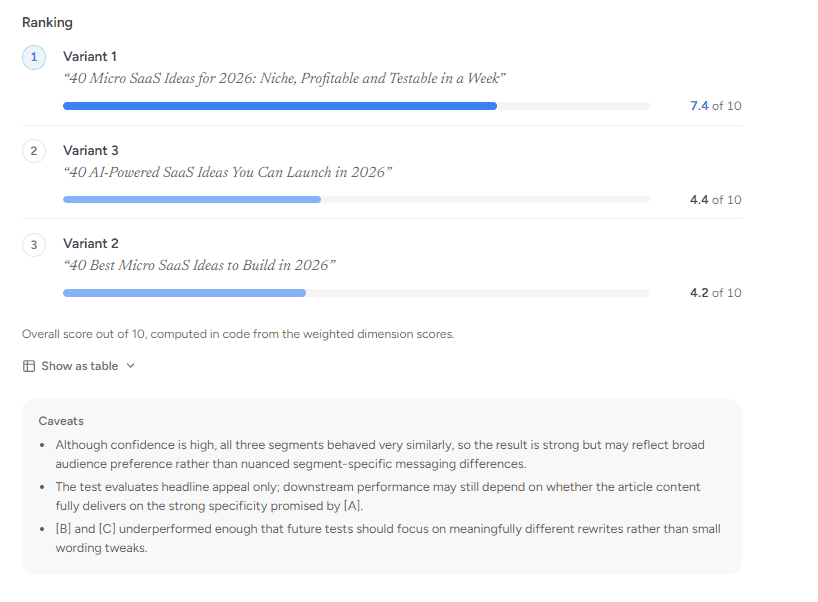
That lines up with the schlep-blindness point above: a headline that commits to a specific, checkable promise beat both the vague superlative and the AI-hype framing on this panel. Two honest caveats from the same report: all three audience segments reacted similarly, so this reads as a broad preference rather than a segment-specific one, and the test measures headline appeal only, not whether the article underneath delivers on what the winning headline promises. Nine personas is a small panel, so treat this as a direction worth testing on your own headlines, not a universal rule.
Once a synthetic pass narrows your list, recruiting platforms like the ones compared in our Articos vs. User Interviews breakdown are where to go for the real conversations that confirm it. Treat a small synthetic panel as a direction to confirm, not a verdict to act on without a second check.
FAQs about micro SaaS ideas
How many of these 40 ideas should I actually test before building one?
Most founders who work through a list like this end up testing three to five ideas lightly before committing real building time to one. The goal is comparing a handful of real candidates, not exhausting the whole list.
Can one person really build and run a micro SaaS alone?
Yes. The ideas on this list are deliberately scoped to a single feature set and a narrow buyer precisely so one person, or a very small team, can build, launch, and support them without the overhead a broader product would require.
Do micro SaaS ideas have to use AI to work in 2026?
No. Several ideas above, like the compliance and admin-tracking tools, work fine as straightforward CRUD software with alerts and reports. AI earns its place when the task genuinely involves unstructured text or judgment calls, like summarizing shift notes or drafting replies, not as a default feature.
What’s the realistic build time for one of these ideas?
It depends entirely on scope, which is the point of picking a narrow one. A single-feature tool aimed at one buyer type is a fundamentally different build than a platform, and the test described for each idea above is designed to tell you whether it’s worth building before you spend weeks on it either way.
Do I need a technical co-founder to build one of these?
Not necessarily. Several ideas above, especially in the no-code and reporting categories, can be built on existing no-code and automation platforms. Others, particularly the AI workflow tools, benefit from someone comfortable wiring up an LLM API, but that’s a narrower skill than full-stack development.
Pick the one you can test this week
Forty ideas is a shortlist, not a decision. The one worth building is the one where you can name the buyer, reach ten of them without a recruiting budget, and get a real answer before next week starts. Most founders who stall here skipped that step entirely, rather than picked the wrong idea off a list.


