
Buyer Journey Mapping: The Comprehensive Guide
A step-by-step guide to buyer journey mapping.

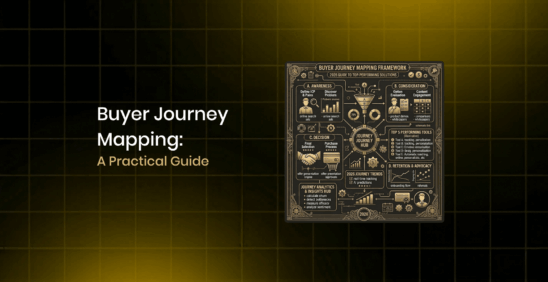
Buyer journey mapping is the process of laying out the stages a buyer moves through, from first noticing a problem to signing a contract, and documenting what they’re thinking, asking, and doubting at each one. Most teams already have a version of this map. Most of those maps are wrong in one specific way: the emotions and objections on them came from a workshop, not from a buyer.
This guide covers the buyer journey stages, a step-by-step journey mapping process, touchpoint mapping, a customer journey map template, and the part most guides skip: how to check whether what you wrote on the map is actually true.
What is buyer journey mapping?
Buyer journey mapping is the practice of documenting the path a buyer takes toward a purchase decision, broken into stages, with the buyer’s questions, emotions, and objections recorded at each one. The output is usually a visual chart or table, often called a customer journey map, that marketing, sales, and product teams reference when planning content, campaigns, and outreach across the sales funnel.
The two terms get used almost interchangeably. “Buyer journey” tends to show up in B2B and sales contexts, where a purchase involves evaluation and often a buying committee. “Customer journey” is the broader term, covering B2C behavior and post-purchase experience too. The mapping process is the same either way: stages, touchpoints, and the buyer’s state of mind at each point.
A journey map is only useful if the content inside it reflects real buyer behavior. A map full of assumed pain points is a workshop artifact, not a research document, and it’s one piece of the broader audience research work that should sit underneath any go-to-market plan.
The buyer journey stages
Every buyer journey framework varies the labels, but the customer journey stages collapse into three core moments, plus what happens after the sale.
| Stage | What the buyer is doing | Core question they’re asking |
|---|---|---|
| Awareness | Recognizing a problem or gap exists | “Is this actually a problem worth solving?” |
| Consideration | Researching and comparing possible solutions | “What are my real options, and how do they differ?” |
| Decision | Narrowing to a shortlist and building internal buy-in | “Can I justify this choice to myself and my team?” |
| Post-purchase | Using the product and deciding whether to renew or expand | “Did this deliver what I was told it would?” |
The stages are the easy part. Every template has them. The part that actually changes outcomes is what you put inside each box, and that’s where most maps go wrong. Teams fill the “objection” cell with what a salesperson remembers hearing once, or what feels intuitively true, then treat it as settled.
That gap shows up in the data. In a Nielsen Norman Group survey of UX practitioners, 234 respondents ranked “involving customers in the process” as the single most important factor in a successful journey map, the top score of eight factors tested. “Rigor of research used to inform the map” ranked seventh out of those same eight factors, ahead of only visual design. Practitioners say customer input matters most, then routinely under-invest in the research that would actually supply it.
How to map the buyer journey
Building a journey map is a five-step process. Skipping the middle steps is how you end up with a map that looks complete but describes nobody’s actual behavior.
- Define the buyer, not the market. Pick one specific buyer role and one specific use case, ideally starting from an ideal customer profile rather than a guess. “Marketing leaders at mid-market SaaS companies evaluating analytics tools” is mappable. “Our customers” is not.
- List the stages you’ll use. Three or four is enough for most teams. More than five and the map stops being a working document and becomes a wall poster nobody consults.
- Populate each stage with real data, not memory. Pull from sales call notes, support tickets, win-loss interviews, and direct research. This overlaps heavily with customer discovery work your team may already be running. If the only input is a brainstorm, treat every cell as a hypothesis, not a fact.
- Test the hypotheses. For each assumed objection or emotion, run it past actual buyers, or a validated stand-in for them, before it goes on the final map. A concept testing platform works well here when the hypothesis is really about a specific message or claim rather than the whole stage. This is the step nearly everyone skips, covered in more detail below.
- Attach touchpoints and owners. Every stage needs a channel (search, a sales call, a comparison page) and a named owner responsible for what happens there.
Touchpoint mapping: where each stage actually happens
Touchpoint mapping is the layer of a journey map that connects each stage to the specific channels and interactions where it plays out, and who inside the company is responsible for that channel.
| Stage | Common touchpoints | Typical owner |
|---|---|---|
| Awareness | Organic search, social content, industry reports | Content or SEO team |
| Consideration | Comparison pages, review sites, demos | Product marketing |
| Decision | Sales calls, pricing pages, procurement docs | Sales |
| Post-purchase | Onboarding emails, support tickets, renewal calls | Customer success |
Without this layer, a journey map is a description with no owner attached, and nothing on it gets acted on. With it, a gap in the map (no touchpoint for the “narrowing to a shortlist” moment, for instance) becomes a specific, assignable task, and the map starts pulling its weight in pipeline and conversion conversations instead of sitting in a shared drive.
B2B buyer journey vs. B2C journey mapping
A B2B buyer journey involves more people, takes longer, and loops back on itself more than a B2C purchase does. Gartner’s research on B2B buying describes the journey as a set of six recurring “buying jobs” (problem identification, solution exploration, requirements building, supplier selection, validation, and consensus creation) that buyers revisit rather than complete in order. The same research found that buyers who complete these jobs digitally alongside a sales rep are 1.8 times more likely to land on a high-quality deal than buyers who go through the process on their own, and that self-directed buyers report more purchase regret than buyers who had some human interaction along the way.
That changes what a B2B journey map needs to account for:
- Multiple personas per stage. A single “decision” stage in B2B often hides a finance stakeholder, a technical evaluator, and an economic buyer, each with a different objection, all part of the same buying committee.
- Non-linear movement. B2B buyers loop back to research after they’ve started evaluating, especially when a new stakeholder joins the committee.
- Longer post-purchase weight. Renewal and expansion decisions carry as much mapping value as the initial sale, since B2B revenue depends on them.
A B2C map can usually run on three stages and one persona. A B2B map needs a row for every stakeholder role that can veto the deal, not just the one who requested the demo.
Customer journey map template
Here’s a journey mapping template you can copy directly into a spreadsheet or whiteboard tool. The two right-hand columns are the ones most teams leave blank, and they’re the ones that matter most.
| Stage | Buyer question | Assumed objection (workshop guess) | Tested objection (from real buyers) | Touchpoint | Owner |
|---|---|---|---|---|---|
| Awareness | Is this worth solving? | ||||
| Consideration | What are my options? | ||||
| Decision | Can I justify this? | ||||
| Post-purchase | Did it deliver? |
Fill the “assumed” column first in a workshop. Fill the “tested” column only after you’ve checked it against real buyer input. Where the two columns disagree, the tested column wins, and that’s usually where the biggest content or messaging gap in the current funnel shows up.
Buyer journey examples
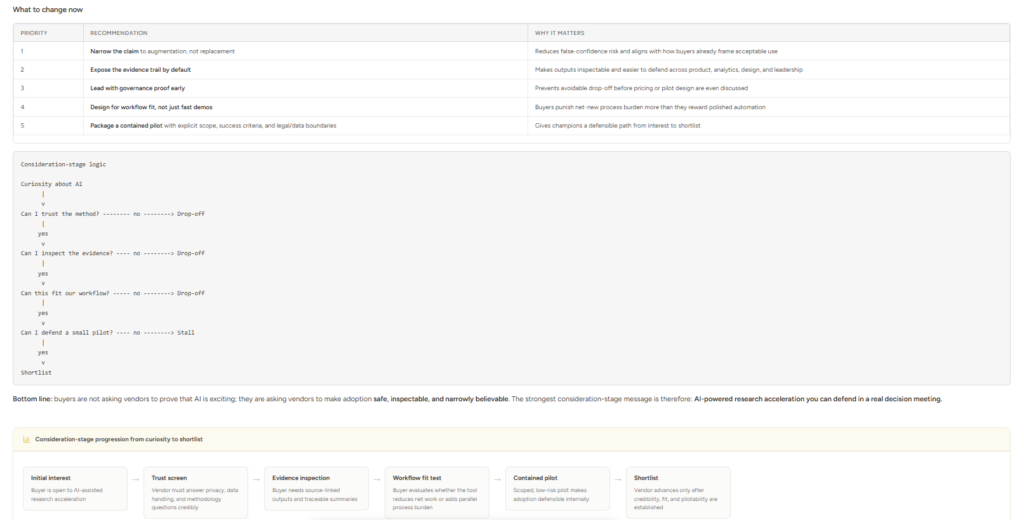
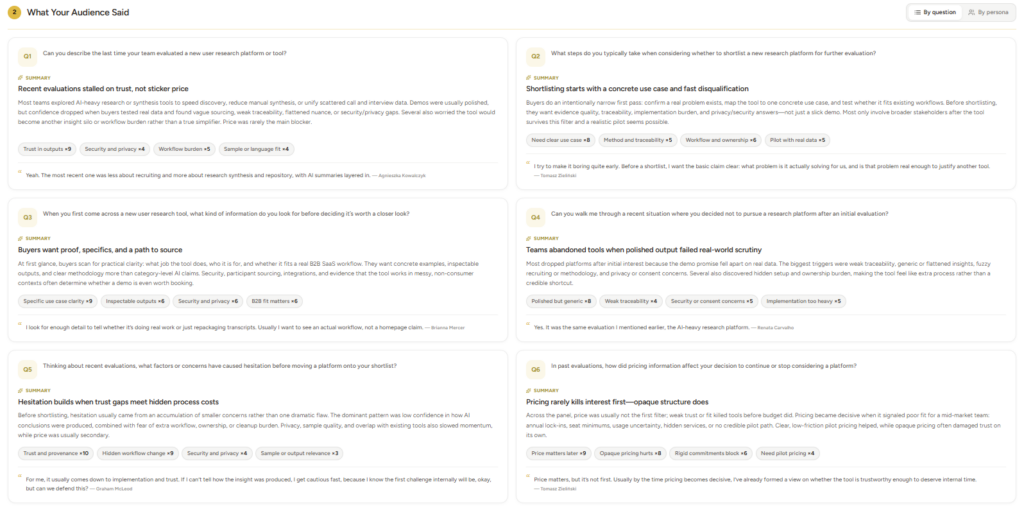
We ran this exact scenario through Articos rather than simulate it: a B2B SaaS company evaluating an AI-powered user research platform, tested against 12 synthetic buyers across four roles (Product Manager, Head of Marketing, Growth Marketing Lead, Senior Product Manager). The workshop assumption going in was the standard one: price is the main consideration-stage objection. The report that came back was titled, plainly, “Shortlists Are Lost on Defensibility Before They Are Lost on Price.” Price wasn’t the first blocker. Buyers screened tools out earlier, on credibility, evidence traceability, and workflow fit. One transcript put it bluntly: price “barely entered it” once trust in the vendor’s data handling broke down.
The tag counts made the size of the gap concrete. “Trust and provenance” came up as a hesitation driver 10 times, more than any other tag in the study. “Opaque pricing hurts” showed up 8 times, but as a trust signal, not a budget objection. Buyers said as much directly: “Price matters later. Usually by the time pricing becomes decisive, I’ve already formed a view on whether the tool is trustworthy enough to deserve internal time.” The report’s single highest-impact fix was exposing the evidence trail (which clip, which quote, which theme fed which conclusion) by default, since buyers wouldn’t move a tool to committee without a way to trace a finding back to its source. A lower price point never made the list.
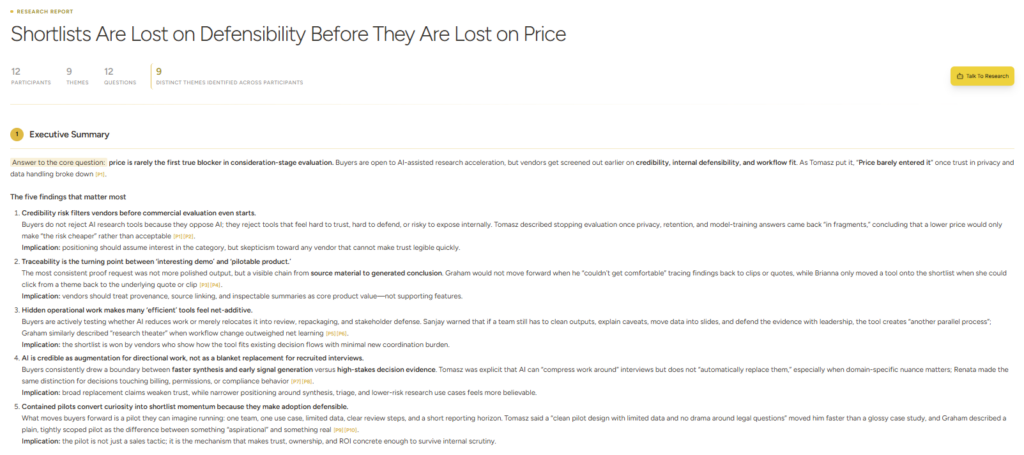
That’s what “assumed vs. tested” looks like filled in for real: the assumed column said “price.” The tested column said “credibility, traceability, workflow fit, then price.” Those are two different consideration-stage pages, two different sales scripts, and two different sets of proof points to lead with.
A creative agency mapped its buyer journey for pitch-stage prospects and assumed awareness-stage buyers cared most about portfolio quality. Testing showed the bigger early-stage question was whether the agency could work inside the buyer’s existing brand guidelines without a lengthy onboarding process. The portfolio mattered at the decision stage. At awareness, “will this be easy to work with” mattered more. Where the gap is specifically about wording, a messaging testing platform is the more direct tool than a full journey re-map.
A direct-to-consumer skincare brand mapped its buyer journey around a single “why should I trust this brand” objection at the consideration stage. Testing with ecommerce-specific audience research surfaced a second, more concrete objection at checkout: uncertainty about return policy on opened products, which never came up in the original assumption. Trust was the right instinct. Return policy was the specific, fixable thing driving cart abandonment.
In all three cases, the stage labels on the map didn’t change. What changed was the content inside each stage, once it reflected what buyers actually said instead of what the team assumed they’d say.
How to test what buyers are actually thinking
Journey map stages rarely cause problems. The emotions and objections written inside them do, because those usually come from a sticky-note workshop, not from a buyer. A room full of smart people who talk to customers is still a room guessing at what customers think, filtered through whoever spoke loudest that day.
Testing the assumption doesn’t have to mean a six-week research project. Traditional interviews to validate a single journey stage still take weeks of recruiting and scheduling, which is exactly why most teams skip the step and ship the workshop guess instead.
This is where Articos fits into the process. Instead of guessing what a consideration-stage buyer objects to, you can run a synthetic interview study against a persona matching that exact buyer role and see what comes up, in under 30 minutes, without recruiting a single participant. The SaaS example above is one of those studies, run for this guide: a workshop can only confirm what a room already suspects, while testing can surface what nobody in the room thought to ask about. Articos’s synthetic interviews are validated at 86% recall against expert-published research findings across 46 studies, which puts the output closer to a real early-stage interview round than a guess from a generic chatbot.
Worth saying plainly: this isn’t a replacement for talking to real buyers on a high-stakes deal, or for the qualitative depth a live interview gets you when a relationship already exists. Teams that need a recruited B2B panel for that stage often look at Wynter, which runs message tests against a real, verified professional audience instead of synthetic personas. It’s a way to stress-test the assumed column of your journey map before you build a quarter of content around it, not the only tool that belongs in the process.
Common buyer journey mapping mistakes
Mapping the funnel you wish you had, not the one buyers actually use. Teams draw a straight line from awareness to decision. Real buyers, especially in B2B, bounce backward constantly.
One persona covering a whole buying committee. If a purchase needs sign-off from finance, IT, and an end user, one journey map with one set of objections misses two-thirds of the actual resistance.
Treating the map as finished once it’s drawn. A journey map built in Q1 and never revisited describes a buyer who no longer exists by Q3. Pricing changes, competitors launch, and objections shift.
No owner attached to each touchpoint. A map with a “consideration” stage and no name next to who owns that content leaves a real gap unaddressed indefinitely.
Confusing a persona with a journey stage. A persona describes who the buyer is. A journey stage describes where they are in the decision. Conflating the two produces maps that are hard to act on. If the persona itself is thin, that’s worth fixing first; see how to create a user persona for the underlying process.
What’s the cheapest way to map a buyer journey?
A first version costs nothing but time. A free spreadsheet or whiteboard template, the stage table from this guide, and a handful of conversations pulled from existing sales calls and support tickets are enough to build a working draft. The free tier gets you the stages and a rough shape of the objections; it doesn’t get you the tested column, since that requires either scheduling real interviews or running a paid research tool. For a single-founder product with a short, low-stakes sales cycle, the free version is often good enough. For a B2B company about to build a quarter of content around the map, the cost of testing the biggest assumptions is small next to the cost of being wrong about them.
Should you combine synthetic and human research?
Yes, for most teams. Synthetic research is fast and cheap enough to test every assumption on the map, so it’s the right tool for the volume of small checks a journey map generates: is this objection real, does this stage need its own row, which claim lands better. Human interviews stay the right call for the handful of decisions where the cost of being wrong is high, where a real relationship already exists, or where a stakeholder needs to hear a real customer’s voice to trust the finding. Most teams that get value from journey maps use both: synthetic testing for breadth across every stage, and a smaller number of live interviews for the two or three assumptions the whole strategy actually rests on.
How to choose the right approach for your journey map
Start with the stages your buyer actually moves through, not a generic template. Populate the map with real input wherever you can get it: sales notes, support tickets, and direct testing of the assumptions that carry the most weight. Revisit the map on a set schedule rather than treating it as a one-time deliverable.
The right level of rigor depends on how much is riding on the map. A single-founder product with a short sales cycle can run on a lighter version, built from a handful of customer conversations. A B2B company selling into a multi-stakeholder committee needs the tested column filled in before the map drives a quarter of content spend, because the cost of shipping content aimed at the wrong objection compounds across every stakeholder who reads it.
Either way, the map is only as good as what’s written inside it. Stages are free. Accurate objections take work to find.


