Shopper Insights: What They Are and How to Get Them Fast
What shopper insights are, how they differ from consumer insights, and how to get a first read in under 30 minutes.

Someone said “shopper insights” in a planning meeting, and nobody stopped to define it. Shopper insights are findings about when, why and how people buy: what they notice, compare and hesitate over on the way to a purchase. They tell you why a sale happened or didn’t.
Getting them the traditional way takes weeks, so many teams skip the research and ship on a guess. This guide covers what shopper insights are, how they differ from consumer insights, where they come from, and how a small team can get a directional read in about 30 minutes. It also says where that fast route stops being reliable.
What are shopper insights?
Shopper insights are research findings about the purchase itself: when, why and how people buy, and what shapes the decision along the way. The term is common in retail and consumer goods research, where researchers separate the person at the shelf or checkout from the person who later uses the product. The buyer of cat food, for example, is not the cat.
The raw material can be sales data, site analytics, interviews, surveys or observation. Data shows what sold. An insight explains the reason, such as a price format that made shoppers pause or a pack design they walked past. Shopper insights research is a branch of user research that studies buyers at the moment of choice, and it covers online shopper insights as much as store aisles.
What is the difference between shopper insights and consumer insights?
Shopper insights study the person buying and the purchase process. Consumer insights study the person using the product and how it fits their life. The two often belong to the same person, but not always: a parent buys the cereal and a child eats it, and the shelf decision follows different logic than the breakfast decision.
The gap between the two shows up in what people say versus what they do. A survey respondent may say they want less sugar, then pick up chocolate at the till, an example the research firm Further uses in a piece republished by Quirk’s. Most brands need consumer and shopper insights together, and the AI for consumer insights guide covers the consumer side in more depth.
| Dimension | Shopper insights | Consumer insights | Example question |
|---|---|---|---|
| Person studied | The buyer, who may not be the user | The end user of the product | Who chose this brand, and who actually uses it? |
| Moment studied | Search, comparison, checkout | Daily use and life context | What made you take this one off the shelf? |
| Main users | Sales, retail and category teams | Brand and product teams | Who acts on the finding? |
| Typical decision | Price, pack, page, placement | Positioning, features, brand | What changes on Monday? |
Why do shopper insights matter for online and in-store retail?
Shopper insights matter because buyers leave at specific points for specific reasons, and sales data only records that they left. Baymard Institute’s list of 50 cart abandonment studies puts the average abandonment rate at 70.22%. In Baymard’s most recent survey of US online shoppers, 42% said they had abandoned a cart because they were just browsing.
Setting that group aside, Baymard’s breakdown of the remaining reasons has extra costs such as shipping, tax and fees at 40%, distrust of the site with card details at 19%, and a forced account at 18%. Each of those is fixable, but only after someone asks shoppers which one applies to them. That question is the job of online shopper insights, and the answers are shopper behavior insights a team can act on. The consumer decision-making process maps the stages where buyers drop out, and ecommerce and DTC teams can test checkout and offer questions with AI user research for ecommerce before they ship a fix.
Where do shopper insights come from?
Shopper insights come from two places: data a company already owns, and primary research that asks shoppers directly. Sales figures, customer demographics and site analytics show what is selling. They rarely show why, and a pattern in the numbers can be a coincidence. Talking to shoppers closes that gap. The main shopper research methods are compared in the table below.
The right method depends on the category. Impulse categories such as confectionery suit in-store observation or mobile intercepts, while routine weekly shops suit online qualitative methods where shoppers describe the whole trip. Quantitative surveys then size what the qualitative work found. Teams new to the interview route can start with the user interviews guide.
| Method | What it answers | Main limit |
|---|---|---|
| Sales and analytics data | What sold, where buyers dropped off | Says little about why |
| Surveys | How many shoppers share a view | Stated intent often differs from behavior |
| Interviews and online communities | The reasons behind a choice | Recruiting and scheduling take weeks |
| In-store observation and intercepts | What shoppers do at the shelf | Logistics, small samples |
| Synthetic shopper interviews | How a defined shopper segment reacts to a price, page or pack | Reaction and reasoning, not real purchase behavior |
What are some examples of shopper insights?
A shopper insight is specific enough to change a decision. Two examples show how it differs from raw data.
A soup maker saw shoppers pick up a competitor’s product more often and call it more appealing. Paired with the consumer view that soup signals healthy eating, the likely cause was the rival’s fresh-vegetable packaging, a link the shoppers may not have been able to state themselves.
Articos ran a nine-persona synthetic study for its synthetic shoppers explainer on a DTC skincare price: $49 once, or three payments of $16.33. The panel’s advice was to lead with the $49 total. When the installment amount looked bigger than the real total, several personas described backing out or opening another tab to check the math, and any sign of a hidden fee ended trust fast. Nine personas show where shoppers hesitate, not how many would.
Shopper marketing insights apply findings like these to promotions, displays and page layouts at the point of purchase. Brands in packaged goods use the same approach on claims and pack designs, and the consumer goods research page shows how. A buyer journey map of the path to purchase shows which stage to study first.
How do you get shopper insights fast?
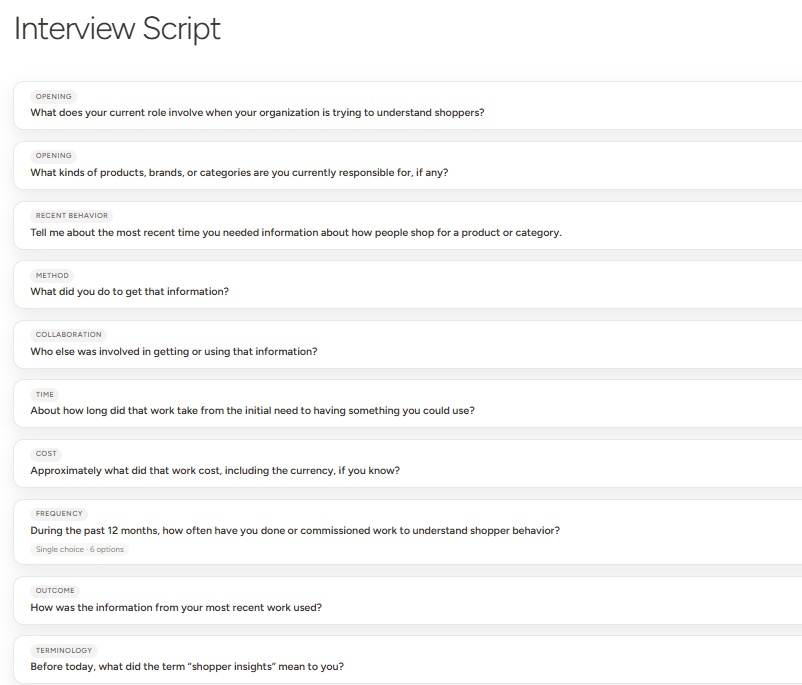
Synthetic shopper research gets a directional read on a buying question in under 30 minutes by interviewing AI personas built to match your target buyer, so nobody needs recruiting or scheduling. Articos is one platform that works this way. A study returns a structured report with findings traced back to individual persona responses, and ecommerce teams use it on ad hooks, landing page variants, pricing and product concepts.
A first study follows five steps:
- Write one decision as a question, such as whether the total price or the installment price reads as fairer.
- Define the shopper segment, for instance price-conscious buyers, comparison shoppers and first-timers.
- Add the variants: two prices, three headlines, two pack designs.
- Run the study and read the segment-level findings and objections.
- Take the top one or two findings into a live test.
For offer and pack comparisons, a concept testing platform fits best. For open questions about a segment, an AI user research platform runs the interviews.
How accurate are synthetic shopper insights?
Articos Research reports that its findings matched 86% of the themes in published Baymard Institute and Nielsen Norman Group research across 46 studies in 9 domains, in a paper it calls Grounded Simulation. That figure comes from the company itself, and an independent review of Articos has noted that no outside party has verified it. The methodology page lays out how the personas are built and tested. The benchmarks are published UX research findings, so the figure measures how well personas reproduce research themes, not how well they predict sales.
The limits matter more than the headline number. Synthetic personas react and reason, so they cannot predict real click-through rate, conversion rate or return on ad spend. They also lack lived experience: a persona can call a checkout confusing because the pattern matches, but it cannot remember a declined card. Questions that are emotional or expensive to reverse still need real shoppers. Sample size and bias both matter. Studies run 12 to 50 personas, and each panel includes built-in dissenters so objections surface, but a persona still carries whatever bias sits in its training data.
What did synthetic readers say about this article?
Nine AI-simulated readers said the speed promise earns the click, but they wanted context around the 86% figure before trusting it. Before publishing, we ran this draft through an Articos interview study: three DTC growth managers, three CPG brand managers and three retail category managers in the US, UK, Canada and Australia, answering 20 questions. They read a condensed version of the draft. The report found 8 themes and rated its evidence strength mixed.
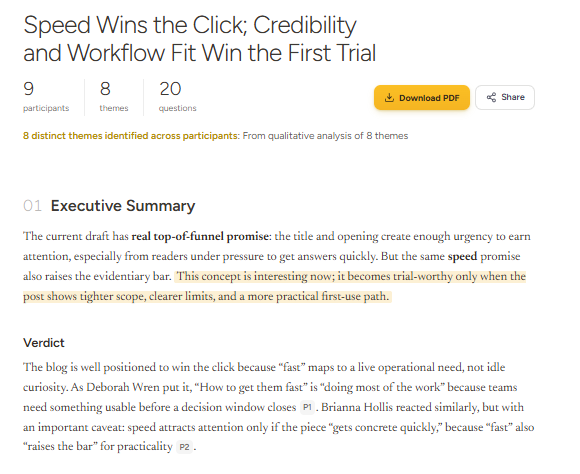
| What the report found | Readers (of 9) |
|---|---|
| The speed promise earns initial interest | 7 |
| Credibility depends on context and limits around the 86% claim | 7 |
| Synthetic research is acceptable as a first pass or directional tool | 6 |
| A low-risk trial needs plain pricing and little internal effort | 6 |
| Workflow fit and sample outputs are missing | 3 |
Deborah Wren, a synthetic retail category manager, said: “‘How to get them fast’ is doing most of the work for me, because that’s usually the pressure.” Nine personas show where readers hesitate, not how many real readers would. In response, the accuracy section above now says what the 86% figure measures.
What is the cheapest or free way to get shopper insights?
The cheapest source is data you already own: analytics, product reviews, support tickets, sales-call notes and a few conversations with recent buyers. These cost only time and cover what shoppers do and part of why.
For a paid study, Articos offers a 14-day trial with 900 credits (about 2 studies) and no credit card. After that, Starter costs $79 a month for 3,000 credits (about 7 studies) and Pro costs $199 a month for 8,000 credits (about 20 studies), as listed in November 2026. A study uses about 400 credits, so base credits alone work out to roughly $11 to $12 per study. The current launch bonus credits (1,200 on Starter, 2,800 on Pro) bring that to about $8 to $10. Articos puts traditional ecommerce customer research at $5,000 to $30,000 per round, so the gap is large even at the higher figure. Current plans are on the pricing page, and the ecommerce research cost breakdown compares the options in more detail.
Should you combine synthetic and human research?
Combining synthetic and human research works better than choosing one. Synthetic research covers breadth, and human research covers the few decisions where a wrong call costs the most. Run synthetic studies on every price, page and pack variant first, then take only the two or three findings the plan depends on to real shoppers in a small round of interviews or a live test.
That split keeps recruiting effort for the questions that justify it. Teams that need recruited participants can compare Articos with User Interviews, a platform built for finding people for live studies. The synthetic users vs. real users comparison walks through which approach wins on which question.
Skip the synthetic step entirely when the stakes are high and the question is about behavior, such as whether a customer will stay loyal for a year. Real purchase data answers that.
How do you choose where to start?
The best first study targets the stage where you lose the most buyers. Pull one number for it, such as cart abandonment, conversion on a product page or a promotion that underperformed, and write down your best guess for the cause. Validate that guess with one shopper study, fix the objection that comes up most, and measure again.
A first decision does not need to be big. Two price framings or three product page headlines are enough, and testing ecommerce product ideas before you build stock is another good first use. Skipped research is the expensive option. Shoppers will tell you what is wrong with a page, a price or a pack, and the only question is whether you hear it before or after the spend.