Why Product Launches Fail: What Customer Research Can Reveal
Why product launches fail, and how customer research catches the warning signs before launch day.

Signups are flat two weeks after launch, the team is arguing about whether the problem is the product, the price, or the ads, and nobody has talked to a buyer who didn’t convert. That argument is how most post-launch reviews start, and it rarely settles anything.
Why product launches fail usually comes down to one gap: the team never confirmed that a specific audience wanted the product, understood the message, and accepted the price before spending on the launch. That gap sits behind most product launch failure, and customer research closes it, mostly before launch day. This article covers the warning signs, the causes the failure data points to, and the research that catches each one. It builds on our guide to pre-launch validation.
What are the signs a launch is failing?
A launch is failing when attention arrives and action does not. Traffic and signups look fine in week one while activation, trial conversion, and sales conversations stall. Each pattern points to a different cause, so match the symptom before spending more.
| Signal | Likely cause | Question to put to buyers |
|---|---|---|
| Traffic up, signups flat | Message or positioning misses the buyer | “What do you think this product does?” |
| Signups up, few activate | Promise and product don’t match, or the wrong audience signed up | “What did you expect to happen after you signed up?” |
| Trials don’t convert | Price, or a value gap the first session didn’t close | “What would you have needed to see to pay?” |
| Prospects ask who it’s for | Audience defined too broadly | “Which of these descriptions sounds like your company?” |
| Sales avoids pitching it | No clear story or proof | “Could you explain this to a colleague in one sentence?” |
One caution on timing. Poornima Mohandas of Product Marketing Alliance writes that products can take 18 to 24 months to find product-market fit, so a slow first month alone doesn’t prove failure. A slow month nobody can explain is the real warning.
Why do product launches fail?
Product launches fail mainly because buyers don’t need the product enough to pay for it, and the team finds out after shipping. CB Insights studied 431 venture-backed startups that shut down since 2023. Of the 385 with identifiable reasons, poor product-market fit appeared in 43%, bad timing in 29%, and unsustainable unit economics in 19%. Companies could cite several reasons, so the figures add up to more than 100%. Running out of capital led the list at 70%, but CB Insights calls it almost always the final cause, not the root one.
That dataset covers company shutdowns, not a single feature launch, so it shows the pattern more than it sizes your risk. Reasons for product failure also include internal ones: misaligned teams, no launch owner, a sales team that can’t explain the product. Our guide to product launch barriers sorts those from the market-facing causes.
How common is launch failure?
The claim that 95% of new products fail is often attributed to Clayton Christensen and gets repeated widely. A perspective in the Journal of Product Innovation Management by Castellion and Markham argues that failure rates of 80% or higher are a myth, and that empirical studies since 1977 put the rate at 40% or less. Why do new products fail, then, if not nearly always? For the market-facing reasons above, which research can catch. Failure is common and mostly avoidable, not close to certain.
Research-backed or assumption-based launches?
Research-backed launches test audience, message, price, and concept with people outside the team before money goes into the launch. Assumption-based launches rely on internal agreement and competitor moves. The gap shows up in the decisions teams make under deadline, which is where the most common product launch mistakes get made.
| Decision | Assumption-based launch | Research-backed launch |
|---|---|---|
| Audience | “Everyone with this problem” | A named segment, confirmed in interviews |
| Message | Voted on internally | Read cold by buyers and restated in their words |
| Price | Copied from a competitor’s page | Tested for hesitation at the target price |
| Concept | Built because the team could | Checked against a problem buyers describe unprompted |
What did our own interview study find?
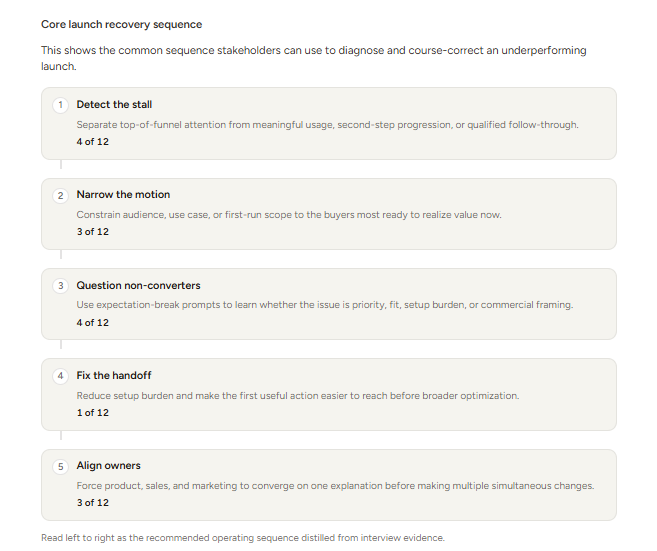
Our own study found that weak launches were rarely fixed by adding traffic or debating price. Recovery started with the gap between what buyers expected and what the first session delivered.
We ran 12 synthetic interviews in Articos with product marketing managers, product managers, growth marketing managers, founders, sales leaders, and customer success managers, two of each. All worked at B2B SaaS companies in the US or UK with 10 to 200 employees, and each had shipped a product or major feature in the last 12 months that underperformed. Our hypothesis was that teams blame the product or ad spend first, and that the root cause is usually a misread message, a broad audience, or a price that felt wrong.
The panel only partly agreed. Buyers understood the promise well enough to click, book, or explore, then stalled because the first real workflow felt heavier or less urgent than the promise implied. Teams that recovered named that break and questioned the people who stalled, instead of buying more traffic.
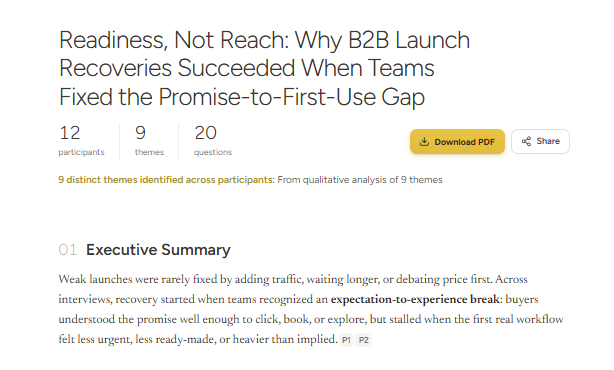
The report distilled a five-step recovery sequence: detect the stall, narrow the motion, question non-converters, fix the handoff, and align owners. It ties each step to between 1 and 4 of the 12 personas, so read the order as a pattern, not a proven method. This is one synthetic panel describing launches it recalls, not measured results from real teams.
What research prevents launch failure?
Four kinds of customer research prevent most launch failures: concept testing, audience research, message testing, and price testing. Each targets one of the causes above, and each costs less before launch than after.
Concept testing checks whether a target audience understands a product idea and sees enough value in it to want it. It answers the product-market fit question while the idea is still cheap to change. Add one question about the first session, because our interview study traced launch recoveries to the gap between the promise and first use. A concept testing platform runs that check without a finished build, and our explainer on what concept testing is covers the methods.
Audience research uses qualitative interviews to confirm who has the problem and how they describe it. Those interviews also sharpen the ICP and personas the launch is written for. Message testing shows whether a headline carries the value on first read; a message testing platform isolates that single variable. Price testing asks where buyers hesitate at specific price points, which avoids the politeness bias that comes with asking what they would pay.
Early-stage teams can follow the sequence in product-market fit validation.
What tools validate before launch?
Five categories of tools validate a launch before it ships: recruitment platforms, survey tools, usability testing platforms, message-testing tools, and synthetic research platforms. The right one depends on which risk is still open.
| Tool type | Examples | Best for | Limitation |
|---|---|---|---|
| Recruitment platforms | User Interviews, Respondent.io | Live interviews with real participants | Recruiting and scheduling set the timeline |
| Survey tools | SurveyMonkey, Qualtrics | Directional data at scale | Collects responses; synthesis is on you |
| Usability testing | UserTesting, Maze | Prototype and flow testing | Needs something built to test |
| Message testing | Wynter | Headlines and copy | Covers messaging, not concept or price |
| Synthetic research | Articos | Fast rounds on concept, message, price | Weak for regulated claims and emotional topics |
Articos runs synthetic interviews with 12 to 50 AI personas built from Big Five personality traits and returns a report in under 30 minutes. Articos reports 86% theme recall against published Baymard Institute and Nielsen Norman Group findings across 46 studies, a figure it publishes itself as a pre-print. The number measures overlap with themes in expert research. It doesn’t forecast sales, and we found no independent review of it.
Live Calls adds real-time voice conversations with any persona from a study. If a pricing study shows hesitation, you can ask the persona who raised it whether the problem is the number, the packaging, or an assumption about what’s included. Talk to Research handles the written version of the same follow-up.
What’s the cheapest or free option?
The cheapest option is talking to five or ten prospects yourself, which costs time and no cash. It works for a first read on one risk, and it gets slow when you need several segments or a quick answer. Friends and existing contacts also tend to be kind, so a small sample from your own network skews positive.
Among synthetic tools, Articos offers a 14-day free trial with 900 credits, about two full studies, and no credit card. As of October 2026, Starter costs $79 a month and Pro costs $199 a month, and a study uses roughly 400 credits. Starter includes around 7 studies a month and Pro around 17. Launch-offer bonus credits add about 3 and 7 on top while the offer lasts, which the pricing page puts at roughly $8 to $10 per study. On base credits alone, the arithmetic lands closer to $10 to $11. Pro adds white-label reports. Live Calls draw on the same credits, so they carry no separate fee.
Check the pricing page before you plan around bonus credits, since launch offers end.
Should you combine synthetic and human research, not choose one?
Combining the two beats choosing one, because they answer different questions and the order matters more than the choice. Synthetic research fits early rounds while the concept is still changing: reactions to an idea, a headline, a price. Human research fits decisions that are expensive to reverse and topics a persona can’t speak to. Articos’s own guidance lists regulatory work such as clinical trials, highly emotional topics, long diary studies, and technical beta testing as cases that need real people. Teams in regulated categories can see how that split works in Articos for healthcare research.
A workable order: run synthetic studies until two or three options remain, then put the finalists in front of recruited participants. If recruiting real participants is the step you’re weighing, our comparison with User Interviews shows where each approach fits. Before either, write down what result means ship, adjust, or kill. Without that rule, an uncomfortable answer is easy to explain away. Our product launch plan shows where each test sits in the sequence, and the go-to-market strategy guide covers the wider rollout.
This week, pick the symptom from the first table that matches your numbers and ask its question of five buyers who didn’t convert.