
Sample Size for User Research: How Many Is Enough
Is there an ideal sample size for user research? Find out here.


If you searched “sample size for research” hoping for one clean number, here’s the honest answer: it depends on saturation, the point where new interviews or tests stop turning up anything new. Saturation looks different for a usability test than it does for a market survey, which is why the “right” number moves depending on what you’re trying to learn.
This guide breaks down what the research actually says: how many participants different methods need and when to stop interviewing, plus how synthetic user research changes the math. It pairs well with our broader walkthrough of how to conduct user research if you’re planning a full study rather than just sizing one.
Sample size by research method
| Method | Typical sample size | Why |
|---|---|---|
| Usability testing (qualitative) | 5 participants per round | Nielsen and Landauer’s model shows 5 users surface roughly 85% of usability issues in a homogeneous group |
| Discovery or exploratory interviews | 5 to 12 participants | Guest, Bunce, and Johnson found thematic saturation by interview 12 in a homogeneous sample |
| Card sorting | 15 participants per group | Nielsen Norman Group’s benchmark for stable category groupings |
| Eye tracking | About 39 participants | Needed for heatmaps that hold up across repeat tests |
| Quantitative surveys | 20 or more, often 100+ | Statistical significance requires a large enough sample to shrink your confidence interval |
Every row above answers a different question. Qualitative methods tell you why something is happening and saturate fast. Quantitative methods tell you how many people feel a certain way, and they need volume to be statistically generalizable, not just directionally useful. Mixing up the two, and the sample sizes each one needs, is the most common mistake teams make. It’s covered in more detail in our guide on qualitative vs. quantitative research.
How many participants do you actually need for user research?
For most qualitative studies, the minimum sample size for user research runs 5 to 12 participants, and the number you land on depends on how uniform your users are. Jakob Nielsen and Thomas Landauer’s original 1993 model, published through the Nielsen Norman Group, found that testing with 5 users uncovers about 85% of usability problems in a single round. That number assumes a fairly consistent user group and a formative test, where a trained moderator is spotting issues to fix rather than logging opinions to prove a statistic.
If your product serves genuinely distinct user groups, such as admins and end users on the same platform, Nielsen’s own guidance recommends testing 3 to 4 users per group rather than 5 total, since each group effectively needs its own small study. Quantitative usability studies are a separate case: NN/G’s follow-up research recommends at least 20 participants to get numbers you can trust, and more for a tighter margin of error and less risk of sampling bias.
For a full walkthrough of usability-specific numbers, see how many test users you need for a usability study. If your team runs a lot of moderated sessions and is weighing recruiting platforms, it’s worth comparing options like User Interviews against a synthetic-first approach before you commit budget to either.
What is research saturation, and how do you know you’ve reached it?
Saturation is the point in a study where new interviews or tests stop producing new findings. Once you’re hearing the same problems and patterns repeat, additional participants add cost without adding insight.
The most cited evidence on this comes from Guest, Bunce, and Johnson’s 2006 study in Field Methods, which analyzed 60 in-depth interviews with a homogeneous participant group. They found that basic themes emerged by interview 6, and full thematic saturation was reached by interview 12.
A separate, frequently cited 2017 study by Hennink, Kaiser, and Marconi in Qualitative Health Research drew a sharper distinction between two kinds of saturation: code saturation, the point where no new themes or codes appear, was reached at interview 9, while meaning saturation, the point where you fully understand the nuance behind each theme, took 16 to 24 interviews.
In practice, you don’t need the academic apparatus to track this. Keep a running list of new codes or themes after each interview. When two or three interviews in a row add nothing to that list, you’ve likely reached saturation for a homogeneous group. For more on how to keep that process defensible and reduce researcher bias in your coding, see our guide on validity and reliability in qualitative research.
What did we find when we asked researchers how they actually decide?
To get past secondhand advice, we ran this question through Articos itself: 9 founders, product managers, and UX designers at startups and SMBs, asked how they actually set their sample size on real projects and how much they trust the result.
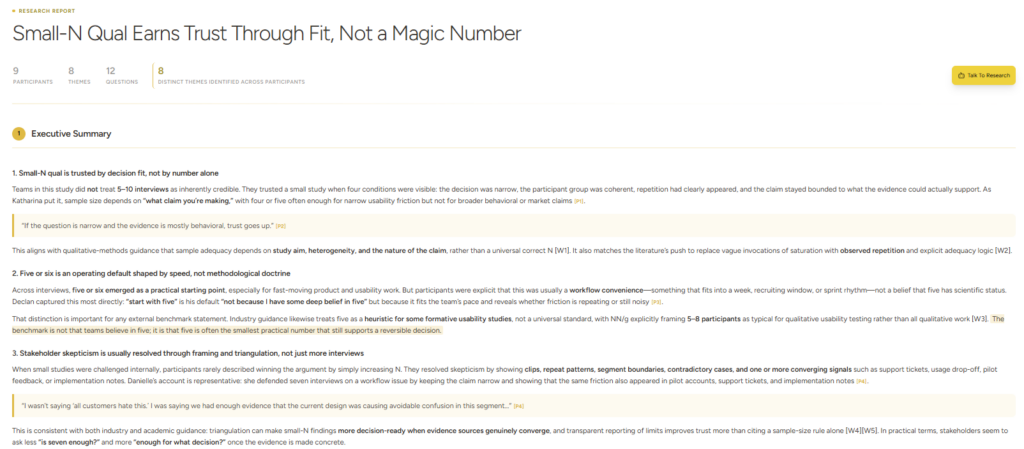
The finding lines up with the saturation research above, but from the practitioner side instead of the academic one. Teams don’t trust a 5- to 10-person study because of the number itself. They trust it when four things line up: the decision is narrow, the participant segment is coherent, the same finding keeps repeating, and the claim stays inside what the evidence can actually support. As one participant in the study put it, “If the question is narrow and the evidence is mostly behavioral, trust goes up.”
Five or six interviews came up again and again as a default starting point, not because anyone believed in five as a magic number, but because it fits a sprint and shows fast whether a problem is repeating or just noise. The benchmark that came out of the study:
“A 5 to 10 person qualitative study is usually trusted when it supports a narrow, bounded decision with a clearly defined segment and visible repetition, but not as standalone proof of broader market truth.”

That’s the practitioner-side version of saturation: the evidence needs to fit the size of the claim you’re making with it, not just clear a headcount.
How many interviews is enough?
For a single, focused research question with a fairly uniform audience, this is a reasonable default:
- 5 to 6 interviews surface the most obvious, high-frequency problems and basic themes.
- 9 to 12 interviews typically get you to code or thematic saturation, per Hennink et al. and Guest et al.
- 16 to 24 interviews are worth budgeting for when you need full meaning saturation, or your audience is diverse enough that you’re comparing findings across multiple segments.
Two things push that number up: audience diversity and topic complexity. A study on a niche B2B workflow with one clear user type saturates fast. A study spanning consumers across age groups and use cases, whether that’s a healthcare app testing a new triage flow, a consumer goods brand testing new packaging, or an ecommerce store testing its checkout flow, needs more interviews before patterns stabilize, because you’re really running several smaller studies inside one.
What’s the cheapest or free option for hitting your sample size?
The cheapest option on paper, posting in a Slack community or asking friends and family, is usually the most expensive option in practice, because a convenience sample this biased can send you toward the wrong conclusion entirely. It’s fast and free, but the participants don’t represent your actual users, and every insight needs to be re-verified later.
A more honest low-cost tier looks like this: a short concept test run through a tool like Articos’s concept testing platform costs $7 to $10 per study and returns results in under 30 minutes, which is now the cheapest way to hit a defensible sample size without sacrificing who you’re actually talking to. Paid participant panels sit well above that: once you combine the incentive with platform and screening fees, a single completed interview commonly runs $150 to $300 or more, which is why traditional studies budget carefully for every additional participant. Free methods, an unmoderated survey sent to your existing user base, for instance, can work well for quantitative volume, but they still need a large enough list to hit the 20-plus threshold that makes the numbers meaningful.
Should I combine synthetic and human research, or choose one?
Combine them, and let the decision’s stakes set the mix. Traditional sample size guidance assumes each additional participant costs real time and money to recruit and schedule, which is exactly why researchers have spent 30 years arguing over the smallest number that still works. Our guide on participant recruitment covers what that cost structure looks like in practice. Synthetic interviews remove most of that constraint: because each one takes minutes rather than days to schedule, you can run past the traditional minimum sample size for a few dollars and see whether your findings hold up across a larger group.
In peer-reviewed testing, Articos’s synthetic personas reached 86% recall accuracy against expert human research across 46 studies, completed in under 30 minutes per study. You can test that directly with Articos’s AI-powered user research.
Human research still earns its place for the decisions synthetic data can’t fully carry alone: regulated products, safety-critical workflows, or a genuinely new user population you have no existing behavioral data on. A pattern that works well in practice is running a synthetic round first to sharpen your hypotheses and interview script, then validating the top 1 or 2 findings with a smaller round of real users before you commit budget or engineering time. For message-specific testing, the same hybrid approach applies through a dedicated message testing platform: synthetic first for volume, human for the final gut check.
What sample size fits qualitative research vs. quantitative research?
Qualitative research answers why, and it saturates around 5 to 24 participants depending on homogeneity and depth needed, as covered above. Quantitative research answers how many or how much, and it needs a sample large enough to hit statistical significance, generally 20 participants at the floor for usability metrics and well into the hundreds for a survey measuring a small effect.
The mistake to avoid: running a 6-person study and reporting the results as a percentage (“83% of users preferred option B”). Six people is a fine qualitative sample. It is not a survey, and treating it like one misrepresents the confidence you actually have and isn’t statistically generalizable to your full user base.
How to choose your sample size
Start with the decision the research needs to support, not a target number. A few questions to work through before you set one:
- Is this qualitative or quantitative? Qualitative studies saturate; quantitative studies need statistical power. Don’t borrow one method’s sample size logic for the other.
- How uniform is your audience? A single clear user type saturates around 5 to 12. Multiple distinct segments each need their own smaller sample.
- What’s the cost of being wrong? A low-stakes internal decision can run on a fast, small study. A pricing change or a regulated product decision earns a larger sample and, often, a mix of synthetic and human research.
- Are you tracking new findings per interview? If you’re not logging what each interview adds, you can’t actually tell when you’ve hit saturation, you’re just guessing when to stop.
Track that, and the right sample size shows up on its own: it’s whatever it takes for new interviews to stop teaching you anything.


