Published October 6, 2026·Updated November 5, 2026· 11 min read
A prospect reads your homepage on Tuesday and takes a discovery call with your rep on Thursday. The homepage says the product saves time. The rep opens with price. The prospect says nothing, but the deal got harder.
Sales messaging is what a rep says to a specific buyer at each stage of a deal: the opener, what the product changes for that person, the proof behind it, and the answers to the objections that come up every week. A sales messaging framework is the one-page document that holds those answers, so every rep says the same thing and every claim traces back to your positioning.
This guide covers what goes into the framework, how sales messaging differs from marketing messaging, whether aligned messaging lifts win rates, and how to test a draft before reps use it.
What is a sales messaging framework?
A sales messaging framework is a short document that tells reps what to say to a given buyer at each stage of a deal, with the proof behind each claim. It sits downstream of your positioning and your brand messaging framework, and upstream of every talk track, email sequence, and deck.
The version we recommend has six parts. The example uses ReportFlow, the agency reporting tool from our message testing guide.
Part
Question it answers
ReportFlow example
Buyer situation
What is the buyer dealing with right now?
An account manager rebuilding the same client report by hand every month
Value statement
What changes for them?
Reports build themselves, branded per client and ready to send
Proof
Why should they believe it?
A customer quote that names the hours saved each month
Differentiator
Why this over what they use today?
Built for agencies, unlike a generic dashboard
Objection responses
What will they push back on?
“We already have a template in Sheets”
Next step
What do we ask them to do?
A 20-minute working session on one real client report
Any row you can’t fill with something specific means the team hasn’t decided yet. Resolve that before anyone writes a script around it. Keep the whole framework to one page, because a document reps have to scroll through during a call will not get used. Each row should hold one or two sentences per buyer persona, written in the words buyers use. Product marketing owns the first draft, and sales leadership signs off, since reps are the ones who will say it out loud.
Why do sales and marketing messages differ?
Sales and marketing messages differ because the two teams talk to different people at different moments and hear different feedback. Marketing writes once for a segment that hasn’t said a word yet. A rep writes in real time for one person, or a buying committee, who raised an objection a minute ago.
The jobs differ too. A June 2025 Gartner release on a survey of 632 B2B buyers found that buyers favor self-service for general information but turn to sellers for tasks that need context, such as judging whether a product fits their company. The website carries the general claim, and the rep carries the fit question.
Drift is where the damage happens. In the same survey, 69% of buyers reported inconsistencies between a supplier’s website and what its sellers told them, and a Gartner analyst warned that this can create mistrust that puts the transaction at risk. Reps rewrite their pitch after a rough call. Marketing rewrites the homepage after a campaign. Neither tells the other, so the buyer finds the mismatch first.
Sales messaging or marketing messaging?
Sales messaging and marketing messaging should share one source and do different jobs. Marketing messaging is published and stays fixed until the next update. Sales messaging carries the same claims, adapted live to one buyer.
When the two conflict, the framework is missing a decision. Both should start from the same brand messaging framework. Settle the messaging hierarchy first so both teams know which claim leads. Then check each claim against feature versus benefit messaging, so the opener leads with what changes for the buyer. SaaS teams can find worked examples in our guide to SaaS messaging. Review the two sets of messaging together once a quarter. Put the homepage headline, the standard call opener, and the top three objection answers on one page, then check whether a buyer who read all of it would hear one story.
How do you build a sales messaging framework?
A sales messaging framework starts from what buyers already say, then adds only the claims you can back up. Five steps get you to a first version.
Pull the buyer’s own words from your last 10 to 15 recorded calls, your win and loss notes, or voice of customer research. Note the phrases buyers repeat.
Write one value statement per buyer persona. A finance lead and a head of operations don’t need the same sentence. Our guide to writing a value proposition covers the format, and your positioning statement checks each one.
Attach one proof point to every claim: a customer result with a number, a named integration, a published benchmark. A claim without proof gets cut.
Write answers to the objections that come up most. This is your sales objection handling. Include “we’ll stay with what we have,” which is often the real competitor. Put the answers in a sales battlecard so reps can find them mid-call.
Test the draft with buyers who match your ideal customer profile before reps use it. If the team can’t agree on who that is, start with how to create an ideal customer profile.
Does aligned messaging lift win rates?
Aligned messaging probably helps, but no public study we found isolates its effect on win rate. What Gartner has published is narrower. Its June 2025 buyer survey found that 69% of B2B buyers saw inconsistencies between a supplier’s website and its sellers, and its guide to the B2B buying journey calls consistent messaging across in-person and digital channels a priority. Neither is a win rate figure.
Alignment statistics circulate widely in this space. Many trace to older analyst reports and measure alignment across the whole organization, which covers far more than messaging, so we don’t lean on them here.
You can measure it yourself. Pick one change, such as a new opener, and have half your reps use it for a month. Compare the share of first calls that book a second call between the two groups. That number moves sooner than win rate, which only shows up after a full sales cycle and enough closed deals to compare.
What tools test sales messaging?
Four types of tools test sales messaging, and the right one depends on whether the message already exists. Call analysis shows what reps already say. Panels and synthetic personas react to drafts. Most teams combine two of them, one that shows what is said today and one that checks what is about to be said.
Approach
What it tests
Speed
Best for
Limitation
Conversation intelligence (Gong)
Real sales calls, recorded, transcribed, and analyzed
Continuous, after each call
Seeing what reps actually say and how buyers respond
Only measures messages already in use
Human B2B panel (Wynter)
Your copy, read by B2B respondents
Under 48 hours, per Wynter
Reactions from real people in your buyer segment
Days, not minutes, per round
Five-second and preference tests (Lyssna)
A message shown for 5 to 20 seconds, then recall and relevance questions
Depends on the panel
First impressions of a headline or opener
Tests a glance, not a conversation
Synthetic personas (Articos)
Drafts, interviewed against personas matched to your buyer
Under 30 minutes
Pressure-testing drafts and objection answers before anyone sees them
Personas aren’t real buyers; confirm close calls with people
Outbound teams can also split-test openers in their sequencing tool, as long as each variant gets enough sends to mean something. Check reply rate and booked meetings rather than opens, because opens say little about the message itself. For a closer look at panel-based versus synthetic testing, see how Articos compares to Wynter.
Can synthetic personas test a sales message?
Synthetic personas can test sales message drafts, with one condition: treat the result as a filter that narrows your options before real buyers decide. In Articos’ messaging testing platform, you describe the buyer role, paste two or three versions of an opener or an objection answer, and the platform interviews a panel of personas matched to that buyer. Every panel includes built-in skeptics (20%) and blockers (15%), so an opener that only works on friendly buyers shows up before a rep tries it.
After the study, ask a persona follow-up questions in writing with Talk to Research, or hold a real-time voice conversation with Live Calls to unpack why one pushed back.
Across 46 studies, Articos findings matched 86% of the themes in published UX research from Baymard Institute and Nielsen Norman Group, as reported in the Articos pre-print. That benchmark is the company’s own, and it covers UX research and leaves sales calls out, so for messaging we read results as directional.
Synthetic testing is the wrong call for live negotiation or anything that depends on a relationship. Those need real buyers and your call recordings.
What happened when we tested three sales openers?
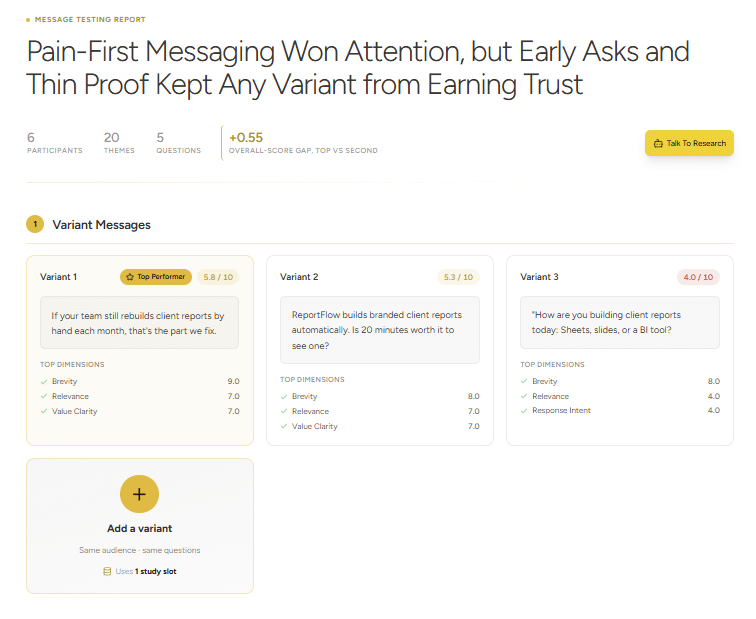
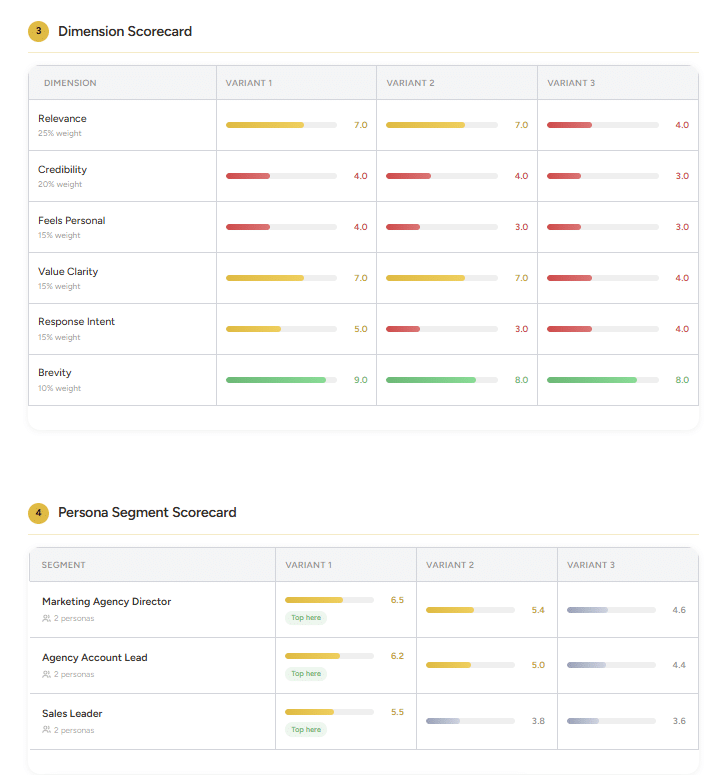
The pain-first opener won our test with 5.8 out of 10, ahead of the product-first opener at 5.3 and the question opener at 4.0. We ran the three ReportFlow openers from this guide through Articos message testing, using two personas each for agency account lead, marketing agency director, and sales leader, six in total.
Opener
Composite score
Relevance
Credibility
Response intent
A: Problem-led
5.8
7
4
5
B: Product-led
5.3
7
4
3
C: Question-led
4.0
4
3
4
Opener A led in all three roles: 6.5 with marketing agency directors, 6.2 with account leads, and 5.5 with sales leaders. Sales leaders scored the product-led opener at 3.8, well below the 5.4 and 5.0 from the agency roles. Credibility was 4 or lower for every opener, so none of them earned a stranger’s trust. The report recommended keeping A’s pain point, borrowing B’s product clarity, and trying a softer ask or a quantified benefit.
Read this as directional. It is one study with six personas, the report rated its own confidence medium, and it covers cold email only. We did not score objection answers in this run.
Should you combine synthetic and human research, or choose one?
Combine them, and let the stakes decide the ratio. Synthetic testing is fast enough to run on every draft, so use it to cut five openers down to two and to catch an objection answer that confuses the persona. Save human input for decisions you will live with for a year, such as a new positioning direction or how reps handle price.
Human input here means your call recordings, a B2B panel, or a live split between reps. Run the synthetic round first so the human time you spend goes to the questions that remain.
The same order works earlier in the process. When you’re still learning how buyers describe the problem, AI user research gives you persona interviews to read before you book real ones. When two positioning directions are still competing, a concept testing platform can compare them before either reaches a script.
What’s the cheapest or free way to test sales messaging?
The cheapest test uses material you already have. Pull five recent call recordings, mark where buyers asked for clarification or changed the subject, and rewrite those lines. Then ask three to five customers or prospects to read your opener and say back, in their own words, what you do. If they can’t, the opener needs work, and the test cost nothing.
For a structured test without recruiting, Articos offers a 14-day free trial with 900 credits (about two studies) and no credit card. After that, Starter is $79 a month for 3,000 credits (about 7 studies), and Pro is $199 a month for 8,000 credits (about 20 studies) with white-label reports, as of October 2026. Live Calls are included on both plans and draw from the same credits.
Where should you start?
The first test belongs on the opener and the top objection, because every buyer hears the opener and the objection decides whether the deal moves. Write three versions of each, and change one thing at a time so you know what caused a result. These ReportFlow openers are illustrative and untested:
Problem-led: “If your team still rebuilds client reports by hand each month, that’s the part we fix.”
Product-led: “ReportFlow builds branded client reports automatically. Is 20 minutes worth it to see one?”
Question-led: “How are you building client reports today: Sheets, slides, or a BI tool?”
Test them against buyers or personas who match your ideal customer profile before the next pipeline review. Then watch the calls. A month of recordings will show whether reps use the winning version and whether buyers respond the way the test predicted. If reps drop a winning opener after a week, look at enablement and at who owns the framework. Update the document whenever a new objection shows up in several calls.
About Alika Nasir
Alika is a GTM lead at Articos, helping teams understand what customers need before they build or launch. She writes about research methods, customer insights, and turning user feedback into smarter growth decisions.