
Product Launch Post Mortem: Questions to Ask After Every Launch
How do you go about a product launch post mortem?

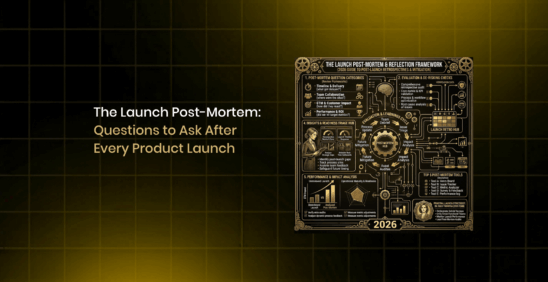
The launch is over, the dashboard is full of numbers, and nobody on the team agrees on why they look the way they do. A product launch post mortem settles that argument with evidence. It is a structured review, held after a launch, that compares what you planned with what happened and traces each gap to a cause you can change. Run it two to four weeks after launch, with the people who built, marketed, and sold the product in the same room. Below: the questions to ask, how to run the session, whether to call it a post mortem or a retrospective, and a template you can copy.
Why do launch mistakes keep repeating?
Launch mistakes repeat because most teams never write down what went wrong, and memory rewrites it fast. In 1975, Baruch Fischhoff ran experiments showing that people who learn how something turned out overestimate how predictable it was, and they rarely notice they are doing it. After a launch, that becomes “we always knew the price was off” or “nobody could have seen that coming.” Neither sentence helps the next launch.
Two habits keep the cycle going. Reviews turn into blame sessions, so people stop volunteering what they saw. And action items get written without an owner or a date, so nothing changes. A post mortem fixes both by putting evidence on the table before opinions and by tying every finding to a named person.
Many causes of a missed launch can be tested before you ship. Our list of product launch barriers sorts the common ones by what you can check in advance.
How do you run a product launch post mortem?
Run a product launch post mortem in five steps: pick the date, pull the data first, write a blameless timeline, trace each gap to a root cause, and give every fix an owner.
- Pick the date. Two to four weeks after launch works for most teams. Activation and conversion numbers have settled, and memories have not hardened.
- Pull the data before the meeting. Bring planned versus actual figures for signups, activation, trial-to-paid conversion, and customer acquisition cost by channel, plus support tickets and customer feedback. Sort each item into what you know, what you suspect, and what you still need to check.
- Write a blameless timeline. Google’s Site Reliability Engineering book defines a blameless review as one that finds contributing causes without indicting any person or team. List dated decisions and surprises, and leave out who to blame.
- Trace each gap to a root cause. Keep asking why until you reach something the team can change.
- Assign every fix an owner and a deadline. Share the summary with cross-functional stakeholders and the wider company.
How do you find the root cause of a missed launch?
Ask why until the answer is a decision someone made. Stopping at the first answer is the common error. CB Insights’ 2026 analysis of 431 VC-backed startups that shut down since 2023 found “ran out of capital” at 70%, yet the firm calls it the final cause of death rather than the root problem. Beneath it sat poor product-market fit at 43%, bad timing at 29%, and unsustainable unit economics at 19%. (CB Insights could identify reasons for 385 of the 431, and many companies cited more than one.)
A single launch works the same way at a smaller scale. A missed signup target is the symptom. A root cause reads like this: the headline described our feature, and buyers wanted an outcome. Write the cause down, attach the evidence, and ask whether a different decision before launch would have changed the result.
Post mortem or retrospective: which should you run?
A post mortem and a retrospective are the same kind of review with different framing, and no industry standard separates them. Teams commonly use retrospective for a recurring review at the end of a sprint and post mortem for a one-time review of a specific outcome. Salesforce’s engineering team says it uses “retrospective” because the word feels less morbid and less threatening.
| Retrospective | Post mortem | |
|---|---|---|
| When it happens | On a schedule: end of a sprint or quarter | Once, after a launch or incident |
| What it examines | How the team worked | What happened, why, and what it cost |
| What comes out | Small process changes | Root causes, decisions, owned action items |
For a launch, run a short product launch retrospective on the workflow when the sprint closes. It covers how the team worked: handoffs, tooling, what slowed approvals. Then hold the post mortem on the result once the data has matured, usually two to four weeks later. That second meeting is your post launch review, and it covers what the market did with the product. Call the meeting whatever keeps people talking.
What questions should you ask after a product launch?
Ask questions in seven areas, and tie each one to a number or document you can pull before the meeting.
| Area | Question to ask | Evidence to bring |
|---|---|---|
| Goals | Did we hit the targets we set before launch, and were they realistic? | Launch plan, targets versus actuals |
| Audience | Did the people who showed up match the ideal customer profile we wrote for? | Signup data, CRM records |
| Positioning and messaging | Could a new visitor say what the product does and who it is for? Which claim did buyers repeat back to us? | Landing page tests, sales call notes, ad results |
| Pricing | Where did buyers hesitate, and did anyone ask for a lower number? | Checkout drop-off, sales objections |
| Channels and timing | Which channel produced paying customers rather than visits, and what did each cost? | Acquisition cost by channel |
| Product readiness | Did signups reach the first useful action? What broke? | Activation rate, support tickets, bug log |
| Team and process | Where did handoffs fail, and which decision waited longest? | The timeline from step three |
You will not have time to discuss all seven at length, so pick the two where the numbers missed by the most and spend half the meeting there. Send the rest as written questions beforehand and collect answers in the doc. Positioning and messaging usually produce the sharpest disagreement, because everyone on the team wrote or approved some of the copy. If messaging is the suspect, test the original and the revised versions on a messaging testing platform before you spend on a relaunch, and use our guide to launch messaging to write the variants. Record each answer as one of your lessons learned after the product launch: one sentence, with the evidence next to it.
Where can I get a product launch post mortem template?
Copy the table below into a shared doc and fill in one row per section.
| Section | What to write | Owner |
|---|---|---|
| Launch summary | Goal, date, audience, one-line result | Product manager |
| Metrics versus targets | Planned and actual signups, activation, trial-to-paid, acquisition cost by channel | Growth lead |
| Timeline | Dated decisions and surprises, with no names attached to blame | Launch lead |
| What worked | Two or three items, each with evidence | Whole team |
| What missed | Each gap, its root cause, and the evidence, split into known and suspected | Whole team |
| Customer evidence | Quotes from interviews, tickets, and reviews | Research or support |
| Actions | Fix, owner, deadline, review date | Launch lead |
This launch post mortem template pairs with the validation gates in our product launch plan. The gates set the targets before launch, and the post mortem shows which ones held. If you skipped the gates, the first row of the template will be the hardest to fill: nobody wrote down what “success” meant, so the team has to agree on it after the fact.
Assign the owner column before the meeting, not during it, so people arrive with their section half filled. The product manager can draft the summary, the growth lead can paste the metrics, and support can pull the three most repeated customer complaints. Keep the finished document to two pages. A review nobody reads teaches nobody, and a long one rarely gets read.
What did a test of this guide with launch owners find?
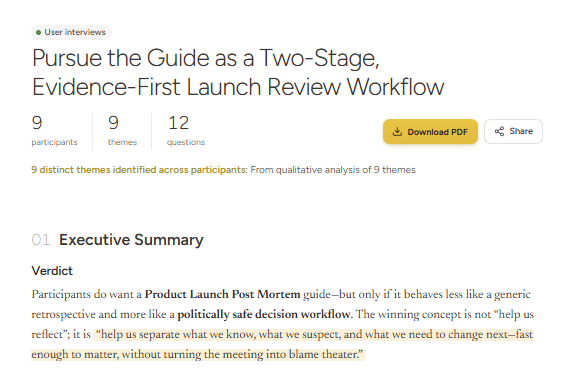
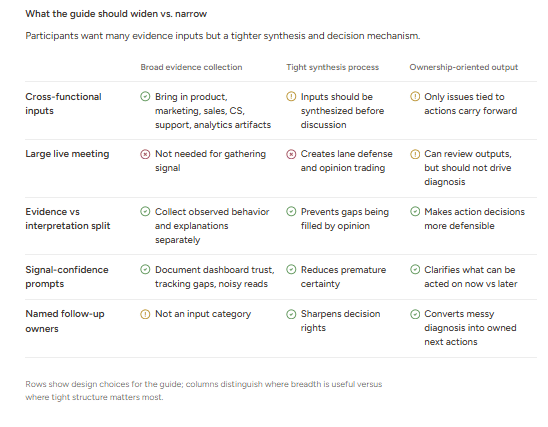
A synthetic test told us to separate evidence from interpretation before anyone meets. We ran this guide’s headline and outline through nine synthetic interviews on Articos: three product marketing managers, three product managers, and three directors of product marketing, all at B2B SaaS companies and all briefed as having missed a launch target. Their verdict was that they want the guide only if it helps them “separate what we know, what we suspect, and what we need to change next” without “turning the meeting into blame theater.” They asked for wide evidence inputs, a tight synthesis step, and named follow-up owners, and they saw a large live meeting as where opinion trading starts. Step two above now reflects that. This was one study with nine synthetic participants, so confirm it with real interviews before you rebuild a process around it.
Should you combine synthetic and human research after a launch?
Yes. Real customers, churned trials, and support tickets show what happened, and no simulation replaces that. Start by collecting voice of customer evidence. To recruit real people for interviews, a participant platform such as User Interviews does the job, and here is how it compares with Articos.
Synthetic research answers the next question: would a revised headline, price, or positioning land better with the audience you were aiming at? Articos, an AI user research platform, recovers 86% of the themes expert-run research found across 46 validation studies, benchmarked against Baymard Institute and Nielsen Norman Group work. Its Live Calls feature adds a real-time voice conversation with any persona from your panel, which helps when a study surfaces a surprise, such as a price that felt too high. Test the revised offer itself with concept testing.
The limits matter. Synthetic personas cannot explain why your actual customers churned, and they should not settle a high-stakes decision alone. Regulated claims need a specialist. Run the human interviews first, write down hypotheses, then test fixes before relaunch spend.
What’s the cheapest or free way to run a post mortem?
The cheapest way costs nothing: a shared doc, an export of your launch metrics, and five to ten customer conversations. Include people who signed up and never converted, along with the ones who replied happily, or the sample will flatter you.
Paid costs start when you want to test a fix before relaunching. As of October 2026, Articos offers a 14-day free trial with 900 credits, which covers around two studies, and no credit card is required. Paid plans start at $29 a month for Lite (1,200 credits, up to 3 studies), $79 a month for Starter and $199 for Pro, which adds white-label reports. One study uses about 400 credits, and Articos’s pricing page puts the cost at roughly $8 per study on Pro and $8 to $10 on Starter, while the launch-offer bonus credits last. Live Calls draw from the same credit pool.
For a wider view of what testing costs elsewhere, see our breakdown of user testing cost.
What should happen after the post mortem?
Within a week of the meeting, every action has an owner, the summary is shared company-wide, and a 30-day review is on the calendar. That review checks whether the fixes shipped and whether the numbers moved. Without it, the post mortem becomes a document people agreed with and then forgot.
Then put the lessons where the next launch team will find them. Update the checklist in your product launch plan, and rerun pre-launch validation on any assumption the post mortem showed to be wrong. If the findings point at positioning or channel choice, revisit your go-to-market strategy before the next spend. The post launching work is only finished when the next plan reads differently because of what this one taught you.


