
Product Launch Plan: A Complete Checklist
The Product Launch Plan explained with a checklist.

A product launch plan lays out what gets built, tested, and shipped before, during, and after a product goes live, with a deadline and an owner attached to every step.
You’re staring at a launch date and a to-do list that keeps growing. Most launch checklists are activity lists: build the landing page, write the emails, book the ads. Nobody stops to check whether any of it is aimed at the right thing.
This product launch checklist (some teams call it a go-to-market checklist, same mechanics either way) adds the step most launch plans skip: a validation gate before each phase moves forward. Test the positioning before you brief design. Also test the landing page before you turn on ads. Test the pricing before it goes on the page. Skip that step and you’re not behind on a checklist, you’re behind on the one thing that actually predicts whether the launch works.
How do you create a product launch plan?
This checklist breaks the product launch process into four product launch stages, and each one earns the right to move to the next by passing a validation gate, not by hitting a date. Assign an owner to each stage. Most launches stall not from lack of a plan but from no single person accountable for a given gate, especially once cross-functional stakeholders (product, marketing, sales) all have a hand in it.
| Phase | Typical window | What happens | Gate before moving on |
|---|---|---|---|
| Validate | 4-8 weeks pre-launch | Concept, positioning, and pricing get tested with real target users | Would your ICP actually pay for this, at this price, described this way? |
| Build & warm up | 2-4 weeks pre-launch | Landing pages, content, outbound lists, and partnerships get built | Does the landing page convert cold traffic at 2% or better?* |
| Launch | Launch week | Coordinated push across PR, community, paid, and email | Are day-one signups activating, not just arriving? |
| Scale | Weeks 1-12 post-launch | Double down on what worked, cut what didn’t | Is CAC trending down as channels mature? |
*2% is a common floor cited across landing page benchmark studies for cold paid and organic traffic; treat it as a rule of thumb, not a fixed target, since good B2B demo pages often run 2-8% and ecommerce pages run lower.
Most teams skip straight to Build & warm up because it feels like progress. Validate is the phase that gets cut when the calendar is tight, which is exactly backward. It’s the cheapest phase to run and the most expensive one to skip.
What should a pre-launch checklist include?
Call it a pre-launch checklist or a launch readiness checklist, the job is the same: before you write a line of landing page copy, four things need to be true. If any of them aren’t, fix them here. Fixing them after launch costs a rewrite, a re-audience, and a delayed relaunch.
- The problem is confirmed, not assumed. You’ve talked to or tested with people in your target segment and they’ve described the problem in their own words, unprompted.
- The positioning has been pressure-tested. Your one-sentence description of the product gets a “yes, I need that” from a stranger, not a polite “interesting.”
- Pricing has a signal behind it. You know roughly what your ICP expects to pay, because you asked them, not because a competitor’s pricing page told you.
- The ICP is specific enough to write to. “Startups” is not an ICP. “Seed-stage B2B SaaS founders validating their second feature before a fundraise” is.
This is the validation layer, and it’s cheap to run relative to what it prevents. Run a concept test on the core idea using a concept testing platform, or a structured customer discovery pass on your target segment. Both fit inside this window and both feed directly into the checklist below.
What’s a realistic product launch timeline?
Four weeks of foundation work before launch week is enough for most SMB and SaaS launches, assuming the validation work above already happened. Shorter than that, and content isn’t indexed and outbound has no momentum. Longer, and teams tend to keep polishing instead of shipping. Use this product launch timeline template as a starting point and adjust the weeks to your own content and outbound capacity.
| Week | Focus | What “done” looks like |
|---|---|---|
| Week -4 | Content and SEO foundation | Core landing pages and 10-15 blog posts live and indexed |
| Week -3 | Outbound and community warm-up | Cold outreach sequences live, first replies coming in |
| Week -2 | Paid and partnerships | Ad accounts tested at low spend, 2-3 partners confirmed |
| Week -1 | Dry run | Full signup-to-activation flow tested end to end, no gaps |
| Launch week | Coordinated push | PR, community, paid, and email go live on the same day |
The order matters more than the exact week count. Positioning tested before content gets written is what determines whether the traffic in week 4 converts, not how much of it shows up. More on how we know that below.
What are the steps to launch a product?
This is the part people mean when they ask how to launch a product: five steps, each with the validation gate that has to clear before you move to the next one.
1. Validate the problem and the concept.
Confirm the problem is real and the concept solves it, using actual conversations or structured tests with your target segment. Gate: at least 60-70% of the people you test with recognize the problem without being led to it.
2. Validate the positioning and messaging.
Turn the concept into a one-line value proposition and a subhead, then test both against the segment. Gate: your positioning gets picked over a generic competitor description in a blind comparison. The messaging framework approach works well here, since it forces you to write down what you’re claiming before you test it. If message testing is the main gate you’re worried about, a dedicated messaging testing platform can run that comparison directly.
When we tested this checklist itself (details below), four questions came back as the ones that actually caught weak positioning before launch:
- What claim are we making?
- What evidence backs it?
- Can sales, or anyone who didn’t build it, repeat it clearly?
- If this fails, what can still change before launch?
3. Build and validate the landing page.
Design and copy the page, then test it for clarity and conversion intent before it goes live to paid traffic. Gate: cold visitors can state what the product does and who it’s for, unprompted, after 10 seconds on the page. Landing page best practices covers the structural side; the validation step covers whether your specific version actually lands.
4. Validate pricing.
Test your price point and packaging against willingness to pay, not against what feels reasonable internally. Gate: your target price doesn’t cause a majority of testers to hesitate or ask for a materially lower number.
5. Build the launch push.
Line up PR, community platforms, paid budget, influencer or partner amplification, and lifecycle email, all scheduled to go live in the same week. Gate: every channel has a specific, numeric target attached (signups, referral visits, backlinks), not just “get the word out.”
Each gate takes a few days, not weeks. Articos runs this kind of test in about 30 minutes per study, at $7 to $10 per test, with 86% recall against expert human research across 46 studies. That catches a bad assumption before it’s baked into a landing page, an ad budget, or a pricing tier, especially pre-launch when you have no customers to interview yet. Once you have paying customers, pair it with real interviews, and lean on a human researcher for anything that needs longitudinal tracking or an accessibility audit.
What should launch day and launch week include?
Launch day is the coordination test, not the strategy test. By this point, the strategy should already be validated. What launch week adds is timing and amplification. This assumes a hard launch (everyone finds out the same day). If you’re running a soft launch or phased rollout to a smaller audience first, compress this list to the channels relevant to that audience and treat the wider push as a second launch week later.
- A single go-live moment, usually a launch platform like Product Hunt, timed to a specific hour, with your team and any partners briefed on exactly when to post.
- Owned channels firing in sequence, not all at once: email to your list first, then social, then paid, spaced by an hour or two so each channel’s traffic doesn’t cannibalize the others’ momentum.
- A response plan for the first six hours, since most of the day’s signal (comments, DMs, support questions) shows up early and shapes whether the rest of the week goes well.
- A daily numbers check, not a post-mortem. Traffic, signups, and activation rate reviewed each evening of launch week so you can shift budget mid-week if one channel is clearly outperforming.
What do you track after a product launch?
Post-launch tracking matters more than launch day itself, especially the first 90 days. Three KPIs tell you whether the launch is working, separate from the vanity metric of total signups. Set a milestone for each one before launch, not after, so you know what “on track” looks like in week 2.
- Activation rate: the percentage of signups who complete the core action (not just create an account) within 48 hours. A launch with strong traffic and weak activation means the product’s first-run experience needs fixing, not the marketing.
- Trial-to-paid conversion: tracked by plan and by channel, so you can see whether Product Hunt traffic converts differently than paid search traffic. It usually does.
- CAC by channel: not blended CAC. Blended numbers hide the channel that’s actually working and the one that’s quietly burning budget.
If any of these three come in soft, look for a gap that validation would have caught before adding more traffic: the wrong ICP is arriving, the activation flow doesn’t match what the ad promised, or the price doesn’t match the value the landing page set up.
Product launch plan template
A minimal version of this checklist, if you want something to copy into a doc:
| Section | Owner | Deadline | Validation gate | Status |
|---|---|---|---|---|
| Problem and concept | 60-70% unprompted recognition | |||
| Positioning and messaging | Wins blind comparison vs. competitor copy | |||
| Landing page | Visitors state the offer unprompted in 10 seconds | |||
| Pricing | No majority hesitation at target price | |||
| Launch week channels | Numeric target set per channel | |||
| Post-launch tracking | Activation, trial-to-paid, CAC by channel set up |
What’s the cheapest or free option?
You can validate for close to $0 if you’re willing to trade money for time. Post in relevant subreddits or niche communities where your ICP hangs out, DM 10-15 people in your network who fit the target segment, or run a simple concept description past your existing customer list if you have one. The limitation is sample size and bias: 5-10 responses from your own network skew toward people who already like you, so treat free validation as a smoke test, not a green light.
Paid options scale from there. AI-moderated research tools typically run $7 to $10 per study. Traditional research agencies typically quote $3,000 to $25,000 or more per study, depending on method and sample size, which is why most early-stage teams skip validation entirely rather than pay agency rates. The free and low-cost options exist specifically to close that gap.
Should I combine synthetic and human research, not choose one?
Both, at different points in the checklist. Synthetic research, the kind covered above, is built for the early gates: problem confirmation, positioning, and pricing, where you’re testing many ideas fast and cheap before you’ve committed to a direction. Once you’re validating a near-final landing page or onboarding flow with real customers, or you need a regulatory-grade audit trail, bring in human participants. Recruiting platforms like User Interviews are built for that layer: sourcing and scheduling real people for the interviews synthetic testing can’t replace. Synthetic testing cuts the number of bad concepts that reach human researchers, so the human budget goes toward ideas that already cleared a first gate.
We tested this checklist before publishing it
Before this post went live, we ran the “validation gate” concept itself through Articos: 12 interviews across product managers, startup founders, growth marketers, and product marketing managers, all 2-8 weeks from a real launch. The question wasn’t whether the checklist is accurate. It was whether the framing actually lands with the people it’s written for.
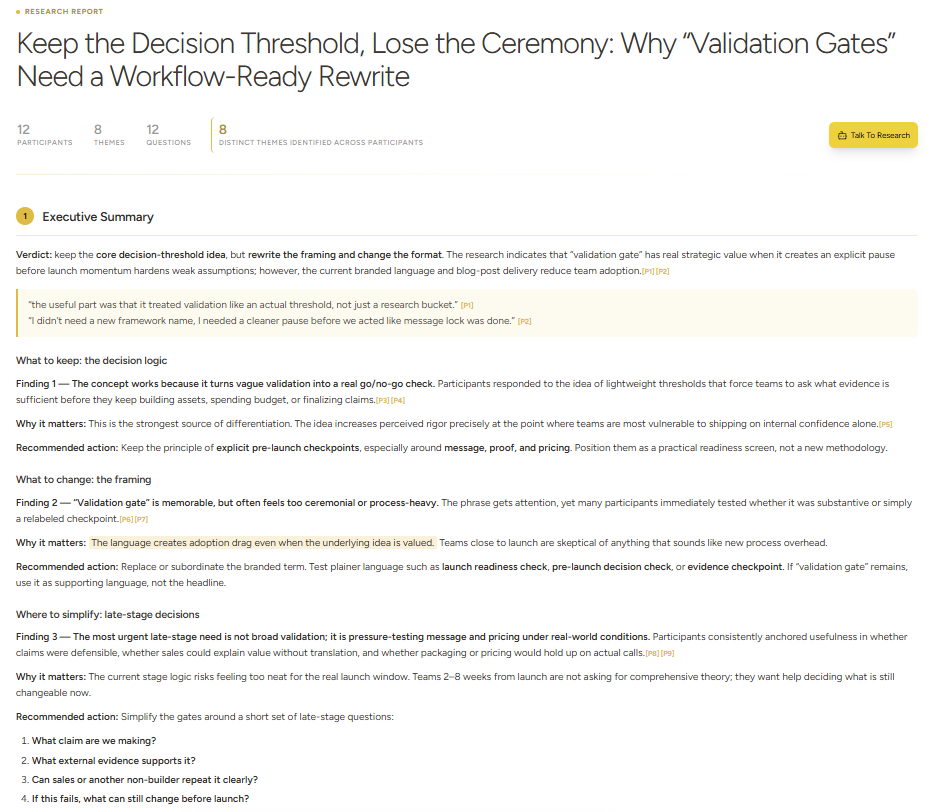
The results were mixed. Here they are in full, including the part that pushed back on our own framing. Participants confirmed the core idea works: “the useful part was that it treated validation like an actual threshold, not just a research bucket.” The packaging drew real pushback too: “I didn’t need a new framework name, I needed a cleaner pause before we acted like message lock was done.”
| What we tested | Signal | What we did about it |
|---|---|---|
| The decision-threshold logic (a gate before you move forward) | Strong | Kept it. It’s the structure of the checklist above. |
| The term “validation gate” itself | Weak, read as ceremonial | Used as supporting language, not the headline (it never was the headline here) |
| Whether teams would adopt the article as-is | Mixed | Most said they’d copy the questions into their own docs rather than reference the post directly |
| The late-stage message and pricing questions specifically | Strong | Folded directly into step 2 above |
The honest gap: participants said they’d rather have this as something to copy into Notion or Airtable than an article to reference later. We haven’t built that yet. The template table above is a step toward it, not the finished version.
What derails most product launches?
Running out of budget or missing the launch date rarely kills a launch on its own. CB Insights’ 2026 analysis of 431 VC-backed startups that shut down since 2023 found poor product-market fit was cited in 43% of cases, ahead of bad timing (29%) and unsustainable unit economics (19%). Running out of capital topped the list at 70%, but CB Insights flags that as the final event, not the root cause: a product with no real demand doesn’t generate revenue, so the runway runs out.
The pattern shows up at smaller scale in individual launches too. A team spends four weeks building content, ads, and a landing page around a positioning statement nobody tested. Traffic shows up. Conversion doesn’t. By the time that’s obvious, the launch week budget is already spent, and there’s no clean way to re-test positioning without burning a second launch moment.
Moving the validation earlier, before the plan gets built around an untested assumption, fixes this more reliably than adding another planning cycle.
How do you choose the right launch plan for your product?
Match the plan to how much is still unknown. If you’ve already sold the product to a handful of customers manually and you’re formalizing what worked, you can compress the Validate stage to a week and spend more time on Build and Launch. That’s also the right approach for an MVP launch checklist or a beta launch to a small list, where the goal is fast feedback, not a big first-week number. If you’re launching something genuinely new, with an ICP you’re still defining, don’t compress Validate. That’s the stage doing the most work, and it’s the part of a go-to-market plan that most task lists leave out entirely.
Either way, the sequence stays the same: confirm the problem, test the positioning, build and validate the landing page, check pricing, then launch. Each gate is small enough to run in days. Skipping one doesn’t save time. It moves the cost of finding out to launch week, when it’s far more expensive to fix.


