How to Conduct Pricing Research: Key Techniques and Methods
How pricing research works? Find out here.


You have a product, a competitor’s pricing page, and a hunch that $49 a month feels right. That hunch is where pricing research starts. Pricing research asks a defined group of buyers what they pay today, what range of prices feels fair, and how many would still buy as the price rises. To conduct it, map current spend first, find the acceptable range with Van Westendorp, test specific prices with Gabor-Granger, and confirm the winner on real traffic.
What is pricing research, and what should it tell you?
Pricing research is a set of survey and interview methods that estimate what a defined group of buyers will pay for a product. A good study returns three things: what the market pays today, willingness to pay (WTP) at specific price points, and the range of prices buyers consider acceptable. Isurus Market Research, in an article published by the Product Marketing Alliance, groups pricing insight the same way.
Current spend comes first, because buyers judge your price against whatever they use now. Isurus reports that B2B buyers rarely accept a price at two or three times what they pay today, even when they agree the new product is better. Buyers also understate their spend. In Isurus’s example, a buyer reports $25,000 when the real figure is $27,000, so treat reported spend as a rough magnitude.
Pricing research is one branch of user research. It’s worth the cost when a price is genuinely uncertain: a new category, or a new version of an existing product.
What are the main types of pricing strategies?
Five common pricing strategies are cost-plus, value-based, skimming, penetration, and prestige pricing. Each one rests on a different research question.
| Strategy | How the price is set | Research question it needs answered | Main risk |
|---|---|---|---|
| Cost-plus pricing | Unit cost plus a fixed markup | Will buyers accept the price this margin produces? | Ignores perceived value and can land above competitors |
| Value-based pricing | Perceived value to the customer, not cost or rivals’ prices | Which features do buyers value, and how much? | Value is hard to measure without buyer input |
| Skimming pricing | High launch price, lowered over time | Which segment pays a premium first? | High prices attract competitors |
| Penetration pricing | Low launch price to win share | Is a low price enough to win share? | Buyers can reject a later increase |
| Prestige pricing | High price held for the product’s whole life | Do these buyers read price as a quality signal? | A price cut can reduce sales |
Skimming and prestige pricing look alike but differ in time. Skimming starts high and drops as competitors arrive, while prestige pricing stays high for the product’s whole life. Penetration pricing carries a known risk: buyers who got used to a low price may refuse a later increase, which is where price increase messaging comes in.
How do you price a product without data?
Pricing a product without data starts with three reference prices: the lowest price that still earns a profit, a realistic price, and a stretch price you could defend. Write them down before you talk to a buyer. Isurus notes that some teams learn a lot from this step alone, because it’s the first time they’ve reasoned through pricing in an organized way.
Next, collect outside anchors. A competitor research pass covers what rivals and substitutes charge (a spreadsheet counts as a substitute for many buyers), and pricing page examples show how others present tiers.
Then talk to a few buyers. Ask what they use today and what it costs, then what they’d expect to pay for something better. Use cost-plus pricing as a check: if your cost plus a margin lands far above what buyers already pay, you’ve found a problem before launch.
How do you conduct pricing research?
Pricing research runs in five steps, each answering a narrower question than the last.
- Define the buyer and describe the product. Screen for people who approve the budget, and write a description clear enough that a stranger can judge its value. Both main survey methods assume respondents know the category well enough to judge.
- Map market context: the solution buyers use now and what it costs them.
- Find the acceptable range with a Van Westendorp survey.
- Test specific prices inside that range with Gabor-Granger questions, or use conjoint when buyers must trade features against price.
- Confirm on real traffic with a live A/B pricing test before you commit.
Steps 3 and 4 usually share one pricing survey. A common vendor rule of thumb is about 100 completes for each segment you want to compare. The sample size guide covers the trade-offs, and survey methodology covers question design.
Van Westendorp or conjoint analysis?
Van Westendorp finds the range of prices buyers consider acceptable, Gabor-Granger estimates demand at specific prices, and conjoint analysis measures how buyers trade price against features. Use the simplest method that answers your question.
| Method | Question it answers | Output | Design notes | Main limit |
|---|---|---|---|---|
| Van Westendorp Price Sensitivity Meter | What range feels acceptable? | Acceptable range, optimal and indifference price points | Four open-ended questions; about 100 completes per segment is a vendor rule of thumb | Measures stated thresholds and doesn’t estimate demand |
| Gabor-Granger | How many buyers say yes at each price? | Demand curve and revenue-maximizing price | A ladder of prices for one product (Isurus uses three, some vendors five or more) | Stated intent overstates real purchases |
| Conjoint analysis | How do buyers trade features against price? | Value of each feature level | 200 to 300 completes is a vendor rule of thumb; keep to about four to six attributes | Reliability drops beyond about six features |
Peter van Westendorp introduced the Price Sensitivity Meter in 1976 at an ESOMAR congress. Its four questions ask at what price the product is so cheap you doubt its quality, a bargain, getting expensive, and too expensive. Plotted as curves, the answers mark an acceptable range plus two reference points.
André Gabor and Clive Granger developed their method in the 1960s. It shows each respondent a series of prices and records purchase intent at each one, which yields a demand curve and may reveal a flat point where price changes barely move the number of willing buyers. Isurus recommends running both methods together, because each offsets the other’s weakness.
How reliable is pricing research?
Pricing research can set a range and rank options. It overshoots as a sales forecast, because people overstate what they’ll pay. A 2020 meta-analysis of 77 studies in the Journal of the Academy of Marketing Science found that hypothetical willingness to pay ran about 21% above real willingness to pay on average. The gap was larger for higher-priced products and specialty goods. In the authors’ full model, indirect methods (a group that includes conjoint) overshot by roughly 10 percentage points more than direct questions.
Four habits narrow the gap. Screen for people who would sign the purchase order. Ask when they plan to replace their current solution, since a buyer who just bought won’t switch soon. Apply a discount to stated intent, which Isurus calls standard practice. Then finish with a live price test. Van Westendorp measures stated thresholds, not purchases, so it needs the same discount.
For the qualitative side of the same question, see validity and reliability in qualitative research.
What are the best pricing research tools?
A pricing research tool should run your method. Conjointly and Qualtrics support Van Westendorp, Gabor-Granger, and conjoint; Sawtooth is built for advanced custom conjoint; SurveyMonkey and Pollfish suit lighter studies.
| Tool | Methods covered | Best fit |
|---|---|---|
| Conjointly | Van Westendorp, Gabor-Granger, several conjoint variants, built-in respondent panels | Guided, self-serve pricing studies |
| Sawtooth Software | Advanced and custom conjoint | Research teams running complex trade-off studies |
| Qualtrics | Van Westendorp, Gabor-Granger, conjoint | Teams already on the Qualtrics platform |
| QuestionPro | Choice-based and adaptive conjoint, Van Westendorp | Mid-market budgets |
| SurveyMonkey | Van Westendorp through its price optimization solution, sold per study | A quick range check |
| Pollfish | DIY Van Westendorp surveys, pay-per-response from $0.95 | Fast consumer panel reach |
Google Forms and similar basic tools can ask the questions, but they don’t enforce Van Westendorp’s question order, randomize Gabor-Granger prices, or draw the curves for you.
What’s the cheapest or free way to run pricing research?
The cheapest pricing research is a price scan plus buyer interviews, which cost only time. A panel survey through Pollfish starts near $95 for 100 responses, and the Articos free trial covers about two studies.
| Option | Cost | What you get | Catch |
|---|---|---|---|
| Competitor and substitute price scan | Free | Reference prices | List prices often differ from what buyers pay after negotiation |
| Buyer interviews | Free, plus your time | Current spend and expected price | Small samples, and buyers understate spend |
| DIY Van Westendorp in a basic survey tool | Free tool; panel from about $95 per 100 responses | Acceptable price range | You plot the curves yourself |
| Live A/B price test | Free if you have traffic | Real purchase behavior | Needs enough traffic to reach a clear result |
| Articos free trial | Free for 14 days, 900 credits, no card | Reasons and objections behind a price | Gives reasons, not a measured willingness to pay |
After the trial, Articos costs $29 a month on Lite (1,200 credits, up to 3 studies), $79 a month on Starter (3,000 credits, about 7 studies) or $199 a month on Pro (8,000 credits, about 20 studies, with white-label reports). During the launch offer, bonus credits lift those to about 10 and 24 studies a month. One study uses roughly 400 credits, and Live Calls come with both plans.
Ecommerce and DTC teams with steady traffic can start with ecommerce pricing testing, and AI user research for ecommerce covers the synthetic side.
Should you combine synthetic and human pricing research?
Yes: synthetic and human pricing research work best together. Synthetic research shows what to ask and which price framings to test, and real buyers measure the number. Synthetic interviews return reasons and objections in about 30 minutes, while a human survey returns willingness to pay with an overstatement you can correct for.
Articos reports 86% theme recall against published Baymard Institute and Nielsen Norman Group findings across 46 studies. That covers research themes, not price accuracy, so keep the dollar figures for human respondents. Message testing can compare plan names and pricing-page copy, and a concept testing platform can compare feature bundles.
AI user research can also surface objections worth adding to your survey. Live Calls let you hold a real-time voice conversation with any persona from your panel during a study, so you can ask the one who balked at the price what would have changed their mind. If the answer matters, follow up with real people: see how Articos compares with User Interviews, and read the guide to participant recruitment.
What happened when we ran pricing research on our own pricing page?
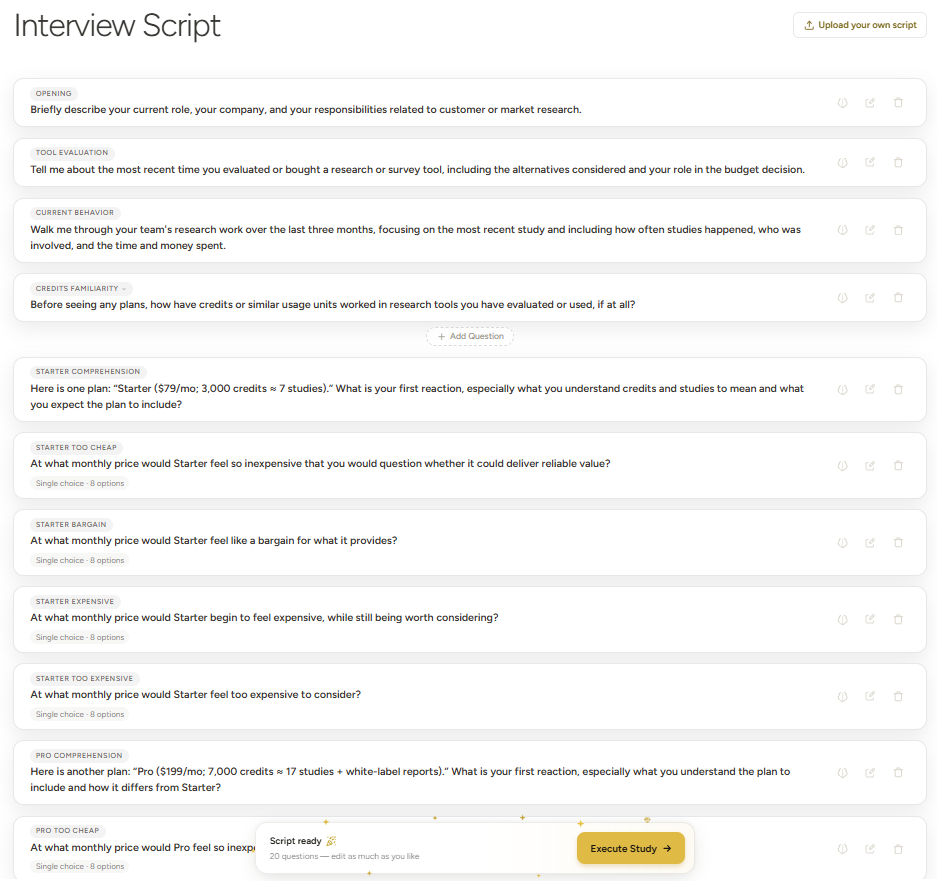
Before launch, we ran nine synthetic buyer interviews on the Articos pricing page. Participants were product managers, UX researchers, and marketing leads at US companies with 10 to 500 employees. The 20-question script gave each plan four Van Westendorp-style questions: too cheap, a bargain, getting expensive, and too expensive.
Price level wasn’t the blocker. The report’s verdict was that the page underperformed on decision enablement more than on price. Eight of nine participants asked for concrete study examples, and eight of nine wanted to know whether the 1,000 trial credits would cover one meaningful study or only light tests. One persona put it this way: “the blocker is less price than clarity.”
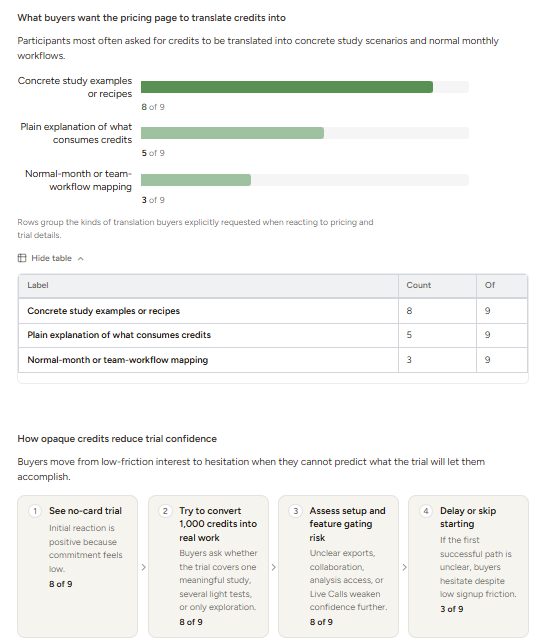
Nine synthetic personas give reasons and objections, not a measured willingness to pay, so we treat these as hypotheses. The fix to test is worked examples of credit burn per study type, confirmed with a live A/B price test.
Where should you start this week?
Write your three reference prices today. Book a few buyer conversations about current spend. Then draft your four Van Westendorp questions around a product description a stranger could follow. To see how buyers react to your plan names and price framing before you field a survey, run them through the Articos free trial.