
How to Position Against a Market Leader
Here's how you position yourself against a market leader.

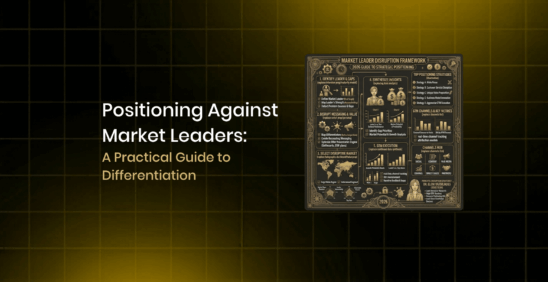
You’re not going to out-market the category leader on their own turf. They have the budget, the analyst relationships, and the “best-known” answer to every generic search query. Positioning against a market leader means picking one specific place where you’re provably better for a defined slice of the buyer market, and building the rest of your go-to-market around that one place. It’s not a tagline exercise. It’s a bet about which customers will choose you because of who the leader is, not despite it.
Most challenger brands skip the “which angle” question and jump straight to writing copy. That’s how you end up with five different value props across your website, sales deck, and ads, none of which a prospect could repeat back to a colleague. This piece covers the angles worth considering, how to pick between them with evidence instead of a gut call, and how to avoid the mistakes that quietly undo good positioning against competitors.
What does “positioning against a market leader” actually mean?
It means defining your product relative to the incumbent’s weakness, not your own feature list. Market positioning is the broader discipline of deciding where your product sits in a buyer’s mind relative to every alternative; positioning against a specific leader is the sharpest, highest-stakes version of that exercise, because you’re picking a fight with the reference point every buyer already carries around in their head.
A market leader earns that position by being good at something broad enough to serve the biggest chunk of the market. That breadth is also their exposure: somewhere in their customer base is a segment they serve adequately but not well, a use case they treat as an edge case, or a buying criterion they’ve stopped competing on because they won it years ago. Positioning against them is the act of naming that gap out loud and building your product story, your value proposition, and your competitive advantage around it.
That’s different from feature-matching, where a challenger lists everything the leader does and adds “but cheaper” at the end. Feature-matching puts the leader’s scorecard in charge of the conversation. Real positioning against competitors replaces the scorecard. It’s also different from brand positioning versus product positioning as a general discipline: challenger positioning is product positioning with a named opponent baked into the claim, aimed at one target segment rather than the whole addressable market.
What are the classic challenger positioning angles?
Challenger positioning has a long history in marketing theory, going back to Adam Morgan’s 1999 book Eating the Big Fish, which first framed “challenger brand” as a mindset rather than just a market-share label (Brighttail). Most successful challenger brand strategies still fall into a handful of repeatable patterns from that same tradition. None of them is universally right. Each one asks something specific of your product and your operations, and picking the wrong one for what you can actually deliver is where a lot of positioning work falls apart.
| Angle | What it claims | Real example | What it demands operationally |
|---|---|---|---|
| Underdog effort | We work harder for you because we have to | Avis’s 1962 “We Try Harder” campaign, which never named Hertz but built its whole promise around second-place hustle | Every team, not just marketing, has to visibly deliver on the claim |
| Access or price disruption | You’ve been overpaying for something that should be simple | Dollar Shave Club’s 2012 launch video, which took direct aim at the cost and complexity of Gillette’s razor lineup | A cost structure that survives being the cheap option long-term |
| Underserved segment (ICP-first) | The leader built this for someone else; we built it for you | A vertical SaaS tool that only serves one industry the horizontal leader treats as a rounding error | Genuine depth in that ideal customer profile, not a relabeled generic product |
| Single-attribute superiority (USP) | We’re not trying to be everything. We own this one thing. | A tool that’s the fastest, the cheapest, or the most accurate on one measurable dimension | The willingness to say no to feature requests outside that lane |
| Category redefinition | The leader is the best answer to a question that’s no longer the right question | Framing an incumbent’s product as legacy by naming a new category around what’s changed | A genuinely different mechanism, not just new language for the same thing |
Avis’s market share moved from 29% to 36% within a few years of the “We Try Harder” launch, while Hertz’s share slid from 61% to 49% (Campaign). Dollar Shave Club went from a $4,500 launch video to roughly half the online razor market within three years, against a Gillette that had dominated shaving for decades (CNBC). Neither company tried to beat the leader at being the leader. They picked one claim their operations could actually back up.
How do you compete with a bigger, better-funded competitor?
The honest answer to how to compete with a market leader is that you stop trying to win the same fight. A market leader’s advantage compounds inside their own battlefield: their spend goes further, their brand recall does more of the selling, and any claim that requires broad awareness favors them by default. Choosing a narrower battlefield, one specific segment, one specific attribute, one specific buying moment, is what lets a smaller budget do real work.
This is also where a battlecard earns its keep for sales enablement. A good battlecard doesn’t just list what the leader does wrong. It tells your sales team exactly which prospects are worth fighting for on your chosen ground and which ones aren’t, so reps stop trying to win deals your positioning was never built to win.
How do you pick the right angle instead of guessing?
A differentiation strategy is only as strong as the angle underneath it, so write down three or four candidate angles before you touch a single word of copy. For each one, name the specific buyer persona it’s built for, the objection it has to survive, and the operational proof that has to exist for the claim to hold up under a sales call. An angle that sounds sharp in a workshop but has no operational backing turns into a promise your team can’t keep.
Then rank the candidates against what you can actually prove today, not what you plan to be true in a year. A messaging framework helps here: it forces the angle down into a single competitive positioning statement a prospect could repeat back, plus three supporting proof points. If you can’t fill in the proof points with something specific, the angle isn’t ready. It’s a guess wearing a strategy’s clothes.
How do you test a challenger angle before you commit the brand to it?
Test it with the audience it’s supposed to win before it goes on the homepage, the pitch deck, and the sales script all at once. This is the step most challenger brands skip, usually because the workshop where the angle got picked felt conclusive enough on its own. It rarely is. A room of internal stakeholders agreeing an angle sounds strong is a different signal than target buyers reacting to it unprompted.
This is where an AI user research platform like Articos is useful, and it’s worth being specific about the role it plays. Articos doesn’t write your positioning or decide your angle. Its concept testing tool runs your candidate angles past synthetic personas built on your target segments and reports which one lands, which objections come up, and which claims prospects don’t believe on first read, in about 30 minutes per round instead of the weeks a formal message-testing study usually takes. A peer-reviewed validation study benchmarked Articos’s synthetic interviews at 86% recall against expert-published findings from the Baymard Institute and Nielsen Norman Group, across 46 studies, for roughly $8–$10 per study.
We ran this exact test to write this piece
The four angles from the table above went in as value-proposition variants, tested against 12 synthetic personas split across founding CEOs, product managers, marketing leads, and buyers already using a category-leading tool and open to switching.
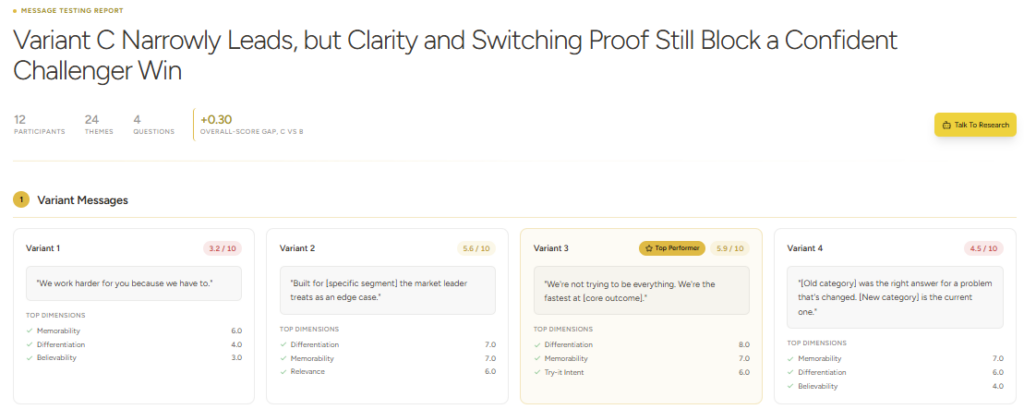
The single-attribute angle (“We’re not trying to be everything, we’re the fastest at [core outcome]”) narrowly topped the ranking at 5.9 out of 10, just ahead of the underserved-segment angle at 5.6. The underdog-effort angle (“We work harder for you because we have to”) finished last at 3.2, held back mainly by a low believability score of 3.0 despite scoring fine on memorability. The category-redefinition angle landed in the middle at 4.5.
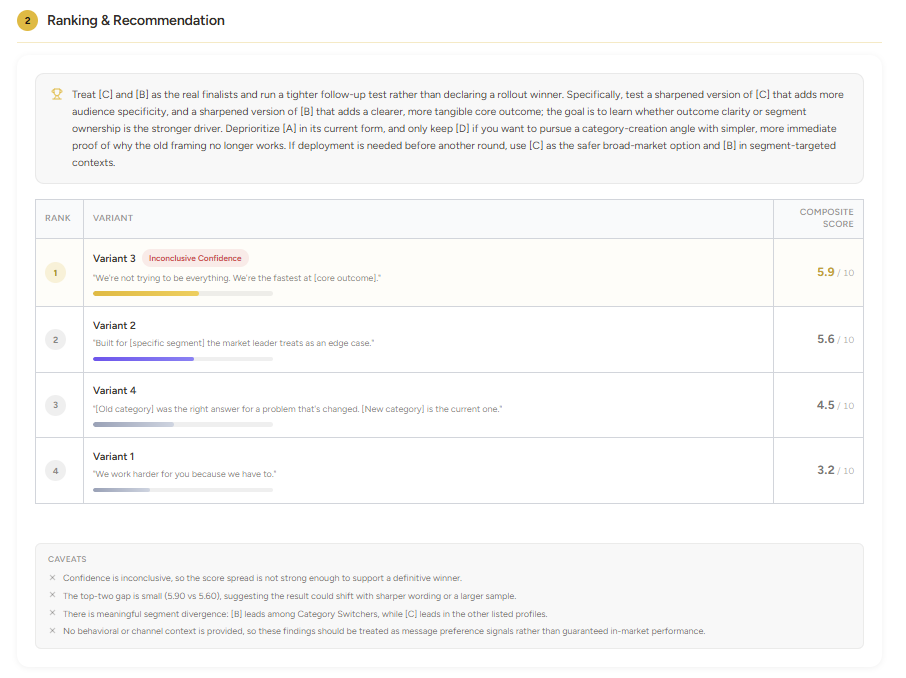
The more useful finding wasn’t the ranking. It was the caveat underneath it: the report flagged the result as inconclusive confidence, because the gap between the top two variants was only 0.3 points, and it surfaced a real segment split. Buyers already using the category leader and open to switching favored the underserved-segment angle, while the other roles leaned toward the single-attribute claim. That’s the kind of signal a workshop vote never gives you, and it’s what the report recommended acting on: treat the top two as finalists, sharpen both, and run a tighter follow-up instead of declaring a winner off one pass.
That’s a validation layer, not a substitute for talking to real prospects and your own sales team once an angle survives testing. Synthetic testing is strong at surfacing which of several worded angles resonates and why; it’s the wrong tool for generating a positioning strategy from a blank page, and it won’t catch every legal or competitive-claims issue a launch needs reviewed. Use it to narrow four candidate angles to one before you commit budget, not to skip talking to customers altogether. If your candidate angles are specifically about ad copy, landing page headlines, or other worded claims rather than the underlying strategic angle, a messaging testing platform is built for that narrower job.
What’s the cheapest or free option for testing a positioning angle?
The genuinely free option is calling five to ten target buyers yourself and reading them each candidate angle cold, which costs nothing but takes days to schedule and doesn’t scale past a handful of angles. Among paid tools, Articos’s free trial includes two synthetic research runs with no credit card required, and top-up credit packs are available once the trial credits run out, low enough to test three or four angles for less than the cost of one hour of a consultant’s time. That sits well below panel-based B2B message-testing services like Wynter, whose standard test runs closer to $225. The right choice depends on how many angles you’re testing and how fast you need the answer, not just the sticker price.
Should you combine synthetic and human research, or choose one?
Combine them, and let each one do the job it’s actually good at. Synthetic testing is fast and cheap enough to run against every candidate angle, which makes it the right tool for narrowing four or five options down to one or two. Human interviews are slower and costlier per conversation, which makes them the right tool for the final call on whichever angle survives, especially for high-stakes launches or claims that touch price, legal exposure, or a regulated buyer. Treat synthetic research as the first pass that clears out the weak angles fast, and real conversations as the check before you spend real budget.
What mistakes flatten a challenger position?
Naming the leader as the villain in public marketing.
Comparison pages can name a competitor directly and fairly. Brand campaigns rarely benefit from it; Avis’s ads never named Hertz, and the omission is part of why the line still gets studied 60 years later. Punching at a named rival makes the leader look like the safe, serious choice by contrast.
Trying to serve everyone once the angle starts working.
An angle built for one segment gets pressure to expand the moment early traction shows up. Widening it usually dilutes the exact claim that made the first customers choose you.
Competing on the leader’s own scoreboard.
If the leader owns “comprehensive,” racing to add features until you’re comprehensive too means winning, at best, a tie on their terms.
Changing the angle every quarter.
Positioning compounds. A decent angle held for two years outperforms a great angle abandoned after two months, because the market needs repetition to actually learn the claim.
No operational commitment behind the claim.
Avis employees wore “We Try Harder” lapel buttons as an internal standard, not just an ad line, according to contemporary reporting from TIME. If the claim isn’t something your product and support team live up to daily, prospects notice the gap fast.
How do you know a positioning angle is working after launch?
Watch for the angle showing up in places you didn’t put it. Sales reps start using your phrasing unprompted on calls, because it’s the shorthand that actually closes objections. Prospects repeat the claim back in their own words during discovery instead of asking you to re-explain it. Review sites and comparison content start describing your brand perception the way you describe yourself, rather than in generic category terms. And, eventually, the leader responds, directly or through a feature announcement that quietly mirrors your claim. That response is usually the clearest signal the angle found something real.
How to choose your angle
A challenger position only holds up if it does four things: it names one specific segment, it makes a claim your operations can back up under pressure, it survives contact with the buyers it’s meant to win, and it stays stable long enough for the market to learn it. Test candidate angles against real buyers before any of them go on the homepage. The leader already has the broad claim. Your job is to find the specific one they can’t credibly make.


