Messaging Resonance: Scoring a Message on Three Axes
Does your message resonate with your target audience? This guide helps you nail it.

You have rewritten the homepage headline three times, the demo replies are still lukewarm, and nobody on the team can say which part of the message is failing.
Messaging resonance is how strongly a message matches a buyer’s own situation and priorities, so they read it as being about them. It is one of three scores that explain why a message works or fails. The other two are clarity (can the buyer say back what you offer?) and believability (do they accept the claim?). Rate each from 1 to 5 with a small group of people who match your ideal customer profile (ICP), fix the lowest axis first, and test again. Clarity goes first, because the other two scores mean little without it. Teams that build copy from a messaging framework can use these scores to check whether the words land.
What is messaging resonance?
Messaging resonance is the degree to which a message connects with a specific audience’s problems, priorities, and language. Two neighboring measurements get confused with it, and each answers a different question from the buyer. A message can score high on one axis and fail on another, so the table below keeps them apart.
| Axis | Question the buyer answers | Quick test | Red flag |
|---|---|---|---|
| Clarity | What is this, and who is it for? | Ask for a one-sentence paraphrase after one read | The paraphrase names the wrong category or leaves out the audience |
| Resonance | Is this about a problem I have right now? | Ask them to rate the fit from 1 to 5 and give an example | Polite approval with no example from their own work |
| Believability | Would I trust this claim? | Ask what proof they would need before acting | The buyer asks for evidence you never show |
Message clarity is the ability of a reader to restate what a company offers, and for whom, after reading it once. Message believability is the degree to which a reader accepts a claim as plausible and supported by evidence. Keeping the three apart matters because each has a different fix. Our message testing guide covers how to run the test itself, and the axes here explain what to do when a score comes back low.
Why don’t buyers understand our message?
Buyers misread a message mostly because the writer already knows what it means. After months inside a product, a team cannot unsee the context, which is why internal reviews catch so little confusion. Our message validation guide covers this curse of knowledge in more detail.
The most common culprit is a vague category word. “Platform,” “solution,” and “workflow” can describe almost any software, so the reader supplies their own meaning. A second cause is a headline that names a feature when the reader wants a result, which feature vs benefit messaging explains how to fix. A third is a sentence that packs two ideas together, so the reader keeps one and drops the other.
The test takes ten minutes. Show the headline to five people for five seconds each, then ask what the company does. Five different answers means the headline fails on clarity. Fix that before touching anything else.
Resonance, clarity or believability: which should you fix first?
The fix order is clarity first, resonance second, and believability third. A buyer who cannot restate the message cannot judge whether it is relevant, so a resonance score on an unclear message mostly measures confusion. Believability comes last because a claim only needs defending once the buyer understands it and cares about it.
| Pattern | What you hear | Likely cause | First fix |
|---|---|---|---|
| Low clarity | Buyers describe a different product category | Jargon or a vague category label | Rewrite the headline in the buyer’s own words, then retest |
| High clarity, low resonance | “Makes sense, but not for me” | Wrong audience or wrong problem | Return to ICP research and test a different pain point against your value proposition |
| High clarity, high resonance, low believability | “Sounds great, prove it” | A claim with no proof nearby | Put a number, a named source, or a customer detail next to the claim |
| All three high | Buyers repeat your phrases and ask about price | None | Confirm the winner with a live A/B test |
Believability needs one extra habit: put the proof beside the claim. Stanford’s Web Credibility Project drew on three years of research with more than 4,500 people, and its first guideline is to make accuracy easy to verify. It adds that citations and source material help even when readers never click them. The guidelines are old and were written for websites, yet a number, a named source, or a customer detail beside a claim still does the same job. For packaged goods, our claims testing guide shows a believability gap in practice, and the consumer goods research page covers how teams run that work.
How do you score message resonance?
A message score is a 1 to 5 rating per axis, given after a participant reads the message once, using a fixed script and written anchors. Show the message, then ask three questions in this order: “In your own words, what is this offering and who is it for?” (clarity), “How closely does this describe a problem you have right now?” (resonance), and “What would you need to see before you believed it?” (believability). Two people on your team score the answers separately against the anchors, then average the results.
| Axis | 1 means | 3 means | 5 means |
|---|---|---|---|
| Clarity | Cannot paraphrase, or names a different category | Gets the category right, misses the audience or outcome | Restates the offer, audience, and outcome accurately |
| Resonance | No connection to their work | Agrees in general, gives no example from their own situation | Names a specific, current problem the message addresses |
| Believability | Rejects the claim as exaggerated | Accepts it conditionally and asks for proof | Accepts it and can say why |
Average each axis across participants and rework any axis that lands below 3.5. That cutoff is a working rule of thumb, not a published benchmark, so adjust it once you have a few rounds of your own results.
How do you measure messaging resonance?
Messaging resonance is measured with a small qualitative round before launch, and close calls are confirmed with live traffic. For sample size, Hennink and Kaiser’s 2022 review of 23 saturation studies in Social Science & Medicine found that interviews with a homogeneous group and a narrow question usually reach saturation at 9 to 17 participants. Plan on 9 to 17 people per segment, not 200.
A five-second test checks clarity. Open-ended interviews explain why a message fails. A preference test picks between drafts. A live A/B test shows which version converts but not which phrase confused people.
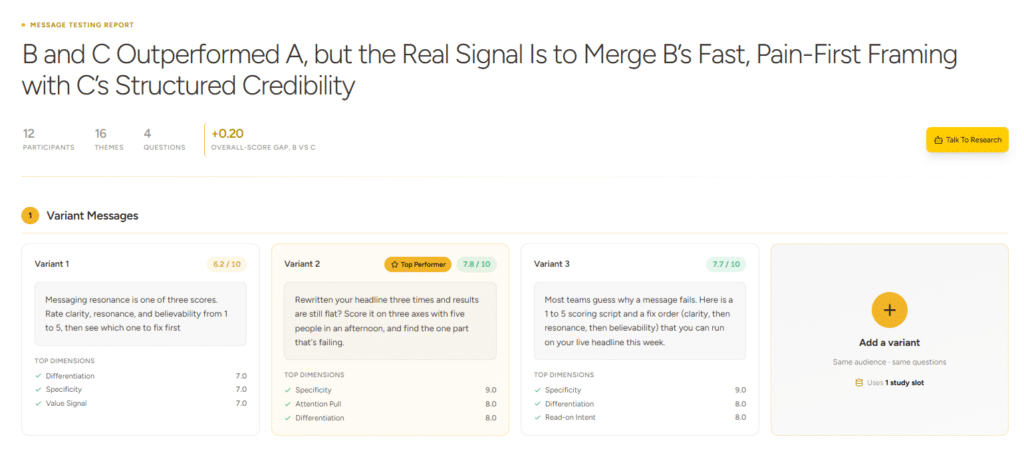
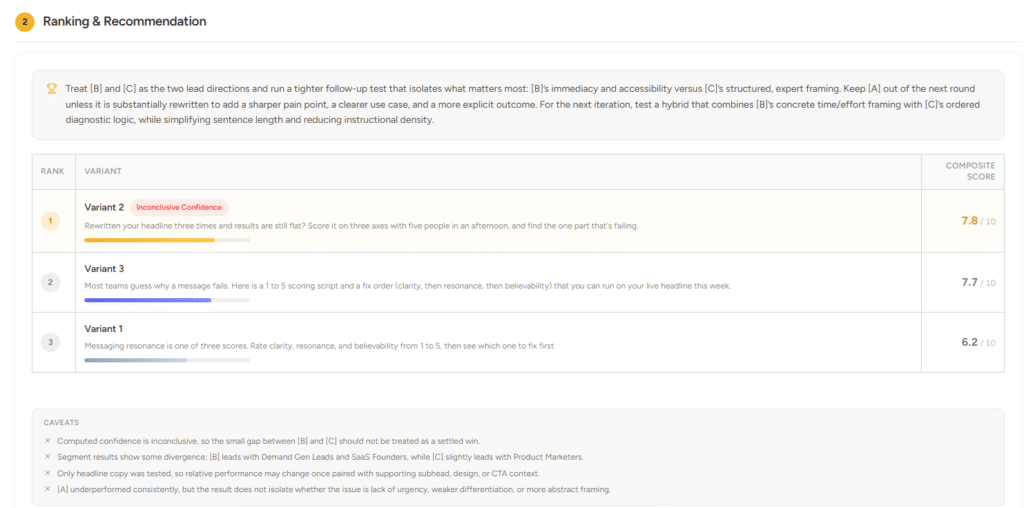
We ran this on our own post. Twelve synthetic buyers rated three headline versions in Articos. The version that describes the three scores rated 6.2 out of 10. A pain-first version (“Rewritten your headline three times and results are still flat?”) rated 7.8, and one promising a scoring script rated 7.7. Articos flagged that gap as inconclusive, so we treated it as a tie and borrowed from both for the meta description. Only headline copy was tested. The copy testing methods guide covers other options.
What tools score messaging?
Messaging gets scored with four kinds of tools: do-it-yourself interviews, panel-based services, live A/B tests, and synthetic research platforms.
| Approach | What it scores | Speed | Cost model | Main limit |
|---|---|---|---|---|
| Interviews you recruit yourself | All three axes, with the reasoning | Days to weeks, mostly recruiting | Your time plus incentives | Finding people who match your ICP |
| Panel-based service such as Wynter | Reactions from a recruited B2B panel | Results in under 48 hours, per Wynter’s site | Credit or subscription | Cost per round, and the panel must include your audience |
| Live A/B test | Which version converts | Needs enough traffic to reach significance | Low, plus the traffic itself | Cannot say why a version won |
| Synthetic research with Articos | Clarity, resonance, and believability per variant | Under 30 minutes | Plans from a month9 a month | Simulated respondents, not people |
Articos tests up to three variants per study against 12 to 50 synthetic personas and ties each finding to a persona quote. The message testing platform reports clarity, resonance, and believability for each variant. Live Calls adds real-time voice conversations with any persona from a study, which helps when one axis drops and you want to hear the reasoning. Written follow-ups go through Talk to Research. Live Calls are included on Starter and Pro and draw from the plan’s credits.
In Articos’s validation work, findings matched 86% of the themes in published Baymard Institute and Nielsen Norman Group research across 46 studies. That is recall measured by Articos itself and released as a pre-print, and the reported precision was 49.2%, so treat its findings as leads to confirm when the decision is expensive. Our Wynter comparison lists where a human panel is the better fit, such as long-running brand tracking.
What’s the cheapest or free option?
The cheapest option is a do-it-yourself round. Show your message to five to nine people who match your ICP and ask the three scoring questions above. It costs only time, and the hard part is finding the right people. Friends and coworkers will not do, because they know your product and tend to be polite, which skews every answer toward approval.
For a software run, Articos offers a 14-day trial with 900 credits (about 2 studies) and no credit card. After that, Starter is $79 a month for 3,000 credits (about 7 studies) and Pro is $199 a month for 8,000 credits (about 20 studies) with white-label reports. Launch bonus credits add to both. See the full pricing page for current terms. Free rounds suit an email subject line. A homepage rewrite ahead of paid spend deserves the 9 to 17 participants described earlier.
Should you combine synthetic and human research, or pick one?
Synthetic and human research work best combined. Use synthetic testing early, when you are narrowing three or four drafts and checking clarity, and bring in real buyers when the decision is close or costly. Synthetic personas are simulated, so they cannot replace named human respondents when a board, regulator, or client requires real people.
A workable sequence has three rounds. In round one, run every draft through a concept testing platform or AI user research to cut the unclear ones. In round two, take the top two drafts to 9 to 17 real buyers when the claim carries risk, as with efficacy claims in healthcare messaging, where a source for each statement is the expectation. In round three, confirm the winner with a live A/B test before heavy ad spend, which is how ecommerce and DTC teams often handle product page claims.
Pick one of your live headlines this week, run the three scoring questions with five people, and write the three scores in a doc with the date. The lowest score tells you what to rewrite first.