
How to Create a Message Map: 6 Steps and a Template
Here's how you can create a messag map in 6 simple steps.


Your homepage promises speed. The sales deck leads with price. The launch email pushes a feature neither of the others mentions. Each piece reads fine alone, and together they sound like three companies.
A message map fixes that. To create a message map, pick one audience and one concern, write a primary message that answers it, back it with three supporting messages, and attach proof to each. The result fits on one page, and every headline, email and ad draws from it. This guide shows how to create a message map in six steps, then gives you a copy-ready template and a way to test the map before anyone writes from it.
What is a message map?
A message map is a one-page document that ranks what you want one audience to hear: a primary message, three supporting messages, and the proof behind each. Writers, designers and salespeople check it before they produce anything public. A product message map applies the same format to a single product, so the claims stay tied to what it does. Teams that keep several message maps, one per audience, share the same core message across all of them.
The format comes from risk communication. Vincent Covello developed message mapping for crisis and public health settings, where a media sound bite runs under nine seconds on television. His 27/9/3 rule caps a map at three key messages, 27 words in total and about nine seconds aloud, which works out to roughly nine words per message. Marketing teams use a looser version, and layouts vary from team to team. The version below keeps the cap of three, because the cap forces the cuts.
A message map also sits inside a larger brand messaging framework, which defines purpose, pillars and voice for the whole company. The map takes those pillars and turns them into a script for one audience.
Why is our messaging inconsistent?
Messaging turns inconsistent when nobody owns a single ranked version of what to say, so every writer fills the gap with a personal version. Two causes show up most often.
The first is time. A homepage written in January, a deck rewritten in April and an email drafted last week each reflect what the team believed that month. The second is rank. With no order, every message competes for the headline, and each writer picks a different winner.
Run a 30-minute audit to see how far it has drifted. Gather ten assets: the homepage, pricing page, three emails, two ads, the sales deck and the onboarding email. Underline the main claim in each. If you find four or more different main claims, the problem is a missing source document, and rewriting copy will not fix it. That count is a rough test of our own, not a benchmark, but it tells you quickly whether a map is worth building.
What goes in a message map?
A message map has six fields: the audience, their concern, one primary message, three supporting messages, proof for each, and voice rules. The audience and concern come first because every message below them answers that concern. A map written for everyone answers no one’s question.
| Field | What it holds | Limit |
|---|---|---|
| Audience | One role at one type of company | 1 |
| Concern | The worry, in the audience’s words | 1 |
| Primary message | The claim to remember if nothing else sticks | 1 sentence, 15 words or fewer |
| Supporting messages | Three reasons the primary message is true | 3, one sentence each |
| Proof points | A number, name or demo behind each message | 1 or 2 per message |
| Voice rules | Words to use and words to avoid | 5 of each |
The 15-word ceiling is our own guideline for marketing copy. Covello’s 27-word total for three messages works out to nine words each his nine principles of message mapping, hosted by the EPA.
How to create a message map
Create a message map in six steps: choose an audience and concern, write the primary message, add three supporting messages, attach proof, set voice rules, and test. Each step fills one field of the template further down.
Step 1: Pick one audience and the concern they carry
Write down who the map is for and what worries them, in their own words. Sales call notes, support tickets and interview transcripts all work as sources. A usable entry sounds like “I can’t tell which of our three value propositions is working,” said by a marketing lead at a 40-person SaaS company (an illustrative example). If you have not defined the audience yet, start with an ideal customer profile. If you have no transcripts, AI user research with synthetic personas can produce a first list of likely concerns, which you then check against real customers.
Serving several audiences means one map each. The primary message can stay close across maps, while the supporting messages change.
Step 2: Write the primary message
Write one sentence that answers the concern from step 1. It names the audience’s outcome and the reason you can deliver it. Draft five versions, pick one, and count the words. Anything past 15 gets cut.
For a scheduling app, a primary message could read: “Clients book you in two clicks, with no email thread.” That is 11 words. If the claim feels vague, the guide on what a value proposition is shows how to sharpen it.
Step 3: Add three supporting messages
Each supporting message answers a different doubt a skeptical reader would raise: why believe this, how does it work, and what does it cost me. Three is Covello’s limit, and it keeps the map short enough to hold in your head. Together with the primary message, these supporting messages form the key messages every asset draws on.
Before you commit, open the homepages of your three closest competitors. A message all three make is table stakes and does not deserve a slot. If two candidates compete for the lead, rank them with a messaging hierarchy.
Step 4: Attach proof to each message
Give each supporting message one or two proof points: a number, a named customer (with permission), a screenshot or a demo. “Fast onboarding” is a claim. “New users finish setup in 11 minutes” is proof, provided you measured it. Mark any message without proof as unproven, then find the proof or cut the message.
Step 5: Set voice rules and cut to fit
List five words your team will use and five it will avoid, with a reason for each. Then read the primary message and the three supporting messages aloud. Covello’s version takes about nine seconds. Yours will run longer, so cut until you can say it in one breath. A sentence that needs a second breath usually holds two ideas.
Step 6: Test the map before anyone writes from it
Treat the finished map as a hypothesis. Show the primary and supporting messages to people who match the audience from step 1, and ask two questions: what does this mean to you, and which of these would you repeat to a colleague? Internal reviews miss this because the team already knows what each phrase refers to. The guide to message testing covers the methods, and message validation explains how to check positioning before launch. Testing wording against an audience is a form of concept testing, applied to sentences instead of products.
Is there a message map template?
A message map template fits in one table. Copy the table below into a doc and fill in the third column. The example column uses a fictional scheduling app, so every figure in it is illustrative. This is also a short message map example you can model your own on.
| Field | What to write | Example (fictional scheduling app) |
|---|---|---|
| Audience | One role, one company type | Independent consultants booking 10+ client calls a week |
| Concern | The worry, in their words | “I lose hours to email back-and-forth.” |
| Primary message | One sentence, 15 words or fewer | Clients book you in two clicks, with no email thread. |
| Supporting message 1 | Why believe it | It reads your calendar, so double bookings stop. |
| Supporting message 2 | How it works | Clients see only the slots you have opened. |
| Supporting message 3 | What it costs | Free for one calendar; paid plans add team scheduling. |
| Proof | One per message | Syncs with two major calendar apps; setup takes 2 minutes. |
| Voice rules | 5 use, 5 avoid | Use “book” and “slot”; avoid “solution” and “platform”. |
Keep the filled-in version to one page. Anything longer belongs in a messaging framework.
Message map or messaging framework?
Use a messaging framework to define how the whole brand speaks, and a message map to decide what you say to one audience about one concern. The framework is the strategy document. The map is the page a writer keeps open while drafting.
| Document | Scope | Question it answers | Build it when |
|---|---|---|---|
| Message map | One audience, one concern | What do we say to this person, and in what order? | Before writing campaign copy |
| Messaging framework | Whole brand: purpose, pillars, segments, voice | How does the brand speak everywhere? | Once, then when positioning changes |
| Messaging hierarchy | One page or pitch | Which message leads? | When messages compete for the headline |
Pillars from the framework become the supporting messages in the map. If you do not have a framework yet, build it first, because a map without pillars to draw from tends to restate whatever the last meeting decided.
Does a message map improve clarity?
A message map improves consistency for certain, and it improves clarity only when the messages inside it have been tested. A map organizes messages. It does not tell you whether a reader understands them. Covello’s 27-word cap forces brevity, which helps, but a brief message can still be wrong.
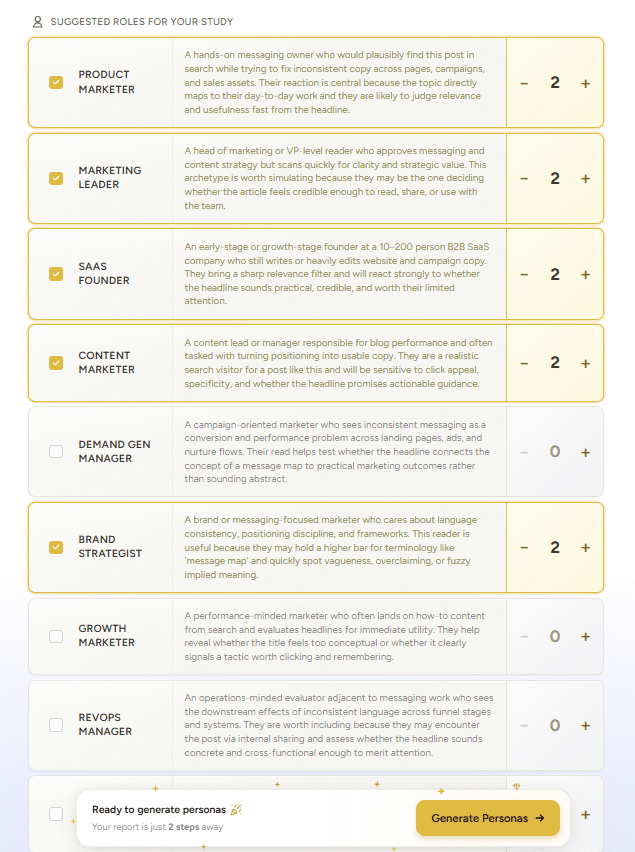
We tested this on the article you are reading. Before publishing, we ran three framings of its headline past 10 synthetic marketers in Articos: two each of product marketers, marketing leaders, SaaS founders, content marketers and brand strategists. A process-led version (“Create a message map in six steps: one audience, one primary message, three supporting points.”) and a problem-led version (“Your homepage, sales deck and launch email say three different things. A one-page message map fixes that.”) tied on clarity at 8.0. The problem-led version won overall, 8.1 to 6.7, because it scored 8 on value signal against 5 for the process-led one. An outcome-led version scored 6.2, held back by a clarity score of 5.0. Every persona group rated the problem-led headline highest, from 8.0 to 8.4. Ten respondents is directional, not conclusive.

This guide follows the result: the H1 keeps the search phrase, and the opening paragraph uses the winning framing. For a message map, the lesson is that a clear message and a persuasive one earn separate scores, so test both.

Can you test a message map without recruiting participants?
A message map can be tested without recruiting anyone, as a first pass. Synthetic users, which are AI personas matched to your audience, can react to a primary message and its supporting messages without anyone being recruited or scheduled. Articos runs this kind of study through its message testing platform and returns a comparative report in under 30 minutes, so you can retest after every rewrite.
Paste the primary message and the three supporting messages, pick the audience from step 1, and compare comprehension, relevance and believability across versions.
New accounts get two free studies with no credit card, and the pricing page lists the paid plans.
Synthetic research suits narrowing candidates. A rebrand or a positioning change also deserves conversations with real buyers, and the two approaches complement each other.
What’s the cheapest or free option for testing a message map?
The cheapest option is to ask five customers which of your supporting messages they would repeat to a colleague, then check whether their answers cluster around one. It costs a few calls and catches a map that is clearly off. The sample leans toward people who already like you, so treat the result as a filter, not a verdict.
Paid options split into two types. Panel services such as Wynter put your messages in front of a verified panel of human B2B buyers, with results in 12 to 48 hours (here is how Articos compares to Wynter). Synthetic platforms run the same comparison against AI personas, with no recruiting step. Free methods can rule out a bad map. They cannot settle a close call between two strong candidates.
Should I combine synthetic and human research, or choose one?
Combine them, and let the cost of being wrong set the ratio. Synthetic testing is quick enough to run after every rewrite, which suits narrowing five primary-message candidates to two. Human conversations suit decisions you will live with for a year, such as a rebrand, where tone and context matter more.
Run the synthetic round first, so the human round, which is slower and costs more, answers a sharper question. A concept testing platform built on synthetic personas handles the first screen, and real buyers confirm the finalist.
Start with the audit above: pull ten assets, underline the main claims, and pick the audience whose pipeline matters most this quarter. That gives you the concern for step 1 and a first draft of the map by the end of the afternoon.


