International Product Launch Research: A Customer Research Guide
How to do an international product launch? Let's find out.


International product launch research tests a concept, a message, and a price with buyers in each target country before you spend on localization, local hires, or ads. Walmart’s German exit shows how much a wrong assumption about local buyers can cost. The company entered Germany in 1997 and sold its 85 German stores to Metro in July 2006, taking a pre-tax loss of about $1 billion. An analyst quoted by the Associated Press said German shoppers rejected store features that worked at home, such as employees required to greet customers heartily and baggers at checkout.
This guide covers how to launch in international markets, how to validate demand country by country, which tools do the work, and what each option costs.
Why do products fail in new countries?
Products fail in new countries when a team assumes the home-market buyer exists abroad with the same language habits, trust signals, and price expectations. The assumption is easy to make because the product itself hasn’t changed.
Language alone moves buying behavior. A 2020 CSA Research survey of 8,709 consumers in 29 countries found that 76% prefer to buy products with information in their own language, and 40% will not buy from websites in other languages. The same research found that many consumers choose a lower price over native-language information, so translation won’t rescue a mispriced offer.
Ecommerce and DTC brands meet this first, because the product page does the entire selling job. Trust, risk tolerance, and decision style also differ by country, and a translated survey can’t surface any of that.
How do you launch in international markets?
Launch in international markets by ranking candidate markets, researching the top few, and releasing in stages instead of everywhere at once. The sequence:
- Rank markets on revenue potential, cultural distance from your home market, regulatory complexity, and demand signals such as existing traffic or waitlist signups from that region.
- Write one ideal customer profile per market. A buyer persona built in the US won’t describe the buyer in São Paulo.
- Test the concept and the message with buyers in each priority market.
- Test the price in local currency, at the checkout step where it will appear.
- Release to the lowest-risk market first and carry what you learn into the next one.
Staging matters because every market launched on the same day splits the attention of product, support, and marketing teams. Our product launch plan lays out the wider sequence, from validation gates to launch week. Market ranking works best after segmentation, which our market segmentation research guide covers.
Global launch or local launch?
A global launch uses one product, one message, and one campaign everywhere. A local launch adapts message, price, and sometimes features market by market. Most teams land between the two: a global product with a local layer for priority markets and baseline translation for the rest.
| Approach | What varies by market | Fits when |
|---|---|---|
| Global | Translation only | Concept, message, and price scores look similar across markets in testing |
| Local | Message, price, sometimes features | Scores or objections differ sharply between markets |
| Hybrid | Full adaptation in two or three priority markets, baseline translation elsewhere | Budget covers deep work in a few markets only |
Language is the clearest signal that a local layer pays off: the CSA Research survey cited above found that 40% of consumers won’t buy from sites in other languages. Run identical questions in every market and compare each score against that market’s own benchmark. A purchase-intent score of 6 out of 10 can be strong where 5 is typical and weak where 8 is typical. Message framing is usually the first thing to differ, and our launch messaging guide shows how to test it before you ship. For the channel and sequencing side of the decision, see go-to-market strategy.
How do you validate international demand?
Validate international demand by testing the same concept, message, and price with buyers from each target market and judging each result against that market’s own benchmark, not a global average. Four checks keep the comparison clean:
- Use the same question set and scoring in every market, so differences reflect buyers and not the instrument.
- Set success thresholds for each market before results arrive.
- Size the sample to the claim. Ten qualitative interviews can show a directional problem and can’t support a quantitative one; our sample size guide covers where the line sits.
- Read cultural context as a tendency. Hofstede’s dimensions, including power distance, individualism, and uncertainty avoidance, describe countries, not any one buyer.
Concept testing measures purchase intent and willingness to pay, and pre-launch validation covers where that testing sits in the launch calendar. Price deserves the same treatment as the concept. A USD price converted at spot rate ignores local purchasing power, which matters most for ecommerce and consumer goods brands testing a single global price ladder.
What does international product launch research look like in practice?
We ran one in Articos: a B2B onboarding feature that auto-configures a new user’s workspace, shown in two framings (speed and reliability) to buyers in the US, Germany, Japan, Brazil, and the UAE, nine participants in total. Reliability won. Buyers read an unqualified speed claim as a sign that something had been skipped.
Nine participants across five markets is one to two per market. That’s enough for a directional read and too thin to say Germany differs from Brazil. The full write-up is in our cross-market concept testing guide.
What tools research international markets?
Four kinds of tools cover international market research: translated surveys, global panel platforms, local research agencies, and synthetic research platforms. They trade speed, cost, and cultural depth against each other, and most multi-market programs combine two of them.
| Approach | Time per market | Typical cost per market | Cultural depth | Best for |
|---|---|---|---|---|
| Translated single survey | 1 to 2 weeks | $5,000 to $15,000 | Low | Quick price checks in similar markets |
| Global panel platform | 2 to 4 weeks | $3,500 to $10,000 | Medium, varies by country panel | Quantitative checks once direction is set |
| Local research agency (native moderators, focus groups) | 6 to 12 weeks | $25,000 to $75,000+ | High | Regulated categories, high-stakes launches |
| Synthetic research platform | Under 30 minutes per study | $8–$10 per study | Medium | Ranking markets before a big spend |
Ranges are Articos estimates from its cross-market concept testing guide, not third-party benchmarks.
Synthetic platforms such as Articos run a persona panel per market. The Articos concept testing platform reports 86% theme recall against published Baymard Institute and Nielsen Norman Group findings across 46 studies (the methodology page has the paper). Each persona carries Hofstede country dimensions, so a German buyer and a Brazilian buyer start from different assumptions. To compare how two framings read in each market, the messaging testing platform runs the same comparison on copy.
Live Calls adds a second layer. After a study finishes, you can hold a real-time voice conversation with any persona on the panel, for example the buyer who balked at the price, and ask why. Talk to Research covers the same follow-ups in writing. Both are part of the wider AI user research workflow.
What’s the cheapest or free option for international market research?
The cheapest option is your own audience: a regional segment of your email list, existing customers abroad, and active communities in the target country. These cost time instead of money, and they carry real limits. Respondents are self-selected, nothing is calibrated for culture, and the sample skews toward people who already like your brand.
Paid options start at roughly $3,500 to $10,000 per market for a panel and climb to $25,000 or more for an agency. Synthetic research is cheaper per market. Articos Starter costs $79 per month and covers around 7 studies; Pro costs $199 per month, covers around 17 studies, and adds white-label reports. One study uses about 400 credits, and Articos prices a study at roughly $8–$10. Live Calls draw from the same credit pool.
The free trial lasts 14 days and includes 900 credits, around two full studies, with no credit card. Two studies are enough for a first pass across a few markets. They’re not enough to defend a market-by-market difference, so treat the result as a smoke test.
Should you combine synthetic and human research instead of picking one?
Combine them. Run every candidate market through a synthetic pass first, rank the markets by opportunity and risk, then send only the top one or two to human research for the final check.
The synthetic pass is built for direction: which markets deserve attention and which framings fail. Human panels catch detail-level differences and carry weight with stakeholders who want recordings of real buyers. A recruitment platform supplies those participants, and our comparison of Articos and User Interviews shows how the two split the work.
Running the synthetic round first shortens the list of markets that need the expensive round, so human budget goes to ideas that already cleared one gate. The cross-market concept testing guide above shows how to structure the two rounds.
What happened when we tested this approach ourselves?
Before publishing, we put this guide’s central recommendation through Articos as a user-interview study: run a fast synthetic pass across every candidate country, then spend human research only on the top one or two markets. The panel was 12 simulated participants answering 12 questions. Roles were product marketing managers, heads of growth, founders, international expansion leads, and one each from regional marketing, pricing strategy, country launch, and compliance, all at B2B SaaS and ecommerce companies planning a multi-country launch in the next 6 to 12 months. The study returned 8 themes.
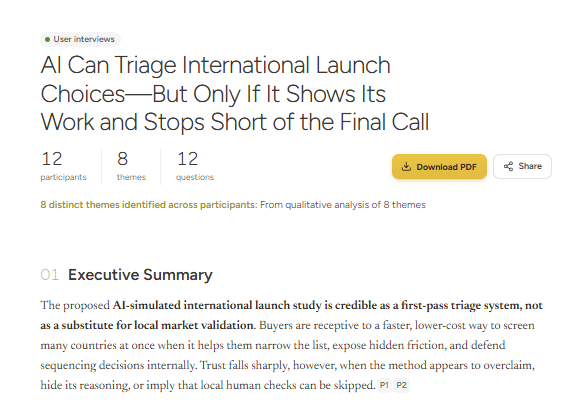
The headline is that the approach is credible as first-pass triage and not as a substitute for local market validation. Participants welcomed a faster, cheaper way to screen many countries at once when it narrowed the list, exposed hidden friction, and gave them something to defend sequencing decisions with internally. Trust fell sharply when the method seemed to overclaim, hid its reasoning, or implied that local human checks could be skipped.
The report also showed what decides early market selection, and it isn’t market size.
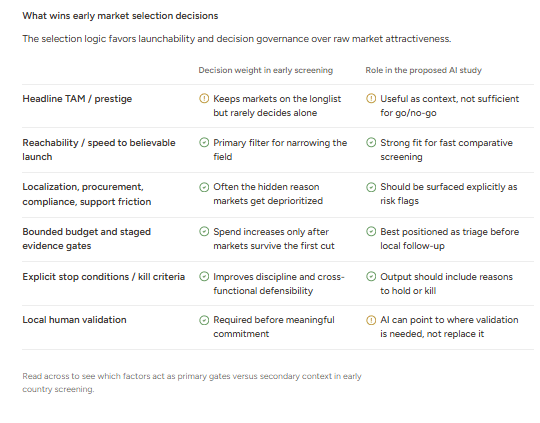
Headline market size keeps a country on the longlist but rarely decides anything alone. Reachability and speed to a believable launch is the main filter. Localization, procurement, compliance, and support friction are often the hidden reason a market gets dropped. Teams also trust a process that has a bounded budget, staged evidence gates, and explicit stop conditions, and they treat local human validation as required before any meaningful commitment.
Two limits apply. This was a simulated panel, so read it as a credibility stress test and not as proof that the approach works. And we tested a recommendation we make ourselves, which is why the pushback matters most. It shaped the next two sections: the synthetic pass is triage, and its job includes naming what must be checked locally.
Where does synthetic international research fall short?
Synthetic research falls short in regulated categories, long-term behavior, and irreversible commitments. Financial products, medical claims, and food labeling often require local compliance review and documented human research, whatever a synthetic pass shows. Teams working on medical products should read the healthcare research page before scoping. Procurement, support, and localization friction also tend to be the hidden reason markets get dropped, so a synthetic pass should flag them as risks to check locally, not settle them.
Diary studies and ethnography need real people observed over time. A six-figure localized product build deserves a human check in the target market. Per-market samples in a synthetic study also stay small, as the five-market test showed. Use the synthetic pass to narrow the list and human research to confirm what you will actually spend on.
How do you decide what to run first?
Match the method to what you already know. If you haven’t picked markets, start with a synthetic pass across every candidate. If you have one market and a regulated claim, go straight to local human research. If you have a short list and a deadline, run both: synthetic on the full list this week, human on the top two next month.
Judge any option on the same five axes: cost per market, time per market, cultural depth, sample size, and whether regulators or stakeholders will accept the result. A method that fails the axis that matters for your launch is the wrong method, however cheap it is.
Write the stop conditions before you run anything: the result that kills a market, the result that sends it to human research, and the result that clears it for launch planning. Teams in our test trusted a screen more when it came with explicit kill criteria than when it only produced a ranking.