
How to Set Price for a Product: A Complete Guide
A practical guide to setting a product price: the margin formula, pricing methods and how to test a price before you commit.


You have a product, a cost sheet, and a number in your head that you can’t fully defend. That is the usual starting point for how to set price for a product, and it is where most pricing mistakes begin.
Calculate a cost floor with the selling price formula, estimate a value ceiling from what the product is worth to the buyer, pick a price between the two, and test it before you commit. Skipping the test is the expensive part. A price set on gut feel either leaves margin on the table or sits above what buyers accept, and you find out months later.
This guide covers the formula, the choice between cost-plus and value-based pricing, how to tell if you are charging too little, four ways to test a price point, which calculators to use, and where synthetic research fits next to real customers.
How do you set a selling price?
The selling price formula divides your unit cost by one minus your target gross margin. A product that costs $18 to make and deliver, with a 55% target gross margin, sells for $18 ÷ (1 − 0.55) = $40. That leaves $22 per unit, which is 55% of the price.
Unit cost covers everything that scales with each sale: materials, packaging, payment fees, shipping you absorb, and hosting for software. Fixed costs such as rent and salaries belong in a break-even calculation instead. Break-even revenue is fixed costs divided by gross margin, so $12,000 of monthly fixed costs at a 55% margin needs about $21,800 in monthly sales.
Margin and markup trip up first-time sellers. Margin is profit as a share of the selling price. Markup is profit as a share of cost. The $40 price above carries a 55% margin and a 122% markup, and a 100% markup is only a 50% margin. Quote the wrong one to a supplier or investor and the numbers will not match.
Cost plus or value based pricing?
Cost-plus pricing starts from what the product costs you, and value-based pricing starts from what the product is worth to the buyer. Most products need both, because cost sets the lowest price you can accept and value sets the highest price a customer will pay.
| Method | Starts from | Works best when | Main risk |
|---|---|---|---|
| Cost-plus | Unit cost plus a target margin | Costs are stable and buyers compare similar goods | Ignores willingness to pay, so it can underprice |
| Value-based | The buyer’s perceived value | The product solves a costly problem or has few substitutes | Needs evidence of value, which takes research |
| Competitor-based | Prices of the closest alternatives | Many near-identical products compete | Copies another seller’s cost structure instead of yours |
Cost-plus fits a physical product with a clear cost per unit. Value-based pricing fits software and services, where serving one more customer costs little and the value delivered differs by segment. Tiered plans let each segment pay a different amount, and pricing page examples show how real companies present them.
Work in this order: calculate the floor (the minimum price you can accept), research the ceiling (the highest price buyers still find believable), then price inside the range.
Am I charging too little?
You are probably charging too little if almost nobody questions the price, if you are the cheapest option for reasons unrelated to your costs, or if one supplier increase would erase your margin. None of these proves it. Each is a reason to test a higher price.
The math favors testing. At a 40% gross margin, a 10% price cut means selling one-third more units just to earn the same gross profit. A 10% price increase works the other way: you can lose 20% of your units and still break even. In a 1992 analysis of 2,463 companies, McKinsey’s Michael Marn and Robert Rosiello reported in Harvard Business Review that a 1% price improvement with no loss of volume raised operating profit by 11.1%. That is an average across large companies. Your result depends on how many customers leave.
Price elasticity is the change in units sold for each 1% change in price, and it is the number you are trying to estimate. If you do raise prices on existing customers, price increase messaging covers how to announce it.
How do you test a price point?
You test a price point by showing likely buyers specific prices, then confirming the shortlist with real purchases. Four methods cover most cases.
| Method | What it asks | What you get | Main limit |
|---|---|---|---|
| Van Westendorp survey | Four open questions: too cheap, a bargain, getting expensive, too expensive | An acceptable price range | Stated opinion, not purchases |
| Gabor-Granger survey | Would you buy at this price, repeated at higher or lower prices | A demand curve and a revenue-maximizing price | Stated intent, and it needs a sensible price ladder |
| Synthetic reaction test | A persona panel reacts to price options and explains why | Objections and reasoning per price | Directional, not purchase behavior |
| Live A/B test | Real visitors see different prices | Actual conversion and revenue | Needs traffic and weeks |
Dutch economist Peter van Westendorp introduced the price sensitivity meter in 1976. André Gabor and Clive Granger developed their method in the 1960s. Both measure what people say they would do. For the live step, the A/B testing guide explains the full method and A/B testing for pricing covers the pricing-specific traps.
Where does a synthetic price test fit?
A synthetic price test fits between your calculation and your live test, when you have a long list of prices and no traffic to test them. The concept testing platform in Articos interviews AI personas matched to your buyer and returns a report in under 30 minutes. Articos reports 86% recall against published Baymard Institute and Nielsen Norman Group findings across 46 studies, in an April 2026 pre-print. That figure is self-reported.
Afterward, Talk to Research lets you ask the persona who balked at a price what made them hesitate. Live Calls does the same by voice, in real time. Consumer goods brands can run this on pricing framings before committing to a price.
Reaction testing cannot measure real willingness to pay. Use it to cut a long list to two or three prices, then confirm with a live test.
What did a synthetic pricing study find?
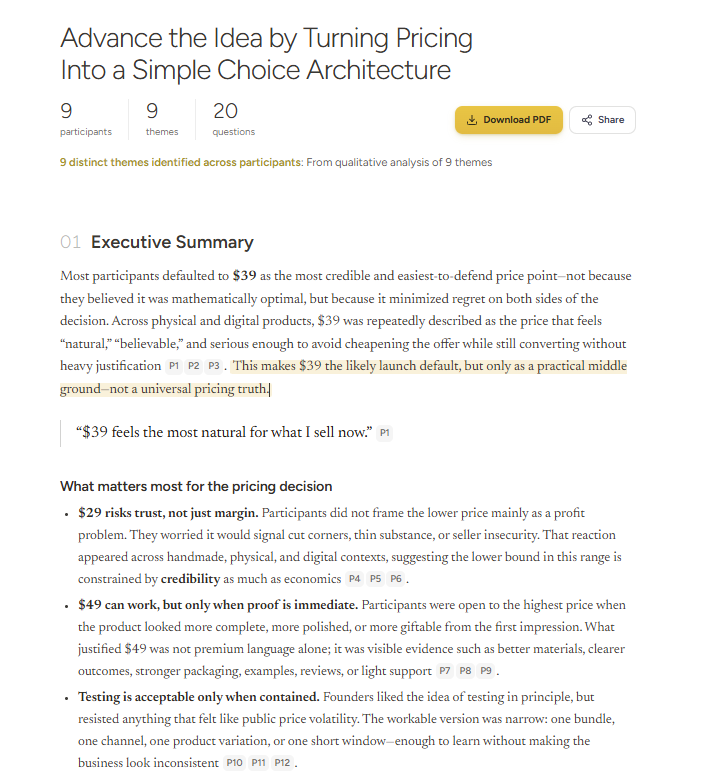
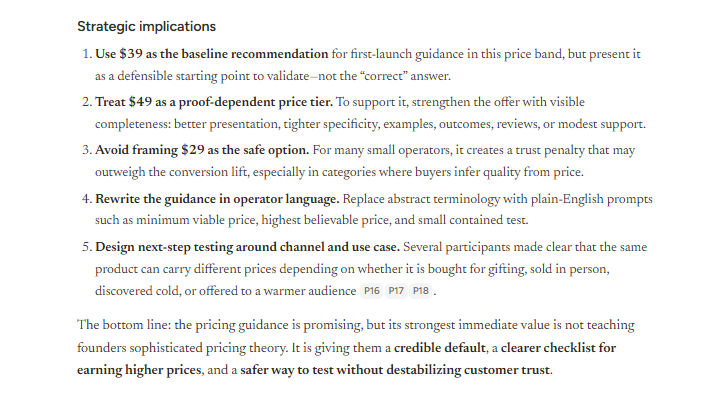
We ran this guide’s advice through an Articos interview study. Nine synthetic founders and small-business owners selling products between $20 and $60 reacted to the same product at $29, $39 and $49, then to the steps in this article. Most picked $39 as the price easiest to defend. They read $29 as a trust risk, not a margin problem, because it suggested cut corners or an unsure seller. They accepted $49 only when proof was visible at first glance: better materials, packaging, examples or reviews. They liked testing in principle but resisted anything that looked like public price swings, so a contained test worked best: one bundle, one channel or one short window. Nine personas is a directional read, not a market measurement.
What pricing calculators are available?
Margin calculators cover the cost side, and sample size calculators cover the testing side. No calculator tells you what a customer will pay.
| Tool | What it does | Cost | Limit |
|---|---|---|---|
| Shopify profit margin calculator | Takes cost per item and markup or selling price, then shows margin and profit per item. Advanced mode adds shipping and customer acquisition cost | Free | Cost side only |
| Evan Miller’s sample size calculator | Gives visitors needed per variant from your baseline conversion rate and the smallest lift you care about | Browser tool, no account | Does not set the price |
| A spreadsheet with the formulas above | Cost floor, break-even revenue, margin after a discount | Your time | You maintain the assumptions |
Use the margin calculator before testing to set the lowest price you will accept. Use the sample size calculator before a live test to learn whether your traffic can detect a difference. The traffic math is in A/B testing sample size.
What’s the cheapest or free option?
The cheapest way to test a price is a Van Westendorp or Gabor-Granger survey sent to your own email list or social audience, which costs only your time. A live A/B test adds no tool fee if you already have the traffic, but it costs weeks of waiting. Paid options trade money for speed.
As of October 2026, Articos lists a Starter plan at $79 a month and a Pro plan at $199 a month. One study uses about 400 credits. The free trial runs 14 days with 900 credits, around two studies, and needs no credit card. Live Calls draw from the same credit pool. That works out to roughly $7.50 to $8 per study with the current launch bonus credits and $10.50 to $11.50 without them. Check the Articos pricing page for current terms.
For a first test, AI user research on the free trial costs nothing and shows whether the method suits your product.
Should I combine synthetic and human research, not choose one?
Yes. Use synthetic research to narrow the price list fast and human research to confirm the final price. A synthetic panel can rule out weak price options and expose confusing plan names in under 30 minutes. A recruited panel or a live test then checks that real people pay what the synthetic ones said they would.
The sequence that works: calculate your floor, run a synthetic reaction test on three candidate prices, survey your own customers on the shortlist, then run a live test sized in advance. Ecommerce teams can use AI user research for ecommerce for the first reaction pass and their own storefront for the last. In an earlier Articos test of a crossed-out price against a flat discount, believability decided the result, and ecommerce pricing testing shows how that first pass played out.
Platforms that recruit real participants, such as User Interviews, cover the human side. The Articos and User Interviews comparison explains when each fits. Synthetic research does not replace buying behavior, so no price should ship without a real-customer check.
How to set price for a product: a five-step checklist
- Calculate unit cost and the price that gives your target gross margin.
- List the three closest alternatives and what each charges.
- Pick three candidate prices between your floor and the highest price buyers will believe.
- Run a reaction test on those three, with a survey or a synthetic panel.
- Confirm the leader with a contained live test (one channel, one bundle or one short window) sized in advance, and set a date to review the price.


