How to Choose the Best Product Name: A Practical Guide
A step-by-step guide to naming a product: write the brief, pick a style, check trademarks, and test finalists with your audience.

You have a product that works, a launch date, and a shared doc with forty name ideas nobody can rank. Here is how to name a product without letting the loudest voice win: write a one-page brief, pick a naming style, generate a long list, screen it against written criteria, check trademark and domain availability, test the finalists with your target audience, and decide with a rule you set in advance.
The eight steps below follow that order. Most of them are desk work. The testing step is the one teams skip, because recruiting participants is the slow part. A synthetic audience removes the recruiting, and the test takes under 30 minutes.
How do you make a product name that fits your product?
A product name starts with a one-page brief. Write four lines: who the buyer is, what problem the product solves, three or four words the name should evoke, and any names you don’t want to sound like. If you already have a positioning statement, paste it in. If you don’t, write one first, because a name that has to carry unclear positioning will carry it badly.
The brief also settles a scope question. A product name labels one offering, such as a plan or a feature set. A brand name identifies the company behind it. When the product sits under an existing brand, the name has to coexist with that brand without confusion, and that narrows the field before you’ve written a single candidate.
How to make a good product name: what should it pass?
A good product name passes six checks: people can say it, spell it, remember it, tell it apart from competitors, connect it to what the product does, and own it legally. Write the checks down before you brainstorm, then score every candidate from 1 to 5 against each one.
| Check | Question to ask | How to test it |
|---|---|---|
| Say it | Can someone pronounce it after seeing it once? | Hand it to three colleagues and listen |
| Spell it | Can someone type it after hearing it once? | Say it on a call and watch what they type |
| Remember it | Do people still have it the next day? | Mention it once, ask for it back tomorrow |
| Tell it apart | Does it sound like a competitor? | Search it next to three rivals |
| Connect it | Does it hint at what the product does? | Ask what they think it does |
| Own it | Can you register it and get the domain? | Run the checks in step 6 |
Treat length as a tie-breaker. A short name that fails the spelling check loses to a longer one that passes.
How to choose a name for a product: which naming style fits?
Product names fall into five types on the spectrum of distinctiveness that trademark law uses: generic, descriptive, suggestive, arbitrary, and fanciful. Pick the type before you brainstorm, because it decides how protectable and how memorable the name can be.
| Type | What it means | Example | Registration note |
|---|---|---|---|
| Generic | The common name for the product | “Beer” for beer | Can’t function as a trademark |
| Descriptive | Describes a feature or purpose | Cold and Creamy, for ice cream | Needs proof of acquired distinctiveness (secondary meaning) to register |
| Suggestive | Hints at a quality with a mental leap | Greyhound, for bus travel | Registrable without secondary meaning |
| Arbitrary | A real word with no link to the product | Apple, for computers | Registrable, broad protection |
| Fanciful | An invented word | Kodak | Strongest protection |
Descriptive names are easy to understand and hard to protect. Founders with little brand awareness usually weigh a suggestive name, which hints at the product, against an arbitrary one, which needs more marketing before it means anything. This is general information, not legal advice.
How do you create a product name? Generate before you judge
You create a product name by generating a long list first and judging it in a separate session. Give each person fifteen minutes to write names alone, then pool them. Writing alone helps keep the first loud suggestion from anchoring everyone else.
Work through the types from the table above so the list isn’t all one style: compound words, real words used out of context, shortened phrases, and invented words. Mine the product’s own territory for raw material: the verbs customers use, the object the product replaces, the metaphor your support team already reaches for. Name generators can add volume, but every output goes through the same screen as the rest.
Keep the rejected names in the doc. Two weak halves sometimes make one strong name.
How to choose a product name from a long list?
Choose a product name by scoring every candidate against the six checks and cutting anything that fails one outright. Keep three to five names.
Then stress-test the survivors. Search each one plus “meaning” in the languages of your target markets. Type each as a lowercase URL to catch accidental words hiding inside it. Line the names up next to the ones your buyers already know, using the list you built in a competitor research pass, so you aren’t one letter away from a rival.
If your finalists still feel interchangeable, the brief is probably too loose. Go back to step 1 and tighten the “evoke” words before you test anything.
How do you brand name a product so you can own it?
To brand name a product so you can own it, check the trademark, the domain, and the social handles before you get attached to a name. Start with the trademark, since it’s the one you can’t buy your way out of later.
The USPTO searches a database of millions of trademarks and tells applicants to run a clearance search before applying. An exact-match search is only the start. The USPTO also points searchers to alternate spellings and pronunciations, and to related goods outside your own class. An owner can sometimes act on common law rights even without a federal registration. Have a trademark attorney run a full clearance on any name you plan to build on.
Slack’s naming search ran into the same wall. The Building Slack newsletter’s account of how the product got its name says the team bought a couple of domains for the name Honeycomb before a trademark search ended it, and that other ideas stalled on disagreement or on domains and trademark checks. Run those checks while you still have three names, not one.
How do you test product name ideas before you commit?
Test the final three names with people who match your buyer, and ask what they think the product does before you tell them. Feedback from friends can skew polite, a form of response bias, so a tight screener matters more than a big sample. Treat the answers as qualitative signal, not a vote count.
Four questions cover most of it: What does this product do, based on the name alone? What does the name remind you of? How would you spell it after hearing it once? Which of the three would you click first, and why?
You can run this with a handful of customers, a survey, or a synthetic audience. The synthetic route, where AI-generated personas react in place of recruited participants, is the fastest because it skips recruiting. With Articos, you describe the audience by role, industry, and geography, list the names, and get back findings per name, the objections that came up, and a recommendation in under 30 minutes. For a straight variant comparison, the message testing platform takes up to three versions in one study.
Testing names before the product ships is a form of concept testing, and our message testing guide covers the method in more depth. A test that presents names as text can’t tell you how they sound in a sales call, so say the finalists out loud yourself.
What happened when we tested three product names in Articos?
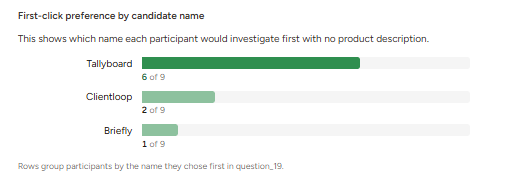
Nine AI-simulated agency buyers did not pick a clean winner among three candidate names: Tallyboard, Clientloop, and Briefly. We tested them for a hypothetical tool that builds branded monthly client reports for small agencies, showing each name alone with no product description. The participants were owners and account managers at 5 to 50 person agencies, simulated by Articos, not real customers. Articos rated the evidence as mixed.
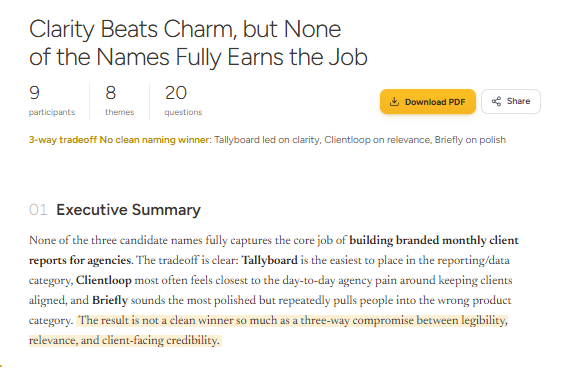
Tallyboard was the easiest to place in reporting and data, and six of nine participants would have investigated it first. They heard dashboards and scorekeeping more than client-ready reporting. Clientloop connected to a real agency pain and drew clicks from owners and client-service leads, but it read as communication or approvals software. Briefly sounded the most polished, and participants kept filing it under summaries, briefs, or AI writing tools.
Articos recommended choosing none of the three as written and renaming around reporting as interpretation and client-facing credibility. That result is useful. Three names that each fail in a different way show what the next list has to fix, and you learn it before the domain is registered.
How do you decide on the name and roll it out?
Decide with the rule you wrote before testing. A workable one: the highest average score wins unless it fails legal clearance. If no name passes the comprehension check, go back to the list instead of picking the least bad one, as in the test above. If two names finish within a point of each other, treat it as a tie and confirm with live people.
Names can also change later. Airbnb launched in 2008 as AirBed & Breakfast and shortened it to Airbnb in 2009.
Once you pick, register the domain and handles the same day, file the trademark application, and write one paragraph on why you chose the name where the team can find it. Then write the line that sits beside it. Our guide on how to write a tagline picks up there.
What’s the cheapest or free way to test a product name?
The cheapest way to test a product name is free: search the USPTO database, check the domain and handles, say each name out loud, and ask five people from your target audience what they think the product does based on the name alone. That covers legal red flags, spelling, and basic comprehension at no cost.
For a more structured result without recruiting anyone, the Articos free trial runs 14 days with 900 credits, enough for about two full studies, and asks for no credit card.
Human panels are another route. Wynter tests messaging with verified B2B participants and charges by the credit, so cost rises with every round you run. Our page on how Articos compares with Wynter lays out the differences in turnaround, pricing, and use cases.
Should I combine synthetic and human research, or choose one?
Combining synthetic and human research beats choosing one. Use synthetic research early, when you’re narrowing forty names to three and the cost per round decides how often you test. Use real people when the decision is close or expensive to reverse.
| Stage | Method | Why |
|---|---|---|
| Long list to shortlist | Your six checks, scored by the team | Free and fast |
| Shortlist to finalists | Synthetic audience, up to three names per test | Repeatable in minutes, no recruiting |
| Two names within a point | Customer interviews or a human panel | Confirms the close call |
| Legal clearance | USPTO search plus a trademark attorney | Research can’t judge legality |
Synthetic research has real limits here. It can’t tell you whether a name is legally clear, and it won’t replace hearing a customer say the name in their own voice. It narrows the field quickly so the slower, costlier checks only run on names that earned them.
Start this week with the brief. Everything else in the list gets easier once four lines of it exist.