
How to Sell to a Healthcare Buying Committee
How can you sell your idea to a Healthcare Buying Committee

Your champion loves the product. Then the deal disappears into a hospital buying committee and nothing happens for three months. This is the normal shape of healthcare B2B sales, not a sign you did something wrong.
A healthcare buying committee is a group of stakeholders, commonly cited at eight to twelve people for a significant technology purchase, spanning clinical, IT, compliance, and finance, who each have to sign off before a purchase clears. None of them can approve the deal alone. Any one of them can stop it. The fix is knowing who else is in the room, what each person blocks on, and rehearsing their objections before you’re standing in front of them.
This guide is one part of a broader sales battlecard approach to objection handling, applied specifically to hospital purchasing.
Who makes purchasing decisions in hospitals?
No single person approves a purchase at a hospital or health system. Decisions run through a committee because the buyer is spending someone else’s budget, on behalf of patients, inside a regulated environment. That spreads risk, and it spreads sign-off.
The exact committee varies by deal size and department, but most software and services purchases pass through some combination of a clinical or operational sponsor, an IT or informatics reviewer, a security and compliance reviewer, and a finance or procurement approver. Larger systems route the decision through a formal value analysis committee (VAC), the cross-functional group hospitals use to evaluate products and services before purchase, or a full RFP process. Smaller practices compress the same roles into fewer people, but the roles themselves rarely disappear.
Your champion is one vote, not the decision.
What roles sit on a healthcare buying committee, and what does each one block on?
Each committee member is defending a different kind of risk, not just asking different questions. A pitch built for one persona in the room will stall the moment it reaches the others, because it never answered what they’re actually worried about.
| Role | What they block on | Typical objection | How to address it |
|---|---|---|---|
| Clinical champion / end user | Does it fit how care actually happens | “This adds a step to my workflow” | Show the workflow before and after, not just the feature list |
| CMIO / medical informatics | Integration with the EHR and clinical systems | “Does this talk to Epic or Oracle Health?” | Bring integration specifics, not a roadmap promise |
| IT / CISO (security) | Data security, breach risk, vendor access | “Where does patient data live, and who can see it?” | Have your SOC 2, HIPAA BAA, and data flow diagram ready before they ask |
| Compliance / legal | HIPAA, liability, contract terms | “What happens if this causes a compliance incident?” | Answer with the BAA and incident process, not reassurance |
| Finance / budget owner | Cost against a fixed or shrinking budget | “What’s the total cost, including implementation?” | Give one number, not a range, and show where the savings actually land |
| Procurement / value analysis | Comparison against alternatives and existing GPO contracts | “Why this vendor over what we already have?” | Name the alternatives yourself and explain the gap they don’t close |
| Executive sponsor | Whether this matters to the system’s priorities this year | “Does this move a metric leadership cares about?” | Tie the pitch to the health system’s own stated priorities, not generic ROI |
Note that Epic’s EHR competitor Cerner was acquired by Oracle in 2022 and rebranded Oracle Health; CMIOs and informatics reviewers will use the current name, so check which platform a given health system runs before you walk in.
The CISO and compliance reviewer are the two most underestimated roles in healthcare B2B sales. Sales teams that only prep for clinical and finance objections are the ones surprised when security review adds another month or more to the timeline.
How do hospitals buy software?
Hospital purchasing usually moves through four stages: need identification, evaluation, committee review, and contracting. Each stage has its own gatekeeper, and skipping ahead to contracting before the earlier stages clear is the most common way a deal quietly resets.
Need identification. A department raises a problem, often the clinical champion or a department head. This is where most vendors get their first meeting.
Evaluation. IT and informatics assess technical fit, and security runs a risk review. This is where medical software procurement slows down: HIPAA compliance review, business associate agreement negotiation, and security assessments commonly add somewhere around a month to three months on top of everything else, according to healthcare SaaS sales-forecasting benchmarks.
Committee review. Value analysis or a purchasing committee weighs cost, alternatives, and clinical benefit together, sometimes against an existing group purchasing organization (GPO) contract. This is the meeting your champion often can’t get you into.
Contracting. Legal negotiates the BAA and contract terms, finance confirms budget, and procurement finalizes the purchase order.
A health system buying process for a mid-market software purchase commonly runs several months to under a year; enterprise deals with large systems are more often reported in the nine-to-eighteen-month range, largely because of stakeholder count and compliance review rather than product fit. Anything that skips a stage tends to bounce back to it later, with less goodwill than the first time around.
Why do healthcare deals stall?
Healthcare deals stall because they’re being sold to one person while being decided by a group that person doesn’t fully control. The champion carries your message into rooms you’re not in, translating it imperfectly to reviewers whose concerns were never addressed in the first place.
The most common stall points:
- The champion can’t answer a security or compliance question, so the deal sits with IT for weeks with no advocate pushing it forward.
- Finance sees a price with no clear budget line to absorb it, so the request waits for the next fiscal-year budget cycle.
- Value analysis compares your product to an internal alternative or an existing GPO contract you never knew existed, and nobody on your side rebuts it.
- The executive sponsor never hears why this matters to a goal they’re already accountable for, so it never becomes a priority.
Nobody prepared an answer for any of them, because the seller only ever talked to one stakeholder.
Who actually kills healthcare deals?
The person who kills a healthcare deal is rarely the person who says no out loud. It’s usually the reviewer who never gets a satisfying answer and quietly stops advocating, which reads to the rest of the committee as tacit disapproval.
Security and compliance reviewers hold outsized power for exactly this reason. They don’t need to argue against a purchase. They just need to flag an open question in a shared document, and the deal stops moving until someone answers it, often weeks later. The same is true of a budget owner who never gets a number they can defend upward, or a clinical end user who nods in the demo and says nothing in the internal Slack thread where the real decision gets made.
The villain here is a pitch rehearsed against one friendly voice and never tested against the four or five other people in the room who weren’t part of that first meeting.
How do you sell to health systems?
Selling to health systems means preparing for the whole committee before you’re in front of any of it, not building a great pitch and hoping it survives contact with reviewers you’ve never spoken to.
Map the committee before the first meeting
Ask your champion directly who else will need to sign off. Most will tell you if you ask early; almost none will volunteer it later once the process is already moving.
Build a one-page answer for each blocking role
Security gets a data flow diagram and your BAA. Finance gets one clear cost figure tied to a budget line. Compliance gets your incident response process. Do this before the meeting where you’ll need it, not after someone asks and you scramble.
Rehearse the pitch against the roles that will disagree with it, not just the ones who’ll like it
A pitch that’s only ever heard friendly questions hasn’t been tested. One way to do this before the real meeting: build synthetic personas for the roles most likely to push back, a CISO focused on data residency, a value analyst comparing you to what they already have, a CFO who needs one defensible number, and run your pitch past them the way you’d run it past the actual committee.
We ran this on our own pitch for a hospital dispensary management system through Articos’ healthcare research workflow, building six committee personas and running 18 synthetic interviews to pressure-test the messaging before it goes anywhere near a real hospital.
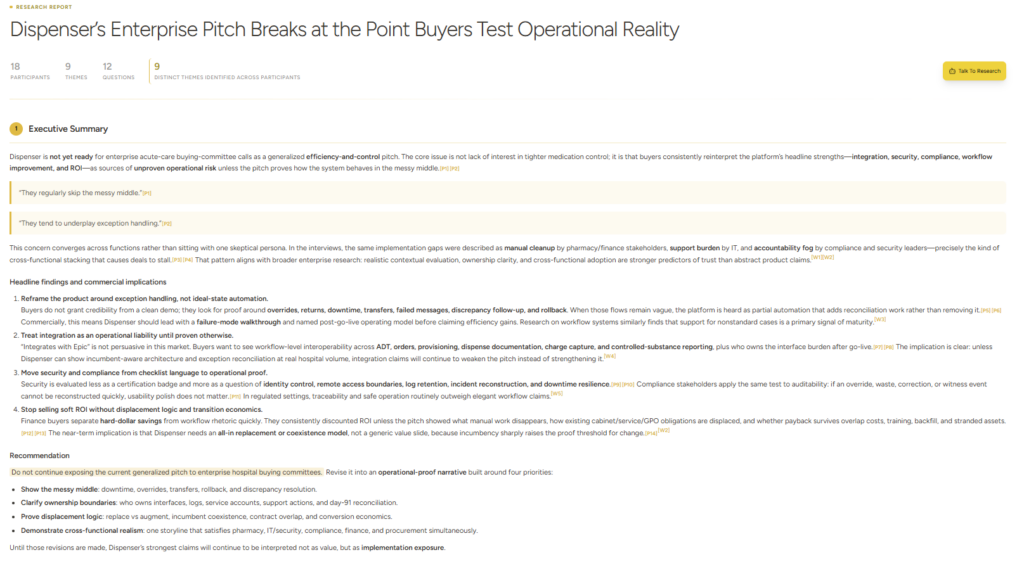
The finding matched the pattern in this article almost exactly. The pitch wasn’t rejected for lack of interest, it was reinterpreted. Reviewers across pharmacy, IT, compliance, and finance independently read the same headline claims (integration, security, compliance, workflow improvement, ROI) as unproven operational risk, because the pitch skipped what the report called “the messy middle”: downtime, overrides, transfers, rollback, and discrepancy resolution. As one persona put it, “they regularly skip the messy middle.” Another said the same pitch style “tends to underplay exception handling.”
| Claim in the pitch | How the committee reinterpreted it | Commercial consequence |
|---|---|---|
| “Seamless interoperability” | Custom interfaces, exception queues, support burden | IT or informatics slows or blocks the deal |
| “Secure / compliant” | Remote access exposure, unclear incident accountability | Security review becomes the gating step |
| “Automation and visibility” | Partial automation with manual cleanup | Pharmacy and nursing confidence drops |
| “Efficiency savings” | Soft savings, overlap cost, stranded assets | Finance discounts the payback |
The same implementation gap showed up as a different complaint depending on who was answering: pharmacy and finance called it manual cleanup, IT called it support burden, compliance and security called it accountability fog. That’s the cross-functional stacking pattern described earlier in this guide, just confirmed with a real test instead of a hypothetical one. None of it surfaced with the one friendly champion who liked the demo. It only showed up once the same pitch was pressure-tested against every blocking role at once, which is the entire argument for rehearsing this way before a real committee sees it.
Give the champion material they can forward, not just remember
A champion who has to paraphrase your pitch from memory in a committee meeting they run alone will lose detail the reviewers need. A one-page leave-behind per stakeholder role travels better than a slide deck they half-remember, and if the messaging itself is still unproven, it’s worth pressure-testing the copy through Articos’ message-testing workflow before it goes in front of a compliance officer who reads it once and moves on.
Testing a pitch this way surfaces the objections you’d otherwise hear for the first time in the room where you can’t fix them, which is the whole point: a signature still depends on the real conversations that follow.
What’s the cheapest way to rehearse a healthcare pitch?
The cheapest option is asking your champion or a peer sales rep to role-play the skeptical reviewers, which costs nothing but tends to miss objections neither of them would think to raise. A friendly internal reviewer rarely asks the question a real CISO would ask.
Paid options scale from there. B2B message-testing panels such as Wynter put your pitch or landing page in front of real, verified professionals matched by role and industry, typically returning feedback within a couple of days, which is useful for testing whether the language lands before you’ve built out full stakeholder personas. Synthetic research platforms like Articos’ concept testing go further by letting you construct specific dissenting roles, a CISO, a value analyst, a budget owner, ahead of time and run the pitch past all of them in one sitting, which is closer to rehearsing the actual committee than a general B2B panel can get you.
Free methods are fine for a first pass. They’re not a substitute for testing against the specific objections a hospital committee will actually raise.
Should you combine synthetic and human research, or pick one?
Combine them. Synthetic personas are fast and cheap for a first-pass rehearsal, catching unanswered questions before you’ve spent goodwill with a real prospect. They don’t replace an actual conversation with the specific hospital’s reviewers, who carry context, politics, and relationships no persona can model.
A reasonable sequence: rehearse against synthetic stakeholder personas first to catch the obvious gaps, then validate what’s left with one or two real conversations, a customer advisory contact, a peer at another health system, or the champion themselves, before the pitch that actually matters. Skipping the synthetic pass wastes a real contact’s patience on questions you could have caught yourself. Skipping the human pass means shipping a pitch that’s only ever been tested against a model of the room, not the room itself.
How to prepare for your next committee pitch
Before you build the pitch, list every stakeholder your champion mentions, and ask them directly who else needs to sign off. Build one page per role that answers what that role blocks on, not what you want to tell them. Then rehearse the pitch, using synthetic personas via Articos, real peer feedback, or both, against the objections you expect from the roles least likely to be won over by enthusiasm alone: security, compliance, and finance.
The health systems that move fastest through procurement are the ones whose sellers never make a reviewer wait weeks for an answer they should have brought to the first meeting.


