Expanding SaaS Into New Markets: The Research That Has to Come First
This is how you tailor your approach when expanding SaaS into new markets.


Your board wants a second region on the roadmap, sales has two inbound leads from Germany, and someone just pasted a market-sizing spreadsheet into Slack. Nobody has asked a buyer there a single question. Expanding SaaS into new markets goes wrong in that gap. The research that has to come first runs in a fixed order: demand, buyer, competition, price and rules, then message. The early checks are cheap, and each can end the plan before you spend on localization, hiring, or ads. This guide covers the order, what each check costs, and where research should stop and a human conversation should start.
Which market should we expand into?
Expand into the market where demand already shows up in your own data and the buyer resembles your best current customers. Look for three things by country: signups or traffic you didn’t pay for, pipeline you didn’t source, and customers who already pay you from there. A market with none of them is a bet.
Then score each candidate from 1 to 5 on revenue potential (a rough total addressable market), distance from home in language and buying habits, regulatory load, and competitor density. Cut any market that scores 2 or below on demand or regulation, whatever its total, because an average hides a fatal gap. Your ideal customer profile says who to look for in each country, and a market segmentation pass shows whether those buyer personas exist in useful numbers.
Shortlist two markets, so localization work (language, local case studies, events) isn’t spread across too many regions at once.
Why does SaaS expansion fail without research?
Expansion fails when the product doesn’t fit the new market and the team finds out after the budget is spent. In CB Insights’ analysis of 101 startup post-mortems, 42% of founders cited lack of market need as a reason for failure, the most common cause in the set. The sample is small and covers startups in general, so read it as a pattern, not a failure rate for SaaS expansions.
The pattern still describes what happens abroad. A product that wins at home meets a different budget owner, different rival vendors, and different data rules. Research done after the launch plan is approved mostly collects support for the plan, while research done before it can change the market, the segment, or the decision to go.
How do you expand SaaS into new markets?
A SaaS market expansion strategy holds up when it passes five checks in a fixed order, and any of them can stop the plan:
- Demand: do buyers there search for, ask about, or already buy this kind of product? Regional analytics and search-trend tools answer this in days.
- Buyer: does the buyer share your home customer’s problem and budget owner? Interview or simulate five to ten per segment.
- Competition: run the competitive analysis framework you use at home, then build a competitive matrix for each region.
- Price and rules: does your price work in local currency, and do privacy or data-residency rules (GDPR in the EU, for example) change what you can sell?
- Message: does your home positioning survive a read by local buyers? A message test answers it.
The order protects budget. Price testing in a market with no demand wastes what check one would have saved. Expanding SaaS into new markets this way also gives your wider go-to-market strategy real inputs instead of a guess.
Enter new markets or go deeper?
Go deeper when your home market still has segments you can reach at today’s cost to acquire a customer. Enter a new market when that cost keeps rising or the reachable segments run out. Treat this as a heuristic, not a law.
Two checks separate the cases. First, read your last 20 closed-lost deals. If most were lost to a competitor or to timing, the pool is fine and the problem is execution at home. If most were marked “not a fit,” the pool is the limit. Second, compare payback periods: a new market has to beat your best home-market segment after you add localization costs. Both checks assume a solid home position, which product-market fit validation covers in detail.
How do you validate a new market?
Validating a new market means testing four assumptions in that market’s own terms: the problem exists, buyers accept your price, your claims are believable, and no local rule blocks the sale. Home-market results prove none of them.
Believability varies by region. A Product Marketing Alliance article on SaaS expansion reports that DACH buyers expect claims backed by facts, local references, and the calculation behind each number, and that a $25 or $50 survey gift card, routine in the US and Canada, can backfire in Europe. Language matters too: a CSA Research survey of 8,709 consumers in 29 countries found that 76% prefer buying products with information in their own language. That is consumer data, so test whether your B2B buyers behave the same way.
Cultural models give hypotheses, not answers: the Hofstede team says its scores describe countries, not individuals. See cross-market concept testing for the method and sample size for user research for interview counts per market.
What happened when we tested this ourselves?
We ran a message test in Articos on our own pitch. Two framings of the same product went to 9 synthetic buyers: three each of Head of Product, Product Marketing Lead, and Growth Leader. Variant A led with speed: “Real user insights in 30 minutes, with no recruiting.” Variant B led with proof: “86% theme recall against published Baymard Institute and Nielsen Norman Group findings across 46 studies, with the methodology documented.”
Speed won, 6.8 to 5.2 out of 10, and it led with all three roles. The dimension scores tell the more useful story. Proof was more believable (6 vs 4), but speed was far clearer (7 vs 3), more relevant (8 vs 4), and more likely to get a trial (7 vs 4). The report’s own headline sums it up: both messages still need stronger trust boundaries.
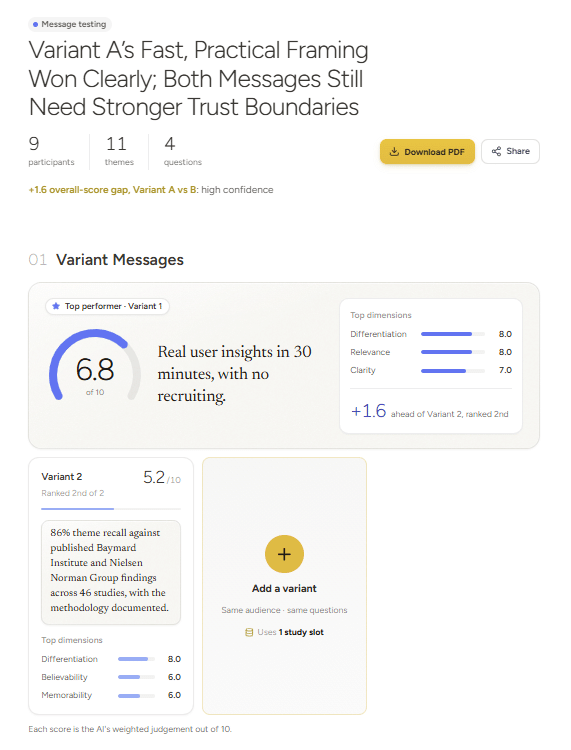
For expansion, the lesson is to score clarity and believability separately. A claim can be the clearer pitch and the less trusted one at once, and asking which message “wins” hides that.
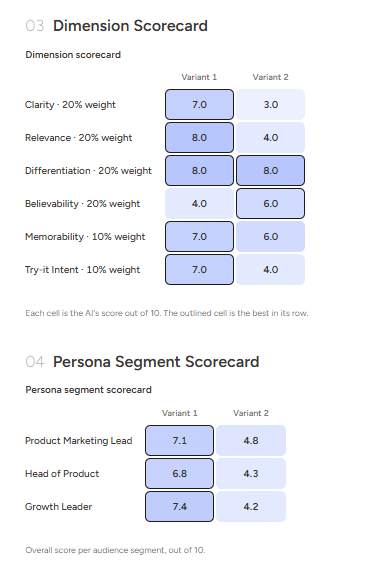
The limits matter here. The study ran as one pool of nine personas, not market by market, so it says nothing about whether proof-led framing wins in Germany or Brazil. Nine personas is also directional, not conclusive. To test the regional question, run the same two messages per market, then confirm with a few human interviews in your top region.
What tools research market entry?
Market entry research draws on seven kinds of tools, and they differ most in cost and in how much cultural depth they give. Costs are indicative; the panel, agency, and synthetic figures come from Articos’s own published benchmarks.
| Method | What it answers | Typical cost per market | Time |
|---|---|---|---|
| Your analytics and CRM | Where demand already exists | Staff time | Days |
| Search-trend tools | Whether buyers search for the category | Free tools exist (Google Trends) | Days |
| Desk research (public statistics, analyst reports) | Market size and local rules | Free to paid, varies by source | Days to weeks |
| Competitor research | Who the buyer compares you with | Staff time | Days to weeks |
| Translated survey or global panel | A quantitative read once direction is set | Roughly $3,500 to $15,000 | 1 to 4 weeks |
| Local research agency | Deep buyer and cultural insight | Roughly $25,000 to $75,000+ | 6 to 12 weeks |
| Synthetic user research | Early buyer and message read | $8–$10 per study on Articos | Under 30 minutes |
Competitor work deserves its own pass; our guides to competitor research and primary vs. secondary research help you decide which rows to buy and which to skip.
Can synthetic research be trusted for market entry?
Synthetic research works as a fast filter for shortlisting markets and testing messages. It should not be the last check before a large commitment. Articos reports 86% theme recall against published Baymard Institute and Nielsen Norman Group findings across 46 studies in 9 domains. That figure comes from the company’s own methodology, not an outside audit, and it measures usability and consumer-research themes, not market-entry outcomes.
In practice, run the same positioning past synthetic buyers for five candidate markets on an AI user research platform, rank the reactions, and take the top two to human research. A concept testing platform fits the step where you compare framings market by market.
Skip it where rules govern the sale. Regulated categories such as healthcare software often need documented human research, and final pricing or legal decisions need real buyers.
What’s the cheapest or free option for market entry research?
The cheapest option is the data you already own. Pull signups, traffic, and closed-lost notes by country, then read ten sales or support calls from each candidate region. That costs staff time only. Add free public sources: search-trend tools such as Google Trends, national statistics offices, and what competitors publish locally, including pricing pages, case studies, and job postings.
Free options have limits. Your own data covers only buyers who already found you, so it over-represents your current positioning, and self-run polls attract people who already like your brand. These sources show where to look. Whether to go needs a buyer’s answer, so before a claim carries real budget, pair them with a paid test, as in our guide to pre-launch validation.
Should you combine synthetic and human research instead of picking one?
Combine them. Each catches failures the other misses. Synthetic runs narrow many markets or messages quickly. Human interviews add qualitative depth and catch what a model can’t: the objection raised mid-call, a hesitation, an unexpected follow-up, or a respondent telling a vendor what it wants to hear.
A workable split: run every candidate market through synthetic testing, rank by opportunity and risk, then recruit around ten buyers in your top two markets. Participant recruitment platforms such as User Interviews handle the sourcing, and Articos’s comparison with User Interviews lays out where each approach fits. The ten-buyer figure is a starting heuristic; raise it if the decision is expensive to reverse.
How much does market-entry research cost, and how do you start?
A first pass across three markets costs staff time plus roughly $24 to $30 in synthetic studies, assuming one study per market at $8–$10. A single local agency study runs about $25,000 to $75,000+ per market, based on Articos’s published ranges.
Start this week. Rank countries by demand using your own data. Run your home positioning past 5 to 10 buyers in each of the top two. Write kill criteria before you see results, for example “fewer than 3 of 10 buyers can restate our value in their own words.” That threshold is an example; set yours from your home-market baseline. Spend agency money only on the markets that survive, and fold the findings into your go-to-market plan.