Emotions in B2B Buying: How They Shape Purchase Decisions
Do emotions factor in B2B buying? Lets find out.

You send the buying committee a clean ROI case. The numbers hold up, nobody argues with them, and the deal stalls anyway.
Emotions in B2B buying are the fears, hopes, and reputation concerns a buyer carries into a purchase decision, and they work alongside price and features. When two vendors look equal on paper, the one that feels safer to choose often has the edge.
This article covers the evidence, how emotion drives a business purchase, why logical pitches fail, and how to test the emotional side of a pitch before it reaches a real committee.
Are B2B decisions emotional or rational?
B2B buying behavior has two layers: rational criteria get a vendor onto the shortlist, and personal factors help decide who wins from it. Bain studied three decades of customer research and sorted B2B purchase criteria into 40 “elements of value” in five categories: table stakes, functional, ease of doing business, individual, and inspirational. In its 2018 Harvard Business Review article, Bain describes price, specifications, and compliance as table stakes, and says subjective concerns such as protecting a buyer’s reputation or reducing anxiety carry real weight as offerings become commoditized.
The neuroscience points the same direction. In Descartes’ Error (1994), Antonio Damasio described patients with prefrontal damage who kept their intelligence but struggled to make sound everyday decisions. He argued that emotion is part of reasoning. His somatic marker hypothesis is still debated, so read it as supporting context, not proof about B2B. The structural differences between business and consumer buyers are covered in our B2B vs B2C research comparison.
Is there evidence emotion affects B2B buying?
Yes, and the largest dataset comes from Google and CEB. In 2013, working with research firm Motista, they surveyed 3,000 purchasers of 36 B2B brands. Seven of the nine B2B brands they studied had emotional connections above 50%, while most consumer brands Motista had studied sat between 10% and 40%. Buyers who saw personal value in a purchase, such as career advancement or confidence in their choice, were almost 50% more likely to buy and 8 times more likely to pay a premium for comparable products. The full report is Google and CEB’s From Promotion to Emotion study.
| Source | Sample | Finding |
|---|---|---|
| Google, CEB, Motista (2013) | 3,000 purchasers, 36 B2B brands | Almost 50% more likely to buy with personal value; 8x more likely to pay a premium |
| Bain (2018) | Three decades of customer studies | 40 elements of value; subjective tiers matter more as products commoditize |
| Gartner (2025) | 632 B2B buyers, Aug to Sep 2024 | 74% of buying teams show unhealthy conflict |
| Gartner buyer research | Survey of 250+ B2B customers | 77% call their latest purchase very complex or difficult |
| Forrester (2026) | 2025 Buyers’ Journey Survey | 13 internal stakeholders and 9 external participants per purchase, on average |
The Google and CEB study is over a decade old and surveyed purchasers of brands they already used, so it shows emotional connection after the sale more than mid-evaluation feeling.
How does emotion drive B2B buying?
Personal risk is the main driver. A consumer who picks a bad blender loses an afternoon. A buyer who champions the wrong platform answers for it in front of the CFO, and Google and CEB noted that a multi-million-dollar software purchase gone wrong can cost someone a job. That risk produces predictable feelings: worry about being blamed, pride in a smart pick, a wish to look competent to colleagues. This is the core of B2B buyer psychology.
The buying committee amplifies it. Gartner’s 2024 survey found groups of 5 to 16 people across as many as four functions, and 74% of them showed unhealthy conflict: clashing goals, disagreement, or being overruled by outside decision-makers. Groups that reach consensus were 2.5 times more likely to report a high-quality deal. Forrester’s 2026 report puts the average at 13 internal stakeholders plus 9 external participants.
Each role tends to carry a different worry. Treat the table below as hypotheses to test with buyers, not findings.
| Role | Likely worry | What may reassure them |
|---|---|---|
| Economic buyer | Wasted budget, being blamed | Evidence trail, references |
| Technical evaluator | Integration and security fallout | Documentation, direct answers |
| End user | A tool that slows daily work | Trial or demo |
| Procurement | Lock-in, renewal terms | Clear contract terms |
Mapping these roles is audience research work. B2B market segmentation splits a committee into researchable groups, and psychographic segmentation covers motivations and fears.
Why do logical B2B pitches fail?
Logical pitches fail because the business case is the minimum, and every competitor submits one. In the Google and CEB data, perceived business value barely differed between leading brands in the same industry, and only 14% of business decision makers said they’d pay a premium for any supplier difference. A pitch built on ROI and features gives a committee nothing to separate you.
Aiming a pitch at one person can also split the group. Gartner found that content tailored to individual-level relevance had a 59% negative impact on buying group consensus, while content tailored to the group’s shared interests had a 20% positive impact. Personal value still matters; the emotional case has to work for the whole committee.
Emotional marketing in B2B means naming a specific fear, such as being blamed for a failed rollout, and showing how the purchase removes it. That belongs in your B2B brand positioning, not in a slogan.
What revives a stalled B2B deal?
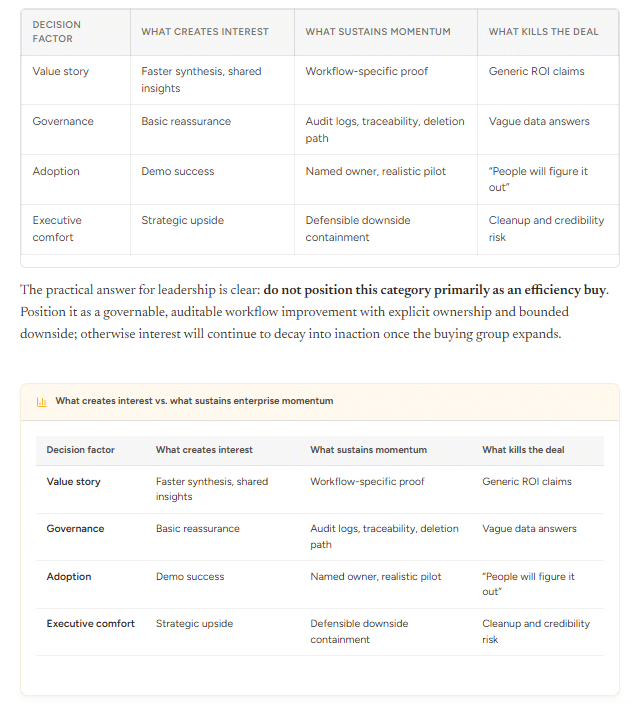
Defensibility revives it, more than speed or ROI. We tested this in Articos with 6 synthetic B2B software buyers at US companies of 200 to 5,000 employees, all weighing an AI user research platform after a stalled purchase. Speed-led and feature-led messaging still created early interest, but it didn’t restart a stalled deal. Momentum stalled on unresolved exposure: unclear ownership, weak data-handling proof, verification burden, and adoption risk.
The report split each decision factor into three columns. Interest came from faster synthesis and shared insights. Momentum came from audit logs, a named owner, and a realistic pilot. Deals died on generic ROI claims, vague data answers, and “people will figure it out.”
An earlier study for our guide to buyer journey mapping found the same pattern: “trust and provenance” was the top hesitation driver, tagged 10 times. Six simulated buyers is a small panel, so treat both results as hypotheses to check with real buyers. They match the Google and CEB data: risk comes first, price second.
What tools research buyer emotion?
Four methods cover most needs, and each has a different cost and blind spot. Interviews and call reviews show what real buyers said. Panels and synthetic personas let you test a message before it goes out, so the right pick depends on the job: diagnosing a lost deal or testing a new pitch.
| Method | What it surfaces | Cost and speed | Limit |
|---|---|---|---|
| Buyer interviews | Fears and wording, in buyers’ own words | Recruiting and scheduling time, often weeks | Small samples; politeness bias |
| Win-loss and sales-call review | Why deals stalled | Free if you own the recordings | Covers only deals you already reached |
| Panel message testing (Wynter) | Scored reactions from verified B2B professionals | Pro plan $20,000 a year for 20,000 credits; results in 12 to 48 hours | Priced per test, which discourages repeat rounds |
| Synthetic user research (Articos) | Persona reactions, objections, follow-up answers | $79 or $199 a month; under 30 minutes a study | Simulated buyers, not named humans |
Articos builds role-specific synthetic personas, interviews them, and returns a report. It reports 86% theme recall against published Baymard Institute and Nielsen Norman Group findings across 46 studies. Live Calls, added in September 2026, let you hold a real-time voice conversation with any persona on your panel, so you can ask what made them hesitate while the objection is fresh. Talk to Research does the same in writing.
For a panel-based option built on real respondents, see the Articos vs Wynter comparison.
What’s the cheapest or free option?
The free option is what you already own. Call recordings, lost-deal notes, support tickets, and your own customer interviews cost time, not cash, and they show where real buyers hesitated. They can’t test a message you haven’t sent yet.
The cheapest paid option for fresh research is a trial. Articos gives 14 days and 900 credits, around two full studies, with no credit card. Paid plans start at $29 a month (Lite), $79 a month (Starter) and $199 a month (Pro). A study uses about 400 credits, which works out to roughly $8 to $10 a study on a monthly plan. Bonus credits currently apply under a launch offer, so check the pricing page before you budget.
By comparison, Wynter’s Pro plan is $20,000 a year.
Should I combine synthetic and human research, not choose one?
Combine them. Synthetic research is cheap enough to test every message and committee role in an afternoon. Human interviews should go to the few decisions where being wrong is expensive or hard to reverse, such as a pricing change or a repositioning.
Run the synthetic round first to find the two or three objections worth a real conversation, then spend interview time on those. A concept testing platform works well for comparing two positioning directions before you commit to either.
Skip the synthetic-only route when a procurement or regulated process requires named human respondents, or when you need quarterly brand tracking from the same panel. Synthetic personas model how a buyer with certain traits would talk about risk. They don’t feel it, and 86% recall means some themes experts found still get missed.
How do I test the emotional side of a pitch before the next deal?
Pick one deal that stalled and write down the fear you suspect, such as “I’ll be blamed if this integration fails.” Write two versions of your core message: one that leads with ROI and one that leads with removing that fear.
Run both through a role-by-role panel, and read the objections before you read the scores. Message testing explains how to structure the comparison, and a messaging testing platform runs it in under 30 minutes. Then take the winning objection to two or three real buyers and ask what they’d need to see to feel safe signing. Their wording is worth more than any score, because it gives your sales team language to reuse in the next pitch.
The 14-day trial covers this: 900 credits is enough for two studies, one per message version.