
Day 1 Shortlist: What B2B Brands Miss and How to Get On It
How to make the most of day 1 shortlists in a B2B context?

Your team loses a deal in the final round, and the post-mortem blames price. Often the deal was decided months earlier, when the buyer wrote down the vendors worth a call and your name wasn’t on the list. That list is the day 1 shortlist: the vendors a buyer already has in mind when a purchase begins.
Google and Bain’s 2022 study of 1,208 U.S. B2B buyers found that 92% buy from it. This article covers how those lists form, why brands miss them, what gets a name onto one, and which methods can test the parts you control. One limit up front: no tool can confirm whether a specific buyer has you on their list. A few can show where you’re weak.
What is a day 1 shortlist?
A day 1 shortlist is the group of vendors a B2B buyer has in mind before the formal buying process starts. Bain calls it the Day 1 list. Google and Bain’s 2022 B2B Discovery to Devotion study found that 86% of buyers have one and 92% purchase from it. The list can change, though: in that same study, most buyers added at least one supplier after more research.
Other studies point the same way. Forrester’s 2024 Buyers’ Journey Survey found that 41% of buyers have a single preferred vendor before formal evaluation begins, and Forrester calls B2B buying a process of confirmation. 6sense’s 2024 Buyer Experience Report found that 81% of buyers already have a preferred vendor at first contact with a seller.
| Statistic | Source | Study details |
|---|---|---|
| 86% of buyers have a Day One list; 92% purchase from it | Google and Bain | B2B Discovery to Devotion, U.S., 2022, n=1,208 |
| About 90% purchase from the Day 1 list (as cited by Bain); hidden buyers hold about half the influence over it | Bain and LinkedIn | Bain brief, June 2026; accompanying NewtonX survey of 750 buyers (February 2026) covered two enterprise software sectors |
| 41% have one preferred vendor before formal evaluation | Forrester | 2024 Buyers’ Journey Survey |
| 81% have a preferred vendor at first seller contact | 6sense | 2024 Buyer Experience Report |
| 17% of buying time is spent meeting suppliers | Gartner | Survey of 750 buyers in complex purchases, reported as early as 2018 |
These are buyer surveys, so they carry recall bias and modest sample sizes. They show association. They cannot prove that list membership causes wins.
Why do we never get shortlisted?
Brands miss the list because buyers never ran into them before the purchase began. Bain’s June 2026 brief says most seemingly lost deals were never winnable, because the vendor was not on the buyer’s initial shortlist to begin with.
Three gaps explain most misses. The first is the buying committee. Bain and LinkedIn found that hidden buyers in procurement, finance, and IT hold about half the influence over the Day 1 list, and they rely more heavily on brand reputation and risk mitigation. The second is time. Gartner found that buyers spend 17% of their buying time meeting with suppliers, about 5% per supplier when three are in the running. The third is measurement. In Wynter’s survey of 100 marketing leaders at B2B SaaS companies with $50M+ in revenue, 52% did not measure brand impact at all and only 13% ran brand tracking surveys.
When a single category leader dominates your market, the work looks different. Our guide to positioning against a market leader covers that case.
How are B2B shortlists formed?
B2B vendor shortlists form through accumulated exposure and past experience. 6sense found that more than 90% of buyers had prior experience with at least one vendor they considered. Google and Bain found that 69% of B2B research happens online, with an average of 40 touchpoints per buyer and more than 670 opportunities to influence the decision. Vendor websites were the second-largest source buyers used.
The list that results is a consideration set built from every impression a buyer picked up along the way, mostly outside your sales process. A map of the buyer journey shows where those impressions happen. Our guide to B2B buyer journey mapping walks through building one.
Day one shortlist or RFP process: which decides the deal?
The day one shortlist decides who gets into the RFP process, so the two run in sequence. Bain’s view is that a vendor off the Day 1 list is effectively out of the running, and Forrester advises vendors to become the category leader in buyers’ minds before the RFP arrives.
Formal processes are shrinking, too. In the employee benefits market, Shortlister reports that the average number of vendors invited to an RFP fell from 18.5 in 2022 to 5.6 in 2026. That covers one industry, so treat it as a signal. Some teams respond by tracking RFP invitations as their brand metric: one marketing leader in Wynter’s survey described their ROI case as brand lift leading to more RFP invites, which lead to more opportunities.
What gets a brand onto a shortlist?
Familiarity comes first, then a clear and credible reason to be considered. For vendors missing the list, Bain recommends strengthening category fame and activating social proof through customer validation, partner advocacy, references, and third-party endorsement. Once a vendor is on the list, Bain says the win depends on buyer confidence in five areas: meeting current and future needs, value relative to total cost, being a safe choice the organization can defend, confidence in implementation, and ease of working with the vendor.
Positioning and messaging are the parts a team controls most directly. A sharp B2B brand positioning statement gives buyers one thing to remember, and a messaging framework turns it into copy a procurement lead and a product owner can both repeat. Message testing then shows whether that copy reads clearly before it ships.
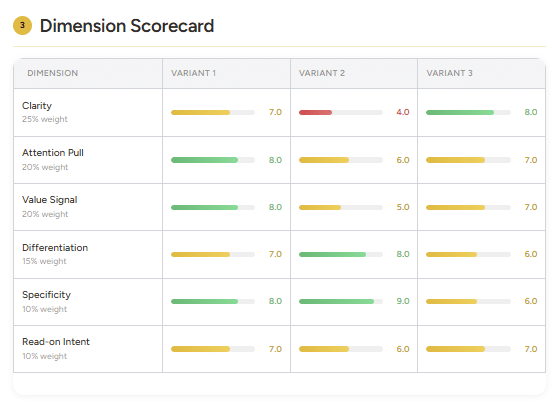
We ran that check on ourselves with Articos’s messaging testing platform. We tested three homepage taglines against 12 synthetic B2B buyers: two each of VP Marketing, Product Marketing Director, Growth Leader, Demand Gen Director, UX Research Lead, and SaaS Founder, with skeptics and blockers included. The speed line, “User research in under 30 minutes, with no participant recruiting,” scored 7.5 out of 10. The shortlist line, “Test your messaging before it ships, so buyers put you on their shortlist,” scored 7.0 and led on clarity, 8 to 7. The validation line, “Synthetic user research validated against Baymard Institute and Nielsen Norman Group findings across 46 studies,” scored 5.9. Its clarity was 4, but it had the highest specificity (9) and differentiation (8) scores.
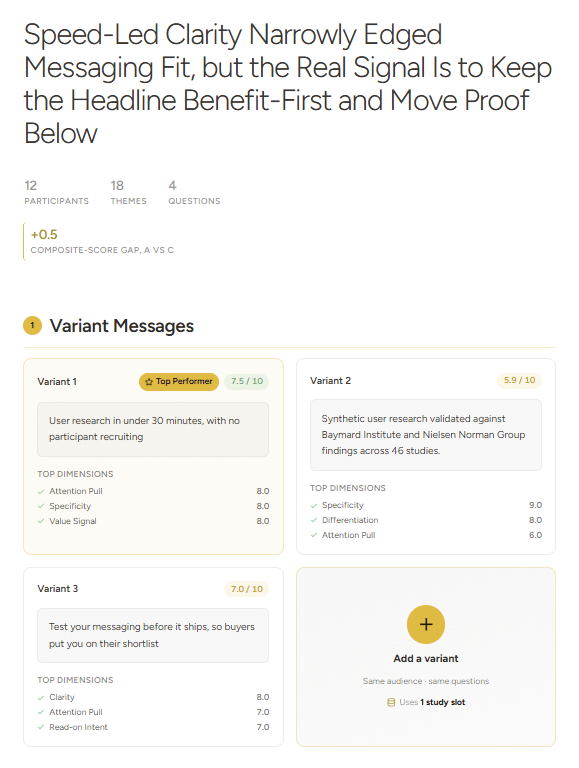
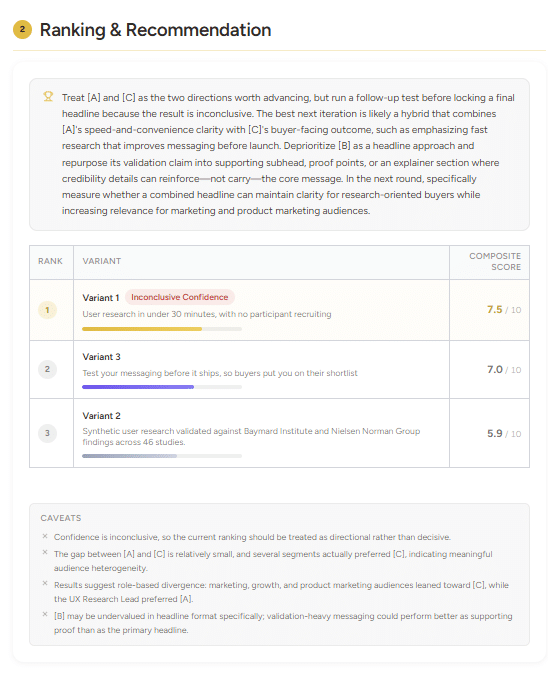
The report marked its own result inconclusive. The gap between first and second place was 0.5 points. Marketing, growth, and product marketing personas leaned toward the shortlist line, and the UX Research Lead preferred the speed line. The report recommended a hybrid headline that keeps the speed claim and adds the buyer-facing outcome, with the validation claim moved to a supporting line. Twelve synthetic personas is a small panel, so treat this as a direction to confirm with real buyers. The study tests language. It can’t tell you whether a given buyer’s list includes you.
What tools research shortlists?
No single tool measures shortlist membership, so teams combine methods. The table compares five.
| Method | What it shows | Main limit | Respondents |
|---|---|---|---|
| Win/loss analysis (qualitative interviews) | Whether you were on the initial list, who else was, and why you lost | Small samples; only covers deals that reached you | Recent buyers |
| Brand tracking surveys (Wynter sells one for B2B) | Awareness, consideration, and preference over time | Cost and panel recruitment | Human panel |
| Short buyer-committee survey (Bain’s Likelihood to Buy approach, about 10 questions) | Which brands made the Day 1 list and which one won | Needs recent buyers; Bain tested it in two enterprise software sectors | Recent buyers |
| Share-of-search tracking | Search interest in your brand versus rivals | Shows what people search for, not whether they would consider you | Search data |
| Synthetic message and concept testing | Whether positioning and copy read clearly and hold up against skeptics before launch | Does not measure real awareness or list membership | Synthetic personas |
Wynter’s article reports that companies succeeding at brand measurement ask whether the vendor was on the buyer’s initial shortlist during win/loss analysis. That question works best inside a structured voice of customer program. Panel-based brand tracking is where Wynter is strong, and Articos says so on its own comparison page. If you’re weighing the two for message and concept testing, see Articos vs. Wynter. The synthetic row refers to Articos’s AI user research workflow, which interviews personas matched to your target buyer.
What’s the cheapest or free option?
Reviewing your own win/loss notes and calling a handful of recent buyers costs nothing but time. Three free moves cover most of the value:
- Add “Were we on your initial list, and who else was?” to every win/loss call.
- Ask five recent customers which vendors they had in mind before they started looking.
- Count RFP and demo invitations by quarter, and note which came from buyers who already knew you.
For a paid test, Articos’s current pricing (checked October 2026) starts with a 14-day free trial that includes 900 credits, about two studies, with no credit card. One study costs roughly 400 credits, and top-up credit packs are available. Starter is $79 per month for 3,000 credits (about 7 studies). Pro is $199 per month for 8,000 credits (about 20 studies) and adds white-label reports. Both plans currently carry launch-bonus credits. Free methods give directional signal from a few people, so pair them with a paid test when a decision carries budget.
Should I combine synthetic and human research, not choose one?
Yes. Human research and synthetic research answer different questions. Synthetic user research uses AI-generated personas in place of recruited participants. It can tell you, before launch, whether your positioning and copy read clearly and hold up against skeptical personas. Human research tells you whether real buyers list you and choose you.
A workable sequence starts with a synthetic panel to remove weak variants. Then take the survivors to real buyers through win/loss calls or a brand tracking survey, and feed what you learn into the next round. When a persona raises an objection you don’t understand, Live Calls let you hold a real-time voice conversation with that persona at any point in a study. It probes the objection faster, and the respondent is still simulated.
Synthetic research has limits. An 86% recall rate leaves about 14% of expert findings unmatched. Articos also states on its Wynter comparison page that longitudinal brand tracking, and deliverables that require named human respondents, belong with a human panel. For testing ideas before launch, a concept testing platform fits. To learn where you stand with real buyers, ask real buyers.
What should you do first?
Start by finding out how many of your lost deals never had you on the list. This month, add the initial-list question to every win/loss call and count the deals that never reached an RFP. Next, pick the positioning statement your team uses most and test it before the next campaign launches. Then choose one measurement method from the table above and repeat it on a schedule: Wynter reports that companies succeeding at brand measurement run tracking every 6 to 12 months. Our B2B brand positioning guide covers how to build and validate the statement itself.


