Customer-First Pricing: How to Build a Pricing Strategy Around Customer Value
Customer first pricing sets prices from the value buyers receive; here is how it compares with cost-plus and how to test it.


A prospect opens your pricing page, scrolls, and closes the tab with some version of “that seems like a lot.” Customer first pricing is built for that moment. It sets price from the value customers receive and the amount they consider fair, then checks the result against your costs and your market. This guide covers what the approach involves, how it compares with cost-based pricing, why buyers decide a price is unfair, and which research methods tell you where your number should land.
What is customer first pricing?
Customer first pricing is a method of setting prices from the value customers receive and the amount they consider fair, with costs acting as a floor. It is closely related to value-based pricing, and the two terms are often used interchangeably.
In a Product Marketing Alliance article, Jameelah Calhoun describes four steps: assess who needs the product and who benefits from it, define the unit you charge for, map the customer journey from consideration to loyalty, and look for buyer biases before launch. The first step carries a useful warning. Many health apps are free to patients because insurers pay for them, so the person using the product is sometimes not the person paying. A team that prices for the user when the insurer is the buyer misses the real source of revenue.
Customer first or cost based pricing?
Customer first pricing starts from what the buyer gets, and cost-based pricing starts from what the product costs you. Cost-plus pricing adds a fixed markup to unit cost, which is simple to run but ignores how much value each customer receives. Competitor-based pricing, the third common approach, sets prices by watching rivals. It is quick, but it inherits whatever mistakes the rival made. Most teams end up with a hybrid: cost sets the minimum, and customer value sets the price above it. The table compares all three.
| Approach | Starting point | Main risk | Fits best when |
|---|---|---|---|
| Cost-based (cost-plus) | Unit cost plus a markup | Prices come out too low for high-value customers and too high for low-value ones | Products with little differentiation in a competitive market |
| Competitor-based | Rival price lists | Copies a rival’s pricing mistakes | Near-identical products in a crowded category |
| Customer first (value-based) | Value and fairness as the buyer sees them | Needs research and a way to measure value | Differentiated products with distinct customer segments |
Simon-Kucher notes that cost-plus can still make sense in highly competitive markets with little product differentiation. Everywhere else, a clear value proposition gives buyers a reason to accept a price above the cost-plus number.
How do you build a customer first pricing strategy?
Build it in five steps, ordered so that research comes before the price does.
- Segment your buyers. Different buyers value different things, so start with an ideal customer profile for each segment.
- Choose the value unit. Charge per feature, per unit of usage, or for an added service, whichever lines up with the moment a customer feels the benefit.
- Interview customers about what they value and what makes them hesitate, using their own words.
- Measure willingness to pay with a pricing survey, covered in the tools section below, and compare the answers by segment.
- Set a cost floor, then test two or three candidate prices on live traffic. Revisit the result as customer perception and market conditions shift.
Why do customers think our price is unfair?
Customers compare any price with a reference point, usually the last price they paid or saw, and they call it unfair when a change or a gap has no visible reason. The classic evidence is a 1986 telephone-survey study by Daniel Kahneman, Jack Knetsch and Richard Thaler in the American Economic Review. A hardware store raises the price of snow shovels from $15 to $20 the morning after a storm, and about 82% of respondents rated that unfair or very unfair. They read it as the store taking advantage of its position.
Software buyers react the same way when a plan rises with nothing new attached or when a limit appears that wasn’t there before. To find out which is happening to you, search cancellation notes and sales-call transcripts for the word “expensive” and see what it was attached to. If you do have to raise prices, price increase messaging covers how to word the change so the added value is visible.
Does value pricing increase revenue?
It can, and price is the strongest profit lever in the best-known analysis. A 1992 Harvard Business Review article by Michael Marn and Robert Rosiello, based on average economics across 2,463 companies, calculated that a 1% price improvement with no loss of volume raises operating profit by 11.1%. A 1% gain in volume raised it by 3.3%.
The catch is the clause “no loss of volume.” Value-based pricing is the attempt to earn a higher price without losing buyers, so the gain depends on how closely your price tracks the value customers perceive. Consultancies that sell pricing work, including Simon-Kucher, report higher margins from value-based pricing than from cost-plus. Treat those claims as directional, since the firms sell the service. To measure the effect in your own business, run a controlled A/B test on pricing and compare revenue per visitor alongside conversion rate.
What tools support value based pricing?
Six methods support value-based pricing, and each answers a different question.
| Method | Question it answers | Best stage | Main limit |
|---|---|---|---|
| Van Westendorp Price Sensitivity Meter | Which prices feel too cheap and which feel too expensive | New product with no known price | Ignores competitor prices |
| Gabor-Granger | How purchase likelihood changes at preset prices | Existing product with a known range | Tests one product at a time |
| Conjoint analysis | How much buyers value each feature against price | Packaging and tier design | Complex to set up and needs segmented data |
| Live A/B price test | What buyers actually do at each price | Final shortlist of prices | Needs enough traffic |
| Customer interviews | Why buyers react to a price | Discovery | Slow, with recruitment and scheduling |
| Synthetic persona interviews | How buyer types react to a price framing and which objections surface | Before a human study | Directional only |
Asking “how much would you pay?” directly is a weak method because people struggle to estimate their own willingness to pay. Dutch economist Peter van Westendorp built the meter that maps an acceptable price range. British economists Andre Gabor and Clive Granger built the technique that traces a demand curve.
For the interview layer, Articos runs concept testing with synthetic personas. You describe the offer and the audience, each persona is interviewed independently without seeing your hypothesis, and a report comes back with evidence chains. Afterward, Talk to Research lets you ask a persona written follow-ups, such as what made it hesitate on the price, and Live Calls adds real-time voice conversations with any persona on your panel. Both draw on the credits in your plan. Synthetic personas can show how buyer types react to a price and where objections come from. They can’t tell you what share of visitors will pay at checkout, so confirm any number with a survey or a live test.
We ran this test on our own pricing
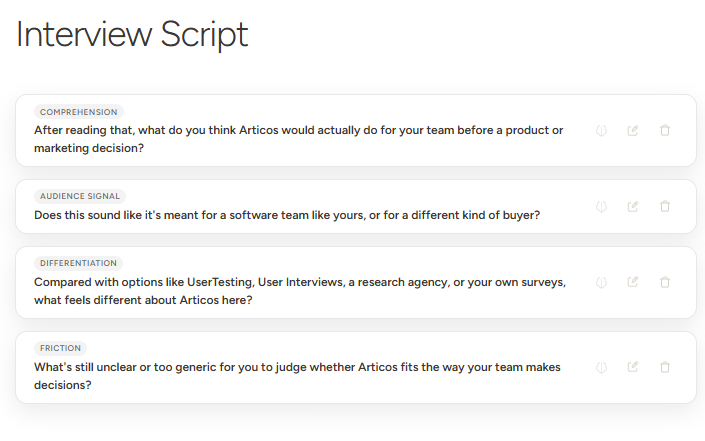
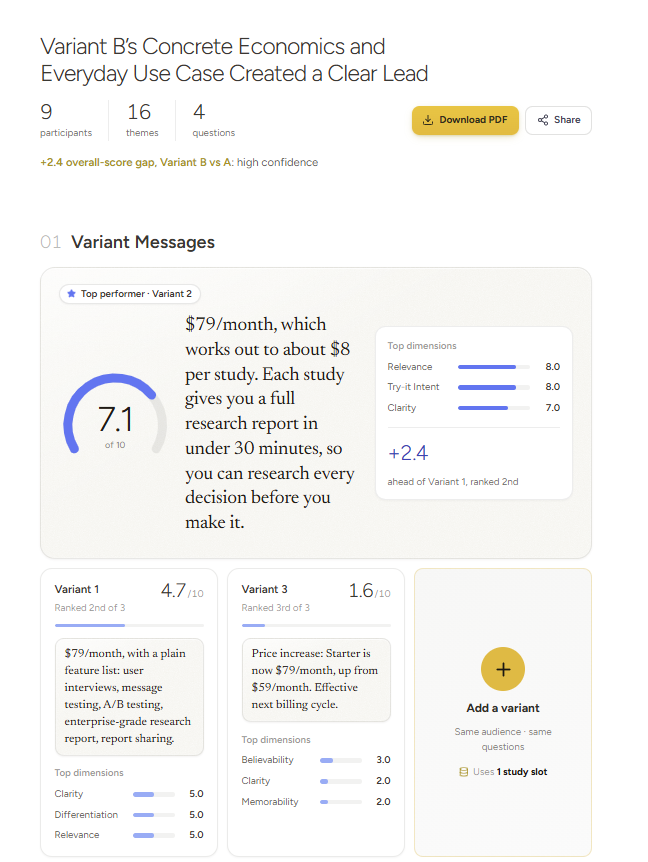
To see how this works, we tested our own Starter price. We wrote three versions of the same $79/month offer and ran them as a value proposition test in Articos with 9 simulated participants: US founders, product managers and marketing leads at software companies with 5 to 200 employees. Variant 1 listed the features. Variant 2 framed the price as about $8 per study, with a full report in under 30 minutes. Variant 3 announced an increase from $59 to $79 and said nothing else. Each participant answered the same four questions on comprehension, audience fit, differentiation and friction.
Variant 2 scored 7.1 out of 10, ahead of Variant 1 at 4.7 and Variant 3 at 1.6. Articos rated the 2.4-point gap between the top two as high confidence. Variant 2 scored 8.0 on both relevance and try-it intent, while Variant 3 scored 3.0 on believability and 2.0 on clarity.
Participants read Variant 2 as a quick check before a decision. One founder persona put it this way: “The obvious difference is speed and low friction.” The same persona named the weak spot: “I still don’t know who or what is behind the ‘research report’.” Nobody could tell whether the findings came from real people, a panel or AI, so a per-use price works best with a plain line on what produces the result.
Read this as direction, not proof. The participants are simulated, nine is a small panel, and Variant 3 changed two things at once: it announced an increase and it gave no reason to value the product. What the test shows is that an unexplained increase tells a new visitor nothing, which fits the Kahneman finding that price changes without a visible reason read badly. It does not show how many real visitors would pay. For that, run the finalists in a live price test.
What’s the cheapest or free option for pricing research?
The cheapest option is a short survey to your existing customers, which costs only the time to write and send it. The limits are real: people who already paid skew toward accepting your price, and a small sample is noisy, so read sample size for user research before you trust a number from 12 replies. Sales-call notes and lost-deal reasons in your CRM add free signal.
For a paid option, Articos offers a 14-day free trial with 900 credits, about two full studies, and no credit card. Paid plans start at $29 a month (Lite), $79 a month (Starter), and Articos lists about $8 to $10 per study during its launch period. Pro is $199 a month and adds white-label reports. If you are weighing a participant-panel platform instead, the Articos vs UserTesting page lays out the differences.
Should you combine synthetic and human research?
Yes. Synthetic research narrows the options fast, and human research confirms the number before you commit. A workable sequence:
- Run synthetic interviews to compare price framings and surface objections.
- Take the strongest two or three candidates to real customers in a Van Westendorp or Gabor-Granger survey.
- Put the finalists in a live price test.
Skip the synthetic layer and use real people only when the decision depends on actual checkout behavior or on a market where you have no data on how buyers decide. For background on how simulated buyers are built and where they fall short, see synthetic consumers. For the wider testing framework this sits inside, the guide to what concept testing is is the place to start.