How to Run Cross-Market Concept Testing: A Step-by-Step Guide
Cross-Market Concept Testing explained with real example.


You’ve validated a concept at home. Now three stakeholders want to know if it holds up in Germany, Brazil, and Japan before anyone commits budget to a launch. This is where a lot of cross-market concept testing goes wrong.
Teams translate the same survey into three languages, run it, and call the result “validated.” It isn’t. A question that reads as direct and helpful in the US can read as pushy in Japan. A price point that feels premium in the UK can feel routine in the UAE. Translating words is not the same as translating the assumptions behind a concept, and global concept testing done well accounts for both.
This guide covers the actual steps: how to structure a testing plan across markets, what changes between testing one market and testing five, and where synthetic and human research each earn their place.
Cross-market concept testing: choosing the right approach and what it costs
Before picking a method, it helps to see the trade-offs side by side. Speed, cost, and cultural depth move in different directions depending on the approach, and most multi-market testing programs (also called multi-country testing) end up blending two or three of these rather than picking just one.
| Approach | Speed per market | Typical cost per market | Cultural depth | Best for |
|---|---|---|---|---|
| Translated single survey | 1-2 weeks | Roughly $5,000-$15,000 | Low, assumes shared reference points | Quick pricing checks in culturally similar markets |
| Local research agency | 6-12 weeks | Roughly $25,000-$75,000+ | High, native researchers, local panels, and focus groups | Regulated categories, high-stakes launches |
| Global panel platform with country add-ons | 2-4 weeks | Roughly $3,500-$10,000 | Medium, panel quality and response bias vary by country | Quant validation after qualitative direction is set |
| Culturally-calibrated synthetic testing, such as Articos’s AI user research platform | Under 1 hour per market | $7–$10 per study | Medium-high, built on a cultural dimensions framework, not guesswork | Early-stage direction-setting before a big spend |
None of these fully replaces the others. A synthetic pass tells you where to look closer. An agency engagement tells you whether to ship.
How do you test a product concept in multiple markets?
Testing a concept across markets works as a staged process: lock the concept, translate the assumptions rather than just the words, run markets in parallel, then compare results against per-market benchmarks instead of a single global average.
- Lock the concept before you localize anything. If the core value proposition is still moving, every market test you run gets thrown out the moment it changes.
- Separate word translation from assumption translation. A feature framed as “saves you time” assumes time scarcity is the primary pain point. That assumption may not hold in a market where the bigger friction is trust, not speed. This is also where message and positioning testing earns its place alongside concept testing, since the concept and the way you frame it are two separate things to validate.
- Run markets in parallel, not one after another. Sequential testing means your later markets get tested against a concept that’s already drifted based on earlier feedback.
- Use the same question set and scoring criteria everywhere. Consistency is what makes cross-market comparison possible. Changing the instrument between markets breaks the comparison.
- Score against per-market benchmarks, not a shared global average. A 6 out of 10 purchase-intent score might be strong in a market where 5 is typical and weak in a market where 8 is typical.
- Watch for response bias by market. Some cultures skew toward agreeable middle-of-scale answers, others toward extremes. A raw score comparison across markets without accounting for this pattern will mislead you.
What we found when we ran this test ourselves
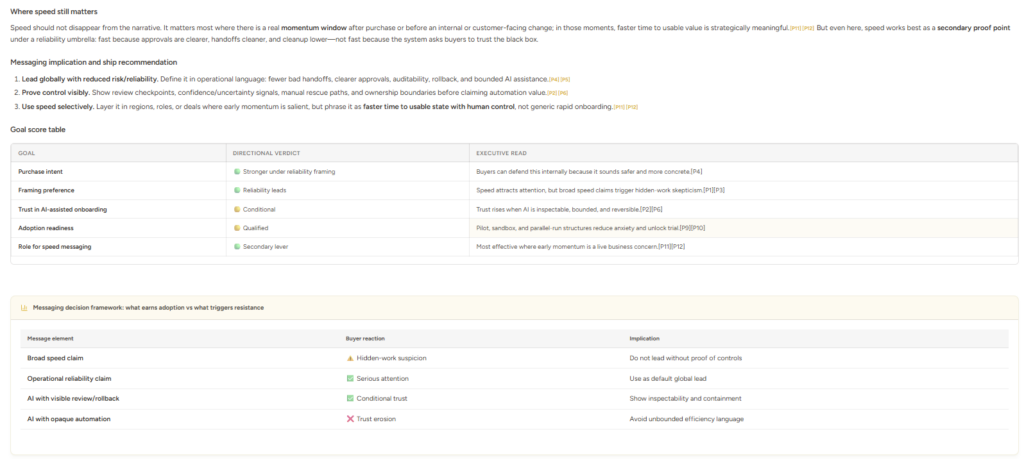
To see this play out, we ran the exact scenario from step 2 through Articos: a B2B SaaS onboarding feature that auto-configures a new user’s workspace instead of making them set it up manually. We tested two framings of the same feature, not two different features, with founders, PMs, and ops leads at 10-200 person companies across five markets (US, Germany, Japan, Brazil, UAE). Framing A led with speed. Framing B led with reliability and reduced risk.
Reliability won, clearly, across the 9-participant panel. Buyers didn’t dislike speed. They distrusted unqualified speed claims and translated them into a specific fear: “Based on past experience, a speed message makes me look for what has been skipped, deferred, or pushed onto my team later.” Reliability messaging only earned trust when it got specific about mechanics, not when it just sounded reassuring: “If it’s positioned as assistance, I want to see the human control points clearly.” The interviews surfaced a four-step trust ladder for AI-assisted features: draft or suggest, review and approve, limited rollout, then expand usage. Skip straight to full automation without visible checkpoints in between, and trust drops fast, regardless of how fast the feature actually is.
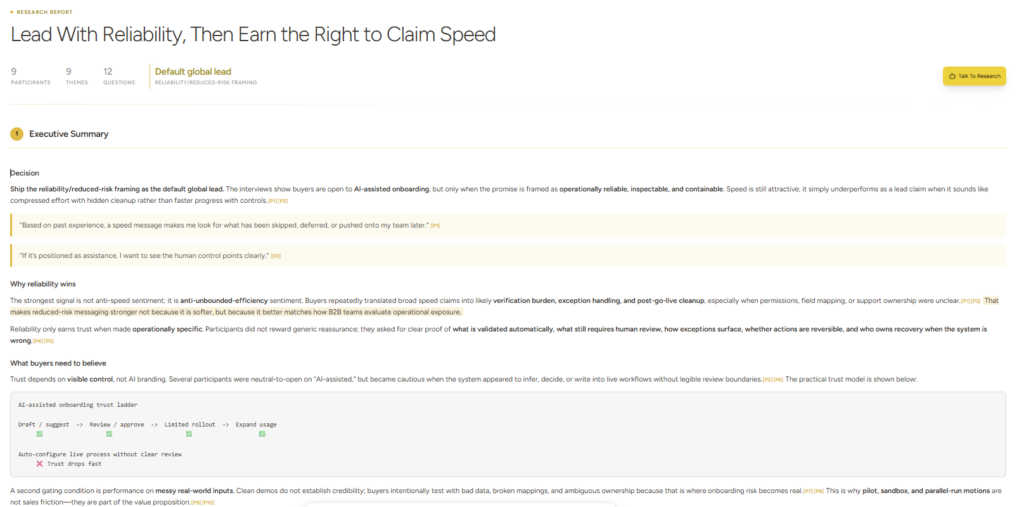
Worth being straight about the limits here too. Nine participants across five markets is roughly one to two people per market, which is enough for a directional global read and not enough to say with confidence that Germany favors reliability more than Brazil does. That’s the same sample-size tradeoff covered earlier in this guide: a synthetic pass like this is well suited to catching the big global signal fast, and if you needed to defend a market-by-market difference with real budget riding on it, the next move would be a larger per-market sample or a human-research follow-up in your top one or two priority markets.
What is cross-cultural consumer research?
Cross-cultural consumer research, sometimes called cross-cultural research methods, or cross-cultural concept testing when it’s applied specifically to a new product idea, studies how the same concept, message, or feature lands differently depending on cultural context, covering decision-making style, risk tolerance, communication norms, and etiquette, not just language.
If you haven’t run a concept test before, our guide to what concept testing is covers the fundamentals this builds on.
The most widely used cultural dimensions framework for this is Geert Hofstede’s model, which scores countries on traits like power distance, individualism versus collectivism, and uncertainty avoidance. A market that scores high on uncertainty avoidance responds differently to a “beta” or “early access” framing than one that doesn’t. Hofstede’s own team is explicit that these are country-level tendencies, not predictions about any individual person, which is worth remembering before you over-read a single score.
Articos calibrates its synthetic personas against Hofstede’s cultural dimensions data across 69 countries, so a concept test run for a German B2B buyer and one run for a Brazilian B2C buyer aren’t using the same underlying assumptions about how people decide.
How do you validate a product internationally?
International product validation means clearing the bar in each target market on its own terms, not averaging results across markets into a single global score that hides where you actually stand.
A few things break this if you’re not careful:
- Sample size per market. Ten qualitative interviews might be plenty to spot a directional problem in one market and not enough to trust a quantitative claim in another, depending on how much variance that market’s audience shows. If you’re testing a claim you plan to act on with real budget, check for statistical significance before you treat a per-market difference as real rather than noise.
- Different success thresholds. Purchase intent, willingness to pay, and feature priority all shift baseline by market. Set the bar per market before you see the results, not after.
- Currency and pricing framing. A price tested in USD and converted at spot rate ignores local purchasing power and anchoring. This matters most for ecommerce and DTC brands testing a single global price ladder. Test the price the way it will actually be presented, in local currency, at the checkout step it will actually appear in.
What’s the difference between single-market testing and multi-market concept testing?
Single-market testing optimizes one concept against one audience. Multi-market concept testing has to hold the concept constant while letting the audience, the benchmarks, and sometimes the framing vary, without losing the ability to compare results across markets.
That’s a harder problem than it sounds. Vary too little and you miss real cultural differences. Vary too much and you can no longer say whether Market A actually liked the concept more than Market B, or whether you were just asking a different question.
How do you decide which markets to test first?
Rank candidate markets on four things: revenue potential, cultural distance from your home market, regulatory complexity, and existing demand signals like inbound traffic or waitlist sign-ups from that region. This kind of regional concept testing works best when you’ve already done the segmentation homework rather than guessing at who the buyer is in each market.
Cultural distance matters more than most teams weight it. Two markets can look similar on GDP and market size and still require completely different concept framing if they sit far apart on dimensions like individualism or uncertainty avoidance. If you haven’t already built out who you’re testing for in each region, mapping ideal customer profiles and running a market segmentation pass before you test saves you from optimizing a concept for the wrong buyer in a new market.
What does cross-market research typically cost, and how long should it take?
Budget and timeline for international consumer research scale with how many markets you’re covering and how much cultural distance sits between them, not just headcount or survey length.
A three-market test using local agencies for each market realistically runs six to twelve weeks per market and lands well into six figures in total once you include recruitment, translation, moderation, and synthesis for every market. The same three-market pass through synthetic testing can return directional results same-day for a fraction of that cost, which is why it works better as a first filter than a final answer.
What’s the cheapest or free option for cross-market concept testing?
The genuinely free options are your own customer base and existing channels: posting a concept to an active community, emailing an existing user list segmented by region, or running informal polls through social channels you already have an audience on. These cost nothing but time, and they come with real limitations: self-selected respondents, no cultural calibration, and a sample that skews toward people who already like your brand.
Among paid options, culturally-calibrated synthetic testing is the cheapest per market by a wide margin, at roughly $7–$10 per study compared to thousands of dollars for even a lightweight translated survey. The trade-off isn’t cost, it’s depth. Free and low-cost options are fine for a first directional read; they’re not a substitute for validating a claim you’re about to spend real budget acting on.
Should you combine synthetic and human research instead of picking one?
For most cross-market programs, yes. In a 2011 Nielsen Norman Group study testing usability across 13 countries, the core finding was that the big usability principles held everywhere, while the real differences showed up in details: reading direction and scanning patterns, how verbose the local language runs, and which design signals a market actually trusts. Concept testing isn’t usability testing, but the shape of that finding is a reasonable working assumption here too: a synthetic pass calibrated on cultural dimensions data is well suited to catching big directional signals and obvious framing mistakes across many markets at once, while a smaller round of human research, whether that’s a local agency or a recruiting platform like User Interviews, is where you catch the detail-level nuance in your top one or two priority markets before you commit real budget.
A reasonable default: run every candidate market through synthetic testing first, rank them by opportunity and risk, then send only the top markets to human research for the final check.
Where synthetic cross-market testing isn’t enough
Cultural-dimension calibration helps you avoid the most common translation mistakes, but it doesn’t replace in-market human research for regulated categories like financial products, medical claims, or food and beverage labeling, where local compliance and lived cultural context matter more than a directional read. For healthcare and medical products specifically, regulatory review usually requires documented human research regardless of what a synthetic pass shows. It’s also not the right call for a six-figure, hard-to-reverse commitment like a full localized product launch. Use it to narrow which markets and framings deserve that level of investment, not to replace the investment entirely.
How to choose the right approach for your test
Match the method to the stakes and the stage. Early-stage direction-setting, before you’ve committed to a market, is where speed and cost matter most and a directional synthetic pass earns its keep. Late-stage validation, right before a launch decision or a regulated claim, is where the deeper cultural depth of local agencies and human panels is worth the extra weeks and budget.
If you’re weighing the trade-offs on a specific test, Articos’s concept testing platform runs Hofstede-calibrated synthetic panels across markets in under an hour per market, which makes it a reasonable starting point before you decide where to spend a heavier research budget. For the different ways to structure that first pass, see our guide to concept testing methods.