Your landing page is live, the traffic is real, and sign-ups have stopped climbing. Another headline rewrite won’t help if nobody has checked what buyers actually say and what makes them hesitate.
Copywriting research is the evidence you collect before drafting. It’s the words customers use, the objections they raise, the awareness level they have, what competitors claim, and what you can prove. This guide covers each input, where to find it, which tools help, what it costs (including free), and how to test copy before it ships.
Why isn’t our website copy converting?
Website copy usually underperforms because it describes the product in the team’s vocabulary, while visitors think in their own.
They also scan: 79% of test users always scanned a new page (only 16% read word by word), and scanners rely heavily on headings and first lines, where language can be mismatched. In the same research, a version of a page written in objective language scored 27% better on usability than a promotional version of the same content.
Two mismatches show up most often. The headline uses internal terms buyers never type, and the page misses the objection that actually stops sign-ups.
If page structure is also in question, our guide to landing page copywriting covers layout and templates. This article covers what goes into them.
What is copywriting research?
Copywriting research is the process of collecting evidence about buyers, competitors, and context before writing copy, so that every claim on the page can be traced back to something real.
It overlaps with audience research and keyword research but answers a narrower question: what should this page say, and in whose words? Audience research defines the ideal customer profile (ICP). Customer research for copywriting pulls the sentences that profile would recognize as their own.
The output is a one-page brief: verbatim customer phrases, ranked objections, an awareness level, a competitor claims grid, and a proof list. Writers who start from that page spend less time debating adjectives.
The brief also feeds your messaging framework, which sets the order of claims the copy then carries.
What should you gather before writing a word?
Gather six inputs: customer language, buying trigger, objections, awareness level, competitor claims, and proof.
| Input | Where to find it | What it changes in the copy |
| Customer language | Sales call transcripts, support tickets, reviews, interview recordings | Headlines and opening lines |
| Buying trigger | Interviews asking what was happening when they started looking | The problem statement you open with |
| Objections | Sales calls, abandoned-checkout surveys, search queries that end in “vs” or “reviews” | FAQ, the lines near the button |
| Awareness level | Traffic source for the page (branded search, broad how-to, cold ad) | How much the headline has to explain |
| Competitor claims | Rival homepages, ad libraries, review sites | What to avoid saying and where to differ |
| Proof | Your own metrics, case studies, named testimonials | Claims you can back with a number |
Awareness level comes from Eugene Schwartz’s 1966 book Breakthrough Advertising, which sorts buyers into five stages: unaware, problem aware, solution aware, product aware, and most aware. A visitor arriving from a branded search sits near the end of that scale. A visitor arriving from a broad how-to article sits near the start of that scale. Their headlines should do different work.
Frameworks like AIDA and PAS arrange evidence, so the evidence has to exist first. Our guide to copywriting frameworks compares them.
Customer research or competitor research?
Start with customer research, because customers supply the language and objections that no competitor pages can.
Voice of customer research is the standard method. John Hauser’s MIT course notes describe a typical study as 10 to 30 one-on-one interviews of about an hour each. Transcribe them and lift exact phrases. That’s a small sample size, so treat patterns as leads to test. Ask what happened the last time they looked for a solution, since hypothetical questions invite bias. Our guide to voice of customer research covers how to code the transcripts.
Competitor research for copywriting comes second and answers a different question: what is every rival already saying? Copy their claims into a grid and mark the ones three or more competitors share. Those claims separate you from no one, so they make weak headlines. The competitor research guide covers the full process.
Interviews and surveys capture what people say. Nielsen Norman Group classes both as attitudinal methods, so pair them with behavior data such as recordings of where visitors stop scrolling.
Does research improve copy performance?
Research raises the odds that copy matches how buyers think, and testing confirms the lift. No study shows that research alone raises conversion.
Writing that fits how people read does has measurable effects. In Nielsen Norman Group’s 1997 test, a version combining concise, scannable, and objective writing scored 124% better on measured usability than promotional copy. That test measured task performance, not sales.
Message testing closes the gap before traffic exists by validating headlines with a target audience. Articos runs message testing with synthetic personas matched to your audience, and the method is peer-reviewed at 86% recall against expert-published findings across 46 studies. After a study finishes, Live Calls let you speak to a persona by voice and ask why a headline missed. DTC teams can apply the same process to product pages through the ecommerce research page. For study design, see our message testing guide and the wider AI user research overview.
We ran this on our own homepage. Three candidate headlines went into an Articos message test with 9 synthetic personas: marketing leads, product marketers, and founders at B2B SaaS companies, plus agency owners. Each persona judged the headline as the first thing a visitor reads above the fold.
“Real insights in under 30 minutes. No recruitment” scored 8.0 out of 10 and was the only variant flagged high confidence. “Stop guessing your value prop” scored 4.5, and “User research. Simplified.” scored 3.4. The winner led on specificity (9.0 out of 10), attention pull (8.0), and clarity (8.0). The two losers scored 4.0 to 6.0 on their best dimensions.
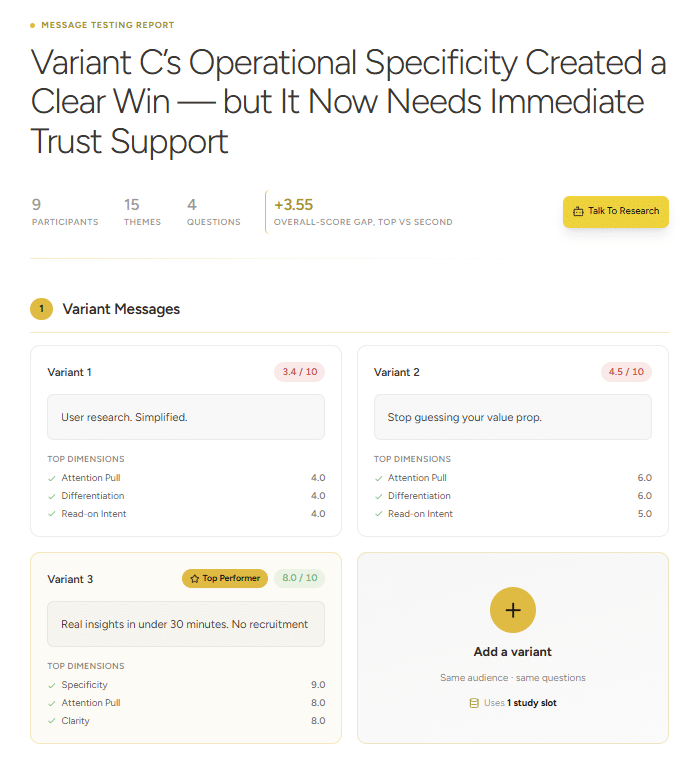
The report’s reading is that a concrete outcome plus a time claim plus less effort beat both a tension opener and a generic promise. It also flagged a catch: the winning line needs trust support right away, because “no recruitment” invites the question of whether synthetic personas can be trusted. That is the objections input from the list above, showing up in the test itself.
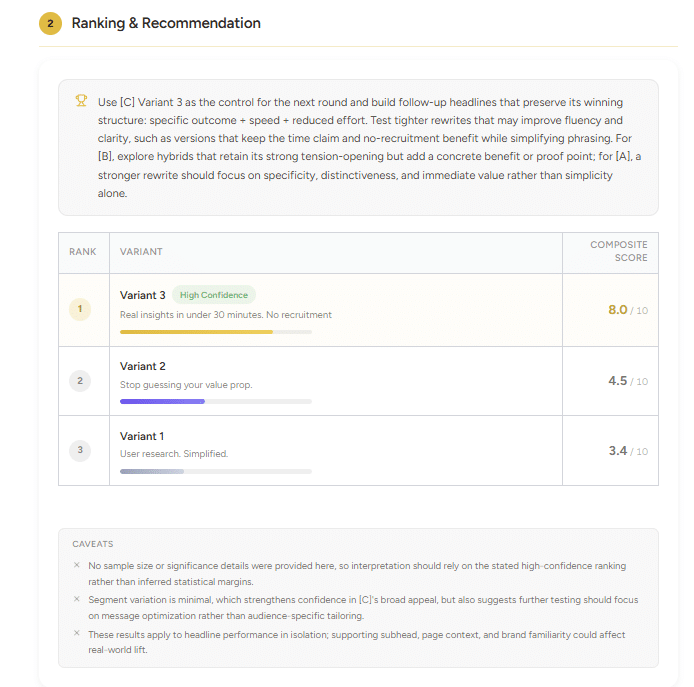
Treat this as a ranking, not a conversion forecast. Nine personas is a small panel, and the test judged headlines alone, without a subhead, page context, or brand familiarity. The next step is to pair the winning headline with a trust line and confirm it with live traffic.
What tools support copy research?
Copywriting research tools fall into four groups: conversation mining, behavior analytics, repositories for qualitative analysis, and message testing.
| Tool type | Examples | Best for | Limit |
| Call recording and transcription | Gong | Exact phrases and objections from sales calls | Built for B2B sales teams, so it needs recorded calls to exist |
| Behavior analytics | Microsoft Clarity, Hotjar | Where visitors scroll, click, or leave | Shows what visitors do, not why |
| Research repository | Dovetail | Tagging themes across interview transcripts and call notes | Needs source material first |
| Message testing | Articos | Comparing headline and page variants before launch | Suits early comparison, not named-respondent sign-off |
Microsoft Clarity is free, and Hotjar has a free plan.
What’s the cheapest or free option?
Free copywriting research starts with data you already have: sales call recordings, support tickets, product reviews, and community threads where buyers describe the problem in their own words.
For behavior data, Microsoft Clarity costs nothing. A spreadsheet works as the competitor claims grid.
To test copy cheaply, Articos offers a 14-day free trial with 900 credits (about 2 studies) and no credit card. As of October 2026, paid options are:
| Plan | Price | Includes |
| Starter | $79/month | 3,000 credits (about 7 studies) per month, plus 1,200 launch bonus credits |
| Pro | $199/month | 8,000 credits (about 20 studies) per month, plus 2,800 launch bonus credits, white-label reports |
| Top-up credits | See pricing page | Extra credits that carry forward |
Current numbers are on the pricing page, since launch pricing can change.
Should I combine synthetic and human research, not choose one?
Yes. Use synthetic research to narrow options quickly and human research to confirm the few decisions that carry real risk.
A workable week looks like this. Monday: mine existing calls and reviews. Tuesday: run a message test on six headline variants. Wednesday: interview five customers about the two winners. Thursday: ship the leader and start an A/B test.
Synthetic personas fit early comparisons and fast iteration. They are a poor fit for longitudinal brand tracking and for work that requires named human respondents, such as some procurement or regulated settings. Human panels such as Wynter’s exist for those jobs, and our Wynter comparison lays out where each approach fits.
When you have several positioning directions instead of one headline, a concept test compares them in a single study.
Your next step is small. Pull ten recent call transcripts or reviews and mark every sentence where a customer describes the problem. Those sentences are your first draft.