
Writing Copy for Cybersecurity Audiences
How do you write and then test copies for cybersec audiences?

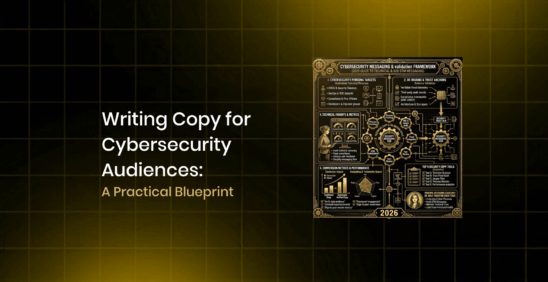
Your security landing page gets traffic. It gets a few demo requests and a lot of replies that say “interesting, we’ll circle back.” Copy for cybersecurity audiences usually fails for two reasons. It makes claims a security reader can’t check, or it speaks to one person while a whole buying group reads along. Both are fixable. Scope every claim, give each role the proof it looks for, and run message testing on the page before it ships. This guide covers the writing, how it differs from ordinary SaaS copy, and what testing costs, including routes that cost nothing.
Why do security buyers ignore our copy?
Security buyers ignore copy when it asks them to take a claim on faith. That habit is professional. NIST’s zero trust architecture guidance (SP 800-207, published in August 2020) is commonly summarized as “never trust, always verify,” and readers who work under that rule apply it to your homepage too. A page that promises “complete protection” or “100% secure” gives them nothing to verify and a reason to leave.
The second cause is audience mix. A practitioner, a compliance reviewer and a budget owner can land on the same page, and copy written for only one of them reads as irrelevant to the other two. The third is tone. Fear-led copy usually tells people something they already know, from a vendor they haven’t decided to trust.
Most ignored pages have all three problems at once, which is why swapping a single headline rarely moves anything.
How do you write for cybersecurity buyers?
Copy for cybersecurity audiences is writing aimed at a security buying group whose members verify claims before they trust a vendor. Write for each role in that group. Put the plain-language outcome on the main path and the technical proof one click away. Gartner describes B2B buyers looping through six buying jobs, validation and consensus creation among them. Its B2B buying journey guide tells marketers to ground copy in buyer needs rather than product capabilities. A buyer journey map shows where each role enters.
The rows below are working assumptions. Testing shows which ones hold for your buyers.
| Role in the security buying committee | What they scan for | What makes them leave | Where the proof lives |
|---|---|---|---|
| Security practitioner (SOC analyst, engineer) | Scope, integrations, what the product does not cover | Vague capability claims | Product page and documentation |
| Security leader (CISO) | Risk reduced, evidence, peer references | Absolutes and fear framing | Main page and case studies |
| Compliance or GRC reviewer | SOC 2 report, ISO 27001 status, data handling | Missing or stale certification status | A findable trust page |
| IT or engineering owner | Deployment effort, performance impact | Hidden setup cost | Documentation and pricing page |
| Budget owner | Cost against risk, contract terms | Unclear pricing | Pricing and ROI page |
Here is the difference on the page. These lines are illustrative, written for this article and not taken from a real vendor. Before: “Complete protection against modern threats.” After, for the practitioner: “Flags credential misuse in cloud logins across AWS, Azure and Google Cloud. See which detections ship.” After, for the executive: “Cuts the time your analysts spend triaging login alerts.” The balance between the two is the one covered in feature vs benefit messaging, and it is tighter here because the technical reader wants the feature while the budget owner wants the outcome.
Is cybersecurity copy different from SaaS copy?
Cybersecurity copy follows the same discipline as other B2B copy, and the difference is how much proof a claim needs. A security buyer is also asking whether your product adds risk, so copy that passes on an ordinary B2B page can read as careless here. Three things change. Claims need a stated scope: which environments, which data, which versions. Plan for a compliance reviewer in the group, which means certification status and data handling need a home they can find. And technical readers need documentation they can check before they book a call.
Everything else follows the rules in our guide to SaaS messaging: value propositions, hierarchy, calls to action. B2B cybersecurity marketing changes the channel mix less than it changes the proof requirement. One caution. Endpoint, identity, application security and GRC tools draw different buyers, so treat “security” as a family of audiences, not one.
What resonates with security teams?
Specific, scoped, checkable claims resonate, along with honest limits and detail about the work a product removes. ISC2’s 2025 Cybersecurity Workforce Study surveyed more than 16,000 practitioners, and 95% reported at least one skills gap on their team. That suggests copy naming the task it takes off the plate, such as alert triage or audit evidence collection, will beat copy that names a category. Put the limit next to the claim, because saying what the product does not cover builds more trust than a footnote does. CISO messaging leans on evidence and peer references, while practitioner messaging leans on scope and workflow.
Tone matters as much as content. The PAS framework (problem, agitation, solution) works in many categories, and our piece on copywriting frameworks covers it. In our view security readers already live with the problem, so agitation lands as noise. Spend the sentence on the fix. Be careful with hackers as villains too. Bug bounty programs pay outside ethical hackers to find and report flaws, so a villain-hacker story can sound out of touch with how the field works. Name the failure instead: an unreviewed access list, a skipped check.
What tools test cybersecurity messaging?
Four approaches cover most cases: conversations with real practitioners, a human B2B panel, free do-it-yourself checks, and synthetic audiences. They answer different questions, and the table shows where each fits.
| Method | Best for | Speed | Cost |
|---|---|---|---|
| Practitioner calls (customers, advisors, your network) | Language, objections, deep context | Depends on scheduling | Free, plus time and any incentive |
| Human B2B panel | Named human respondents on a deliverable | Under 48 hours, per Wynter’s site | Per-respondent or credit pricing |
| DIY form or five-second test | A directional clarity check | Same day | Free |
| Synthetic audience (Articos) | Early rounds and many variants | Under 30 minutes | From a month9 a month |
Qualitative message tests usually reach saturation within 9 to 17 interviews, per the 2022 systematic review summarized in our message testing guide. Five calls are a small sample size, and friendly contacts add politeness bias, so read them as directional.
How does a synthetic test work for security copy?
On Articos, you describe the audience, for example a security operations manager at a 500-person fintech. You upload up to three variants of a headline, ad or value proposition. A panel of 12 to 50 synthetic personas, five of them built-in dissenters, returns a report with every finding tied to a persona quote. The messaging testing platform page covers the setup. Articos reports 86% recall against expert-published findings in its Grounded Simulation paper.
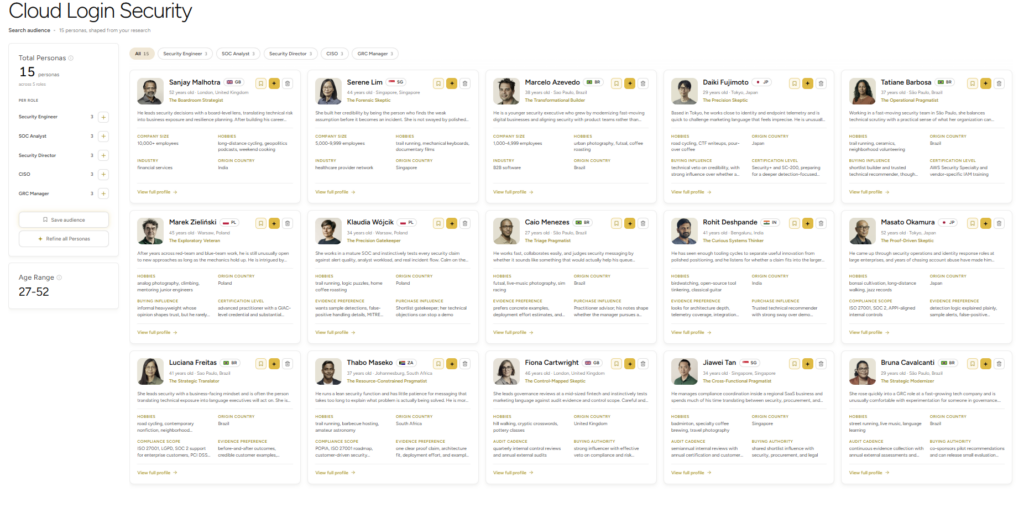
Choosing between two positioning directions rather than two headlines? A concept testing platform compares several directions in one study. Talk to Research then lets you send any persona a written follow-up, and Live Calls add a real-time voice conversation, so you can ask the persona who objected what would have made the claim believable. Broader audience work sits on the AI user research page.
The limit is worth stating plainly. None of the nine validation domains is cybersecurity buyer messaging, and a persona cannot replace a CISO who has been burned by a vendor. Treat a synthetic result as a strong first filter, then confirm with practitioners.
What happened when we tested three security headlines?
We ran one in October 2026 on a fictional cloud login security product, using the three example lines from the writing section above. Fifteen synthetic personas read each line as a homepage hero headline: three each of Security Engineer, SOC Analyst, Security Director, CISO and GRC Manager. Each scored every headline out of 10.
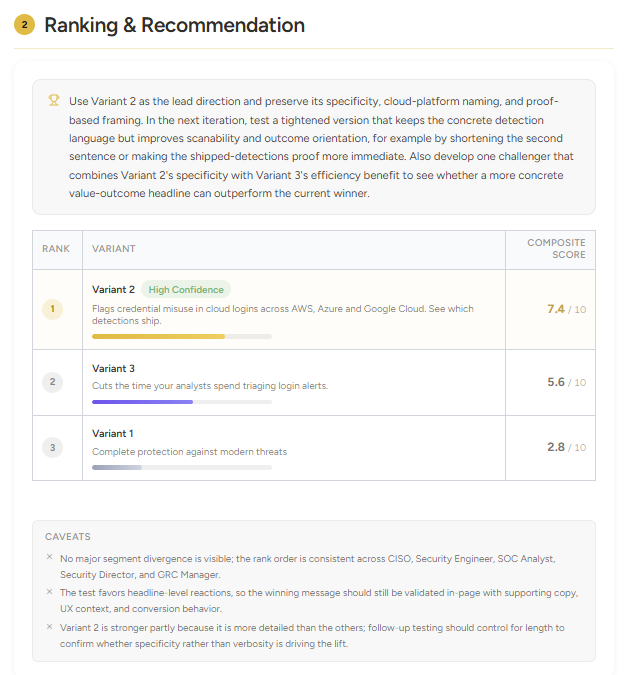
The scoped line won with 7.4, including 9.0 for specificity. The outcome line scored 5.6. “Complete protection against modern threats” scored 2.8, with 4.0 for clarity and 3.0 for attention pull. The rank order held in every role, so CISOs and Security Directors did not prefer the outcome line either.
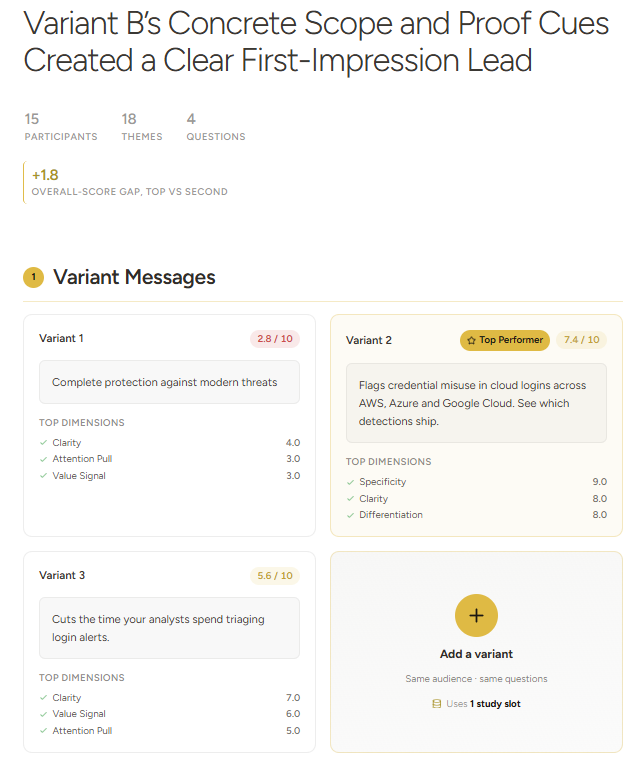
The report flagged two limits. The winner is also the longest line, so length may explain part of the lead, and a follow-up should hold it constant. The test also measured headline reactions only, so the role table above, which is about proof further down the page, is still untested.
What’s the cheapest or free option for testing cybersecurity messaging?
The cheapest option is free: five short calls with practitioners you already know, plus a one-question form. Ask “what does this company do?” instead of “is this clear?” so nobody can be polite about it. A reader who can’t explain your product back to you has told you what you need to know. Free calls catch obvious confusion but miss objections that only show up when a dozen readers push back, which is where paid options start. They are cheap to try.
| Option | Cost | What you get |
|---|---|---|
| DIY calls and a form | $0 | A directional read on clarity and objections |
| Articos free trial | $0, no credit card | 900 credits, around two studies |
| Top-up credits | See pricing page | Credits that carry forward |
| Starter | $79 a month | 3,000 credits, around seven studies |
| Pro | $199 a month | 8,000 credits, around 20 studies, white-label reports, unlimited Talk to Research |
One study costs roughly 400 credits, which works out to about $8 on Pro. Live Calls draw from the same credits, and launch bonus credits currently add more each month.
Should I combine synthetic and human research, or choose one?
Synthetic and human research work best combined. Use synthetic testing early, when you want many variants checked quickly. Bring in human practitioners when the decision is close, when a claim touches compliance, or when real budget is about to go behind the result.
Each side has limits. Articos does not do longitudinal brand tracking, and some procurement or regulated settings call for named human respondents. The Articos comparison with Wynter says as much and sends those jobs to a human panel, so read the Wynter alternatives page if panel work is on your list. A workable sequence: a synthetic round to narrow the field, a handful of practitioner calls to confirm the winner, then an in-market A/B test once you have traffic.
Whatever a test says, have your security and legal teams review every claim before it ships. A test measures reaction, not truth.
What should I check before publishing copy for cybersecurity audiences?
Run five checks. Does each role find its proof? Is every claim scoped to an environment or a version? Are certification statements current? Can a technical reader reach documentation in one click? Does the page explain the risk without leaning on fear?
If the answer to any of those is no, fix it before you test, because testing a page with a known flaw wastes a round. Then pick one page, write three variants and run the first test on the free credits. Retest after the next product or compliance change, since a claim that was accurate in spring can be stale by winter.


