Consumer Research Methods: 9 Types and When to Use Each
A practical guide to nine consumer research methods, what each one answers, where it breaks, and how to combine them.

You have a launch decision due, a research budget that covers one study, and three teammates asking for three different methods. Consumer research methods are the techniques brands use to learn what shoppers think, want, and buy. This guide covers nine: surveys, in-depth interviews, focus groups, ethnography, concept testing, experiments, social listening, syndicated data, and synthetic research. Each answers a different question, and each has a failure point worth knowing before you spend money on it.
Below you’ll find what each method answers, where it breaks, and how to combine them. For the broader view across industries, see our guide to user research methods.
What are the main types of consumer research methods?
The main types of consumer research methods are surveys, in-depth interviews, focus groups, ethnography, concept testing, experiments, social listening, syndicated data, and synthetic research. They split into qualitative methods, which explain why shoppers behave as they do, and quantitative methods, which measure how many do; our guide to qualitative vs. quantitative research covers the split in detail. The table sorts all nine by the question each one answers and the evidence it produces.
| Method | Best for answering | Evidence type | Main limitation |
|---|---|---|---|
| Surveys | How many shoppers prefer or intend X? | Stated, quantitative | Stated intent differs from behavior |
| In-depth interviews | Why does one shopper choose or reject X? | Stated, qualitative | Small samples |
| Focus groups | How do shoppers react to an idea together? | Stated, qualitative | Group influence shapes answers |
| Ethnography and observation | What do shoppers do in real settings? | Observed behavior | Slow and hard to scale |
| Concept testing | Which product idea, claim, or name wins? | Stated, mixed | A reaction to a concept is not a sale |
| Experiments and A/B tests | Which variant changes behavior? | Observed behavior, quantitative | Needs live traffic or a test market |
| Social listening and review mining | What are shoppers already saying unprompted? | Observed language | Skews toward vocal customers |
| Syndicated and secondary data | What sold, where, and at what price? | Observed sales | Shows what happened, not why |
| Synthetic consumer research | How would a modeled audience react today? | Simulated, qualitative | Reaction testing only, not forecasting |
Two columns do most of the work. Evidence type separates what shoppers say from what they do, and the limitation column tells you what to pair each method with. A method that relies on stated answers, like a survey, pairs well with one that observes behavior, like an experiment. A fast method with a thin sample pairs well with a slower one that goes deep. Most strong studies use two or three methods in sequence, not one.
When should you use consumer surveys?
Consumer surveys fit when you need a number: how many shoppers prefer a flavor, which price band feels fair, or how awareness differs between regions. A survey sends the same standardized questions to a large sample, so you can compare segments and check whether a difference is real. Sample size and question wording decide how far to trust the result. Stated intent also tends to run ahead of actual purchase, and the way a question is framed changes the answer. Our guide to types of response bias lists the common traps. Run surveys after interviews have told you which questions matter, because a survey can only measure the options you thought to include. See our survey methodology guide for design choices.
When do in-depth interviews beat surveys?
In-depth interviews beat surveys when the question starts with why. A moderator talks to one shopper at a time, usually from a semi-structured guide, and follows whatever the shopper says next: why they switched brands, what a pack claim made them assume, which rules they apply to a category without noticing. Samples stay small, so interviews generate hypotheses and wording rather than proof of how many shoppers agree. A shopper may also give a human moderator the polite answer. Recruiting and scheduling often set the timeline, so book participants early. Keep each round to one segment so the themes stay comparable. Our user interviews guide walks through guide design and probing.
Are focus groups still worth running?
Focus groups are worth running when the group’s reaction is itself the data: how shoppers talk about a category, which words they pick up from each other, how a concept lands in open discussion. A moderator leads a small group through a topic guide while the team watches. The cost is group influence. Dominant voices pull answers toward them, and people soften opinions around peers, which researchers call groupthink and social desirability bias. Treat focus group findings as directional, and confirm anything that drives a large decision with a survey or interviews. Focus groups also work well for early language, since you hear how shoppers describe a need in their own words before you write survey options. See our focus group guide for formats and moderation details.
Which consumer behavior research methods show what shoppers actually do?
Ethnography and observation are the consumer behavior research methods that show what shoppers actually do. A researcher watches people where the behavior happens: a kitchen during meal prep, a store aisle, a bathroom shelf. Shop-alongs and diary studies belong in this group. You see workarounds, storage habits, and the moment a product gets passed over, all things shoppers often can’t describe because they no longer notice them. These studies take longer than surveys and cover fewer people, so they suit behavior-heavy categories where stated answers and sales data have disagreed. Experiments and sales data also measure behavior and are covered below. Pair ethnography with a survey afterward, so you can size how common a newly observed habit really is. For field methods, see our ethnographic research guide.
How does concept testing work for consumer packaged goods?
Concept testing shows shoppers a product idea, claim, name, or pack description and measures their reaction before anything is built or printed. Respondents rate appeal, relevance, and believability for each variant and explain their choices, in a survey, a qualitative session, or both. It is a core method in consumer packaged goods market research because launch costs are fixed before shoppers respond. A study of 83,719 new US packaged goods products introduced from 2002 to 2009 found that one in four was no longer being bought a year after launch, and about 40% by year two, according to research published in Marketing Letters. Concept testing can’t remove that risk, but it can screen out ideas shoppers misread. We cover the formats in concept testing methods and the basics in what concept testing is.
What do experiments and A/B tests tell you about shoppers?
Experiments and A/B tests tell you what shoppers do when exactly one thing changes. You vary a price or a product-page headline, split the audience, and compare behavior between the groups. Direct-to-consumer brands run these on live traffic; retail brands use test markets or controlled panels. Because the data records actions rather than answers, it avoids the gap between stated intent and purchase. The catch is volume and time: a test needs enough visitors to reach statistical significance, and it only compares the variants you already built, so a weak idea can still win a weak test. Ecommerce and DTC teams can screen variants first with synthetic ecommerce research and send only the strongest to live traffic. Our A/B testing guide covers sample size and significance.
Do social listening and review mining count as consumer insights research methods?
Social listening and review mining count as consumer insights research methods when you treat them as unprompted evidence. Tracking brand mentions, product reviews, support tickets, and forum threads shows the words shoppers use and the complaints that repeat, at close to no cost. The limit is who writes. People who post or review tend to hold stronger opinions than the average buyer, and the data carries no demographic context unless you add it. Use this data to generate questions for interviews and surveys, and to borrow exact shopper language for concept wording. Review mining is also a quick way to spot recurring complaints about a competitor’s product before you position yours. See our voice of customer guide for more on working with this input.
Where do syndicated and secondary data fit?
Syndicated and secondary data fit at the start and the end of a project. At the start, existing reports and retail sales data frame the category before you spend on new research. After launch, point-of-sale and household panel data from providers such as NielsenIQ and Circana show what sold, where, and at what price, but they don’t show why shoppers chose it, or what they would have bought if your product had been on the shelf. Primary methods answer the why. Volumetric forecasting tools such as BASES size a launch. The difference between collecting new data and reusing existing data is covered in primary vs. secondary research. For specific platforms and pricing, see our comparison of market research tools for consumer brands.
What is synthetic consumer research, and when does it work?
Synthetic consumer research tests ideas against AI-modeled shoppers instead of recruited participants, and it works best for reaction and reasoning questions that come before a larger commitment. Our guide to synthetic consumers covers the concept in depth. On Articos, you describe a concept, positioning line, or price framing, choose a study type (user interviews, message testing, landing page testing, or an A/B comparison), and get a structured report in under 30 minutes, with each finding traced to individual persona responses. Consumer goods teams use it to compare concept variants, positioning wording, and price framings; see Articos for consumer goods. Headline and tagline variants go through the message testing tool, and product concepts through the concept testing platform.
What does a synthetic consumer study actually return?
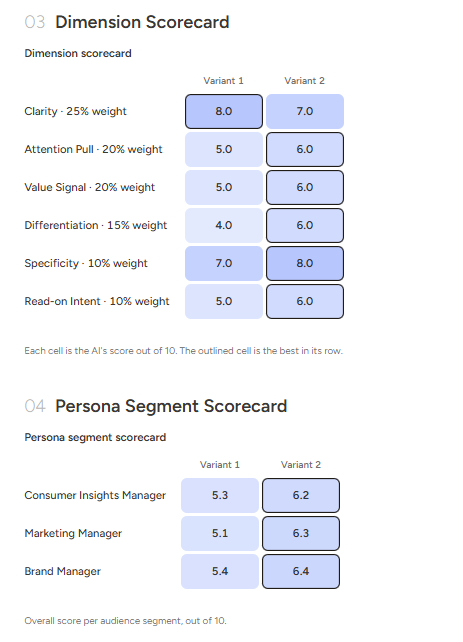
A synthetic consumer study returns a scored comparison, themes, and the reasoning behind both, so you see not just which option won but why. We ran one for this article. Nine synthetic marketing, brand, and consumer insights managers at US consumer packaged goods brands scored two candidate titles for this guide. The CPG-framed title, “How CPG Brands Learn What Shoppers Want: 9 Research Methods Compared,” scored 6.5 out of 10 against 5.8 for the plain one you’re reading, a gap of 0.65 at medium confidence. The report broke the lead down by dimension. The CPG title won on differentiation, 6 to 4, and on specificity, attention pull, and value signal. The plain title won on clarity, 8 to 7. All three persona segments preferred the CPG title, by 0.9 to 1.2 points.
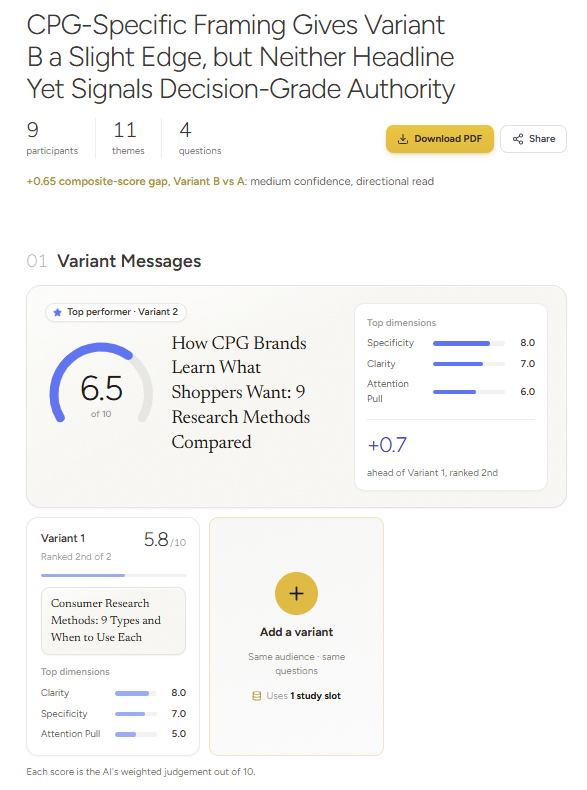
The headline of the report is the useful part: neither title yet signals decision-grade authority. That’s a screening result. It says which option to carry forward and what to fix, and it doesn’t say how many real readers would click. We kept the plain title because it matches the exact search phrase, which the test didn’t measure.
How accurate is synthetic consumer research?
Accuracy depends on how the personas and interviews are built, and the published evidence for Articos is specific. It is also limited, which is why the details matter. The Grounded Simulation paper (April 2026) reports 86.3% recall of expert-published findings across a 16-study comparison, and 7.5 times the theme-recovery score of prompting a general model with the same topic. A wider validation ran 46 studies across 9 domains. Three details limit how far to trust it. The reference findings came from Baymard Institute and Nielsen Norman Group UX research, not shopper purchase data. The 16-study comparison covered ecommerce and SaaS. And the paper’s author leads research at Articos, with independent replication still listed as future work.
Can you talk to synthetic consumers directly?
Yes, on Articos you can question the personas after a study and during one. Talk to Research lets you ask a persona written follow-up questions once the research completes, such as what made it hesitate on a price. Live Calls adds a real-time voice conversation with any persona from your panel, which helps when a finding surprises you and you want the persona to explain its reasoning, or when a written answer left a reaction vague. Both draw on your plan’s credits, so each follow-up has a cost you can budget. Teams often use the written version for quick clarifications and save voice calls for the one reaction that doesn’t add up. Talk to Research includes 2 queries per research on the Starter plan and is unlimited on Pro.
Where does synthetic research fall short for consumer brands?
Synthetic research falls short on anything that depends on measured behavior or a physical product. The Articos consumer goods page lists what it does not test: volumetric forecasts, shelf velocity and category tracking, in-home use tests, packaging visuals such as shelf standout, and regulated claim substantiation. The validation paper adds that cross-cultural questions were its lowest-confidence validated category, and that accessibility audits and longitudinal behavior remain untested. It also reports that expert reviewers wanted the top three themes checked with real users before major decisions. Treat the output as reaction data that screens options, then validate the finalists with real shoppers. Read our comparison of synthetic users vs. real users for how teams draw that line.
What are the best consumer research methods for your decision?
The best consumer research method is the cheapest one that can answer your question with the evidence type you need. Start from the decision, then match the method. A question about market size needs different evidence than a question about a headline, and a method that suits one rarely suits the other. The table maps five common consumer decisions to a first method and a confirming one.
| Your question | Start with | Then confirm with |
|---|---|---|
| How large is the category opportunity? | Syndicated and secondary data | A survey |
| Why do shoppers choose or reject us? | In-depth interviews | A survey to size the themes |
| Which concept, claim, or price framing is stronger? | A synthetic concept test | A survey or experiment with real shoppers |
| What do shoppers do with the product at home? | Ethnography | An experiment |
| Which page or pack variant converts? | An A/B test | Sales data after rollout |
For consumer research methods for marketing, a message test or concept test can run before any paid spend, and an A/B test then confirms the winner on real traffic. Reserve the larger budgets for decisions where a wrong call is expensive: a new pack format, a price change across a line, or a category entry.
What’s the cheapest or free option for consumer research?
The cheapest option is data you already own. Product reviews, support tickets, and social comments cost analyst time only, and a short survey to your own email list adds little beyond a survey tool’s free tier. For fresh reaction data, Articos offers a 14-day free trial with 900 credits, enough for about 2 studies, and no credit card. Paid plans run $29 a month for Lite (1,200 credits, up to 3 studies), $79 for Starter (3,000 credits, about 7 studies), and $199 for Pro (8,000 credits, about 20 studies, with white-label reports). A study uses about 400 credits, so a study costs roughly $7 to $10 depending on plan and the launch bonus credits currently applied. For comparison, Articos’s pricing page estimates traditional research at $5,000 to $30,000 and 2 to 6 weeks per study, a vendor estimate rather than an industry benchmark. See the AI user research platform for current plans.
Should you combine synthetic and human research instead of choosing one?
Combine them: synthetic research is fast enough to screen many ideas, and human research is the right check on the few that survive. A workable sequence starts with reviews and sales data to find the question, then synthetic tests across concepts and wording. Take the top two or three options to real shoppers through a survey, interviews, or volumetric testing, and use sales data and experiments after launch. If you recruit real participants through a platform such as User Interviews, which recruits, screens, and schedules study participants, see how the two approaches compare on our User Interviews alternative page. Synthetic work removes the recruiting wait from early screening. It doesn’t replace the real-shopper check at the end.