Consumer Decision-Making Process: A Practical Guide
The five stages of consumer decision-making process explained.

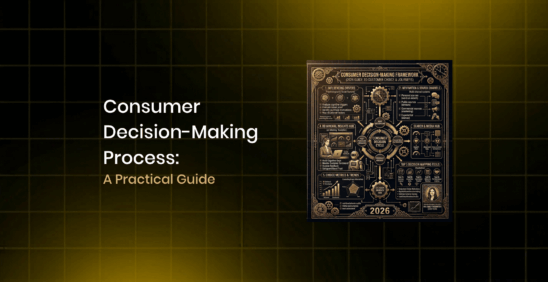
Your traffic looks fine and buyers still vanish somewhere between the first visit and the checkout. The consumer decision-making process is the sequence of five stages a buyer moves through before and after a purchase: problem recognition, information search, evaluation of alternatives, the purchase decision, and post-purchase evaluation.
The stages tell you where buyers might leave. They say nothing about why. This guide covers each stage, the four types of decision making, where buyers drop off, how B2B buying differs, and which tools can research the buyer journey, including free and low-cost options.
What is the consumer decision-making process?
The consumer decision-making process is the series of mental and behavioral steps a person takes from noticing a need to judging how a purchase turned out. Marketers also call it the consumer buying decision process or the consumer purchase decision process. The names vary and the model stays the same.
The five-stage version goes back to John Dewey’s 1910 work on problem solving. Engel, Kollat, and Blackwell adapted it for consumer behavior in their 1968 book Consumer Behavior, and the resulting EKB model is still a standard reference in consumer behavior courses.
The model has a known weakness. A 1979 review in the Journal of Consumer Research argued that a substantial proportion of purchases involve no real decision process at all. Treat the five stages as a map of where deliberation can happen, because plenty of buyers skip ahead.
What are the stages of consumer decision making?
The five stages of consumer decision making are problem recognition, information search, evaluation of alternatives, purchase decision, and post-purchase evaluation. Each one hides a different question you can test.
| Stage | What the buyer does | What to test |
|---|---|---|
| 1. Problem recognition | Notices a gap, frustration, or unmet need | What trigger made them start looking |
| 2. Information search | Searches, asks peers, reads reviews | Which sources they trust and what words they use |
| 3. Evaluation of alternatives | Compares a shortlist | Which criteria separate the final two options |
| 4. Purchase decision | Commits or stalls | What objection appears at the last step |
| 5. Post-purchase evaluation | Judges the result against expectations | Whether the promise matched the experience |
Post-purchase evaluation gets less attention than it deserves. Cognitive dissonance, the doubt buyers feel right after committing, either fades once the product delivers or turns into a return, a refund request, or a canceled subscription. At the evaluation stage, the buyer’s consideration set (the shortlist actually compared) usually holds only a few options, which is why being left off it costs so much.
What are the types of consumer decision making?
Consumer decision making comes in four types: extended, limited, habitual, and impulse. Extended decisions cover expensive or risky purchases such as a car or a software contract, and they run through all five stages over weeks or months. Limited decisions apply to occasional purchases like running shoes, where the buyer compares a few options without deep research.
Habitual buying, such as restocking the same coffee, compresses problem recognition and purchase into one moment. Impulse buying skips research and starts from a trigger like a checkout display or a flash sale.
The type decides where research effort pays off. A habitual product gains little from a long comparison guide, and an enterprise software buyer won’t be moved by a countdown timer. Brands selling packaged goods can test which type their category follows with AI user research for consumer goods.
Why do customers choose competitors?
Customers choose a competitor when that rival clears the criteria they use at the evaluation stage, and those criteria often differ from what the losing team assumes.
Articos tested this on a B2B SaaS purchase for its buyer journey mapping guide. Twelve synthetic buyers across four roles (product manager, head of marketing, growth marketing lead, senior product manager) evaluated an AI research platform. The team assumed price would be the main objection. The report came back titled “Shortlists Are Lost on Defensibility Before They Are Lost on Price.” Trust and provenance showed up 10 times as a hesitation driver, more than any other tag, and buyers screened tools on credibility and evidence traceability before cost came up.
One study in one category proves nothing general. It does show why a guess about lost deals deserves a test. Win-loss interviews and voice of customer research can surface the same patterns with real buyers, though they take longer to run.
Which stage loses the most buyers?
The best-documented losses happen at the purchase decision, and the cause differs for online retail and B2B.
For online retail, Baymard Institute’s average across 50 studies puts cart abandonment at 70.22%. In Baymard’s latest reasons survey, 42% of US online shoppers said they had abandoned a cart because they were just browsing. Setting that group aside, 40% cited extra costs such as shipping, tax, and fees, 19% didn’t trust the site with their card details, 18% were asked to create an account, and 17% found checkout too long or complicated.
B2B sales lose buyers differently. Challenger Inc. reports that 40 to 60 percent of lost deals end in no decision, with no competitor involved. Teams selling online can test checkout objections before shipping a fix, and AI research for ecommerce is one way to do that.
Is B2B buying different from B2C?
Yes. B2B buying involves groups, loops back on itself, and happens largely without the seller in the room.
Gartner describes six buying jobs (problem identification, solution exploration, requirements building, supplier selection, validation, and consensus creation) that buyers revisit at least once rather than complete in order. In a 2018 Gartner survey of 750 B2B buyers, only 17% of purchase time went to meetings with suppliers, which works out to roughly 5% per supplier when three compete. Gartner also reports that buyers are 1.8 times more likely to complete a high-quality deal when they use supplier digital tools alongside a sales rep than when they buy alone.
| Factor | B2C | B2B |
|---|---|---|
| Who decides | Usually one person or a household | A buying group with different goals |
| Path | Close to the five stages in order | Loops across six buying jobs |
| Typical loss | Cart or checkout abandonment | No decision (40 to 60 percent of lost deals) |
The B2B vs. B2C research guide covers how to adjust a study for each.
What tools research the buyer journey?
Five kinds of tools research the buyer journey: analytics, surveys, customer and win-loss interviews, recruitment platforms for live studies, and synthetic research platforms. Each answers a different question.
| Tool type | Best at | Main limit |
|---|---|---|
| Web and product analytics | Showing what buyers do at each step | Can’t explain why they do it |
| Surveys | Counting how many buyers share an opinion | Thin on reasons, open to politeness bias |
| Customer and win-loss interviews | Real reasons from real buyers | Weeks of recruiting and scheduling |
| Recruitment platforms | Live sessions with verified participants | Incentive costs and no-shows |
| Synthetic research | Testing each stage assumption quickly | Real buyers still needed for high-stakes calls |
Combine them. Analytics finds the stage where buyers leave, and interviews or synthetic studies explain the exit.
How can synthetic research test each stage?
Synthetic research tests a stage by interviewing AI personas built to match your buyer and returning a structured report in minutes. Articos runs these interviews without recruiting, and its findings matched published Baymard Institute and Nielsen Norman Group research 86% of the time across 46 studies, according to its pre-print.
A practical setup is one research question per stage. Ask what triggered the search at stage 1, which sources buyers trusted at stage 2, which criteria separated the final two options at stage 3, and what nearly stopped the purchase at stage 4. When an answer surprises you, Live Calls let you hold a real-time voice conversation with a persona from the study, and Talk to Research handles written follow-ups.
For a specific offer or claim at the evaluation stage, a concept testing platform is the more direct fit. On the consumer side, synthetic consumers explains how the personas are built.
What happened when we tested this article with synthetic readers?
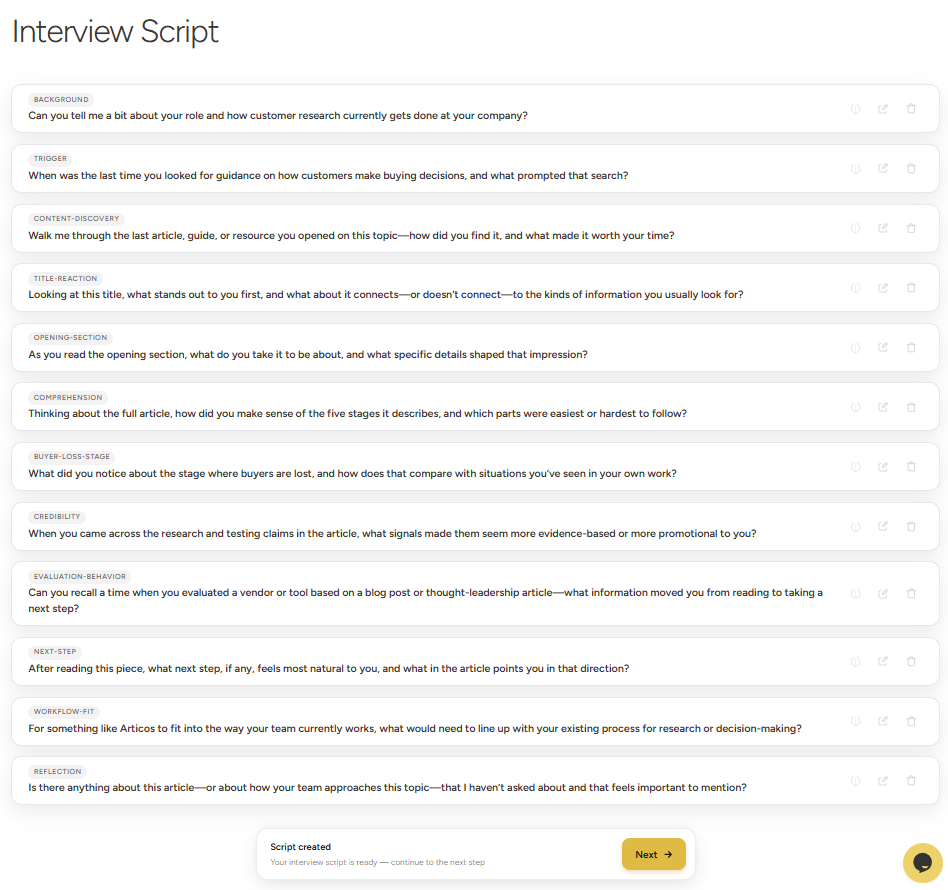
Ten synthetic readers called this article useful education that does not yet earn much trust in Articos. Before publishing, we ran the draft through an Articos interview study: 10 personas (two each of product marketer, growth marketer, startup founder, content marketer, and UX researcher) based in the US, UK, Canada, and Australia, aged 25 to 55. Each answered 12 questions on the title, the opening, the five stages, and the research claims.
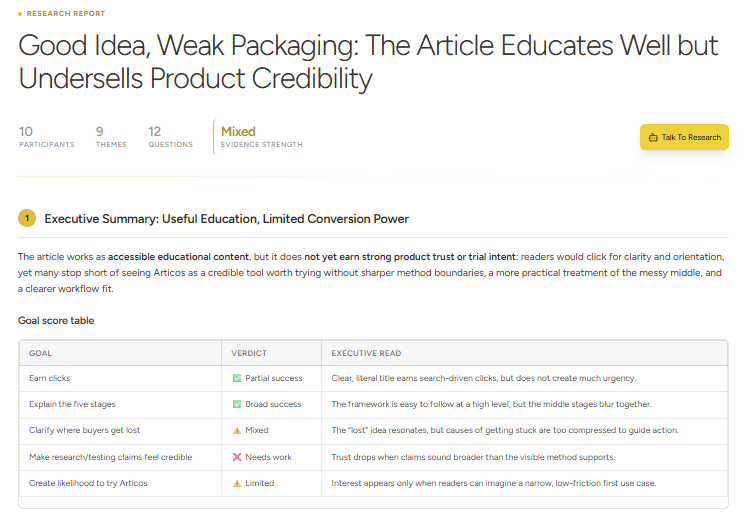
| Goal | Verdict | What the report said |
|---|---|---|
| Earn clicks | Partial success | A clear, literal title earns search clicks but creates little urgency |
| Explain the five stages | Broad success | The framework is easy to follow, but the middle stages blur together |
| Clarify where buyers get lost | Mixed | The idea resonates, but the causes of getting stuck are too compressed to act on |
| Make research claims feel credible | Needs work | Trust drops when claims sound broader than the visible method supports |
| Create likelihood to try Articos | Limited | Interest appears only when readers can picture a narrow, low-friction first use |
Articos labeled the evidence strength “Mixed.” Ten personas can show where readers hesitate, not how many would, so treat the result as a list of objections to check against real traffic. The report’s first recommendation was to keep the five-stage framing, sharpen the middle-stage diagnosis, state the method’s limits in plain language, and show where Articos fits in a real workflow.
What’s the cheapest or free option for researching the buyer journey?
The cheapest option is your own data: analytics, support tickets, sales call notes, product reviews, and a handful of conversations with recent customers cost nothing beyond time. That covers what buyers do and part of why.
For paid tools, Articos starts free with a 14-day trial and 900 credits (about 2 studies), no card required. As of October 2026, the Starter plan costs $79 a month for 3,000 credits (about 7 studies), and Pro costs $199 a month for 8,000 credits (about 20 studies). Live Calls draw from the same credits. Articos estimates a traditional study at $5,000 to $30,000 per research. Current plans are on the pricing page.
Should you combine synthetic and human research?
Yes, combine them. Synthetic research covers breadth: it can test every stage assumption on a buyer journey map quickly and cheaply. Human interviews cover the few decisions where a wrong call costs the most, where a relationship already exists, or where a stakeholder needs to hear a real customer.
Synthetic personas can’t tell you your true conversion rate, your market size, or how a specific named account will behave. Questions of sample size and statistical significance belong to real traffic and real panels. Teams that need recruited participants can compare Articos with User Interviews, a platform for recruiting people for live studies.
A workable split: run synthetic studies on every stage first, pick the two or three findings the plan depends on, and take only those to live interviews.
How do you choose where to start?
Start at the stage where you lose the most buyers. Pull one number for it from your analytics (cart abandonment, trial-to-paid rate, or deals stuck in no decision), write down your best guess for the cause, and test that guess with a few buyer conversations or one synthetic study. Then fix the objection that comes up most often and measure again.
Repeat the check each quarter. Buyer criteria shift as competitors launch and prices change, and a stage that held up in spring can leak by fall.