
Concept Validation: How to Test an Idea Properly
Here's how to do validate a concept optimally.


Concept validation is the process of testing a product or business idea against real target users before you build it, using their reactions to measure demand, clarity, and willingness to pay. It answers one question: does this idea solve a problem people will actually pay to have solved, before you find out the hard way.
This guide covers the discipline itself: what separates validation from testing, which methods fit which stage, what they cost, and the mistakes that quietly waste a study’s data. If you already know your idea’s stage and just need the right method, the comparison table below gets you there fastest.
What Is Concept Validation?
Concept validation checks whether a specific idea, feature, or business concept solves a real problem for a defined group of people, before any code gets written or budget gets committed. It’s a narrow test with a single job: tell you whether to keep going, change direction, or stop.
A concept validation study usually asks three things. Do people recognize the problem you’re solving? Does your proposed solution make sense to them? Would they actually use it, or pay for it? Willingness to pay is the hardest of the three to fake, since it’s the one place stated enthusiasm and real behavior most often disagree. Answering all three honestly, with people who match your target user (your ideal customer profile, or ICP, if you’re validating a B2B concept), is what separates validation from a founder polling friends for reassurance.
Concept Testing vs. Concept Validation: What’s the Difference?
Concept testing and concept validation get used interchangeably, but they’re not the same thing. Firstly, concept testing is the method: showing people a concept description, prototype, or mockup and recording the reaction. Concept validation is the goal that method serves: deciding whether the concept is worth pursuing. A related term worth knowing is concept screening, the earlier step of narrowing several rough concepts down to the one or two worth a full validation study.
You can run a concept test and still learn nothing useful. If the sample doesn’t match your target user, if the questions lead people toward the answer you wanted, or if you test one concept in isolation with nothing to compare it against, the test produces opinions, not a validated answer. Concept validation requires a defined hypothesis, a representative sample, and a clear bar for what counts as a pass. Nielsen Norman Group defines concept testing as a method that presents the idea of a product or service, not the full built experience, specifically to learn whether people would want or need it. For a deeper breakdown of the individual concept testing methods available at each stage, see our companion guide, and for the fundamentals of how concept testing fits the broader research process, start with what concept testing is.
One distinction worth making up front: if what you’re actually testing isn’t the product concept but a specific headline, tagline, or positioning line, that’s a narrower job than concept validation. Our messaging testing platform is built for that case specifically.
The Concept Validation Process: 5 Steps to Test an Idea Properly
This concept validation framework is deliberately simple: five steps, run in order, every time.
1. Write the hypothesis before you write the questions.
State exactly what you believe: “[User type] struggles with [problem] and will pay for [solution].” If you can’t fit it in one sentence, the concept isn’t specific enough to test yet.
2. Define who counts as a target user.
Recruit or select people who match that definition, not whoever answers fastest. A study run on the wrong sample gives confident, wrong answers.
3. Choose a method that matches your stage.
An idea with no prototype needs a different test than a feature with working mockups. The comparison table in the next section breaks down which method fits which stage.
4. Run the test and separate reaction from behavior.
What people say they’d do and what they actually do diverge, especially around price. Weight behavioral signals, like a signup or a pre-payment, over stated intent.
5. Set a decision rule before you see the results.
Decide in advance what result means “build it,” what means “rework it,” and what means “kill it.” Without that line drawn ahead of time, it’s easy to read ambiguous data as support for the answer you wanted.
What Are the Main Concept Validation Methods?
| Method | Best For | Typical Time | Typical Cost | Sample Size |
|---|---|---|---|---|
| Concept interviews | Understanding why people react the way they do | 1–3 weeks (recruiting) | $5,000–$15,000 for 10–15 interviews | 5–12 people |
| Online survey | Quantifying preference across a larger group | 3–7 days | $1–$3 per response via a panel, plus your survey tool’s subscription | 100+ respondents |
| Synthetic user testing | Fast first-pass validation before committing budget | Under 30 minutes | $7–$10 per study | Persona-based, no recruiting |
| Landing page smoke test | Measuring real market validation from actual clicks | 1–2 weeks (needs traffic) | Modest ad budget, often enough for a few hundred visits | 100+ visitors |
| Fake door test | Measuring intent-to-buy without building the product | 1–2 weeks | Low, mainly ad spend and hosting | 50+ visitors |
| A/B concept comparison | Choosing between two competing directions | 2–4 weeks | Moderate, driven by traffic and tooling | 200+ per variant |
Concept interviews get you the why, at the cost of small samples and weeks of recruiting; if you need to find and screen participants for this method, a recruitment platform is usually faster than sourcing them yourself. A landing page test tells you whether strangers will click and sign up, useful market validation, but it won’t tell you why the ones who left, left. Online surveys, run through SurveyMonkey’s panel, buy you a larger quantitative sample without recruiting anyone yourself.
Synthetic user testing sits at a different point on this table entirely. Platforms built around AI user research test a concept against AI-generated personas instead of scheduled participants, which is why it’s the only row here measured in minutes rather than weeks. That speed makes it a reasonable first pass before committing budget to a slower method, not a replacement for one.
None of these replace each other. A common sequence is a cheap first-pass test to cut the number of directions worth pursuing, then a slower, higher-fidelity method, like real interviews or a live landing page, on whatever direction survives.
What’s the Cheapest or Free Way to Validate a Concept?
The genuinely free option is five structured conversations with people who match your target user, unpaid if they’re already in your network. It costs nothing but time, and it’s still validation, as long as you go in with a written hypothesis and ask about their current behavior rather than their opinion of your idea.
If you want to spend something small rather than nothing, two options sit just above free: a synthetic user study through Articos’s concept testing platform, which runs $7–$10 per test, or a one-page site with a clear headline and a signup form, run against a small amount of paid traffic to see who actually clicks and signs up. Founders specifically validating a business idea before incorporating or raising anything will find our guide to validating a startup idea useful alongside whichever method you pick here.
Cheap and free validation still needs a defined hypothesis and a real target user. Skipping those to save money is what produces data nobody can act on later.
When Should You Run Early Concept Testing?
Early concept testing happens before a prototype exists, or even before an MVP (minimum viable product) gets built, using nothing more than a description, a sketch, or a one-line pitch. Its job is to catch a wrong direction before design or engineering time gets spent on it, so the right moment to run it is as soon as the idea is specific enough to describe in one sentence.
Waiting until a working prototype or MVP exists feels safer, but it usually backfires: by then, the sunk cost of building makes people, including the founder, less willing to hear that the idea doesn’t land. Early testing is intentionally rough. A one-paragraph concept description, a single mockup screen, or a five-minute pitch works fine at this stage. The goal isn’t polish. It’s catching a fundamental miss before it gets expensive to fix.
How Many People Do You Need to Validate a Concept?
For qualitative concept interviews, five to eight people who match your target user is usually enough to surface the major reactions and objections. Nielsen Norman Group’s long-standing research on testing with small groups found that testing with five users uncovers close to the maximum share of usability problems you’d find with a much larger group, and that same logic carries over reasonably well to early concept feedback, where the goal is surfacing themes rather than measuring exact percentages.
For quantitative validation, like a landing page test or a survey comparing preference between two directions, the numbers need enough volume for the percentages to mean something. A sample of roughly 100 gives a wide margin of error, around ±10 percentage points at typical confidence levels; larger samples narrow that band, which is why teams staking real budget on the result often aim for several hundred responses rather than a hundred. The mismatch to avoid is running a quantitative-sized question (“which concept do more people prefer”) with a five-person sample, or running a qualitative-sized question (“why does this confuse people”) with a large survey that only captures multiple-choice answers.
Should I Combine Synthetic and Human Research, or Choose One?
Combine them, sequenced by stage, rather than picking one and standardizing on it. Synthetic testing is built to rule out weak directions fast and cheap, before you know which idea deserves real budget. Human interviews are built to catch the messy, contradictory, emotionally loaded reactions that a synthetic persona tends to smooth over. Using synthetic testing to cut five concepts down to one, then spending real recruiting budget on interviews for the survivor, gets you both the speed and the depth, for less total cost than running five full interview rounds.
The exception is high-stakes decisions where the cost of being wrong is severe: a major funding round, a regulatory or medical claim, an irreversible pivot. For those, run synthetic and human research in parallel rather than in sequence, and don’t let a fast synthetic result substitute for the slower human pass just because the deadline is close.
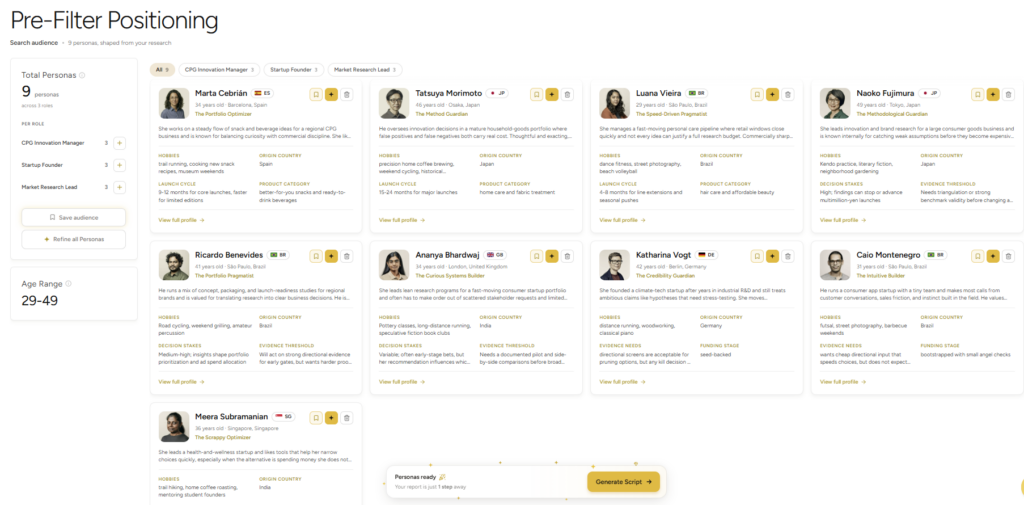
We tested this exact question inside Articos rather than just asserting it.
The research question: do the people who actually approve research budgets, a CPG innovation manager, a startup founder, and a market research lead, trust a cheap AI pre-screen at all, and under what framing? We ran synthetic interviews across 9 personas spanning those three roles, testing a specific pitch: run $7–$10 AI-moderated screens on 5–10 rough concepts, cut the weakest 2–3, and only send the survivors to an expensive validated study like Nielsen BASES or Zappi.
The finding surprised us a little: the pitch only held up when it was framed as bounded portfolio triage, a way to improve what reaches premium validation, never as a decision-grade replacement for it. And the objection wasn’t cost. It was false negatives, the fear that a good idea gets killed by rough wording or an off-note phrase before it ever reaches a human panel.
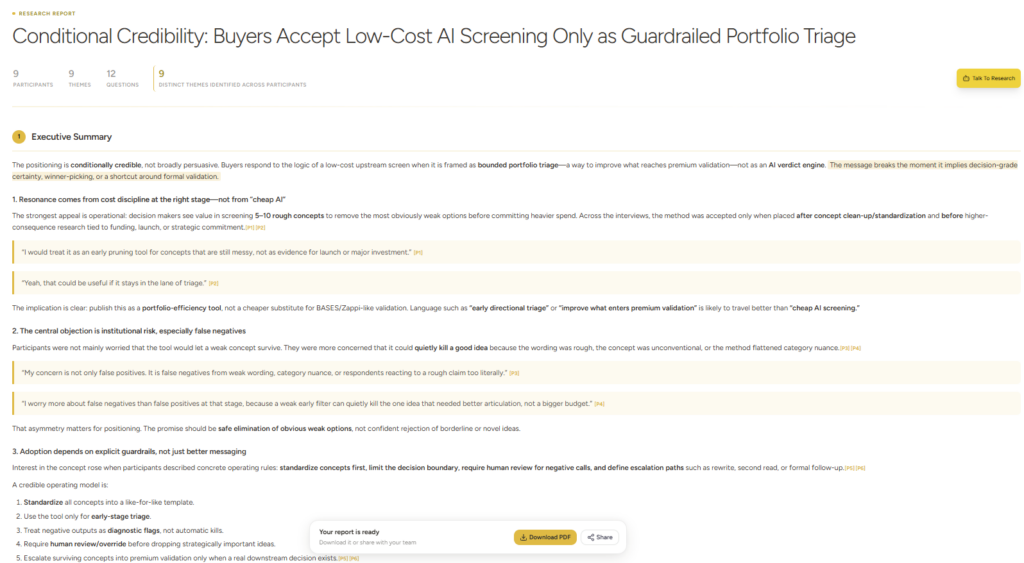
That’s the same sequencing logic from above, confirmed by the people who’d actually have to sign off on it: cheap methods earn trust for elimination, not for the final call, and only with explicit guardrails, standardized concepts, a limited decision boundary, mandatory human review before any negative result gets acted on, and a defined escalation path for anything borderline.
Common Concept Validation Mistakes That Waste the Data
Validation studies tend to fail quietly. The test runs, a report gets written, and nobody notices the data can’t actually answer the question until the product ships and the market disagrees.
- Testing with the wrong sample. Friends, coworkers, and social media followers are not your target user, unless your target user is specifically friends, coworkers, and social media followers. If you’re not sure who your target user actually is yet, customer discovery work usually needs to happen first.
- Asking leading questions. “Would you find a tool that saves you 10 hours a week useful?” isn’t a question, it’s a suggestion, and it invites the exact confirmation bias a validation study is supposed to guard against. Ask what people do now and what’s wrong with it instead.
- Trusting stated intent over behavior. “I’d definitely pay for that” is cheap to say and doesn’t predict who actually pays. Weight signups, pre-orders, and waitlist joins over verbal enthusiasm, and treat willingness-to-pay claims made without a real payment step as the softest signal in the study.
- Testing one concept alone. A single concept with nothing to compare it against makes every reaction feel more positive than it is. Test at least two directions when you can.
- Skipping the decision rule. Without a bar set in advance, ambiguous results get read as a green light more often than they should be, and recruitment bias (whoever was easiest to reach, rather than whoever actually fits) quietly compounds the problem.
How to Choose the Right Validation Method for Your Idea
Start with the stage of the idea, not the budget. No prototype and a rough hypothesis calls for a cheap, fast method: a synthetic user test or five informal conversations. A working prototype with a specific usability question calls for structured concept interviews or a small usability study. A go/no-go decision on demand, where the cost of being wrong is high (a funding round, a major pivot, a big engineering commitment), calls for a landing page test or a larger survey, run alongside a synthetic or interview-based pass rather than in place of one.
The same framework applies regardless of category, whether the concept is a healthcare product, a consumer goods launch, or an ecommerce feature; only the recruiting bar and the stakes change. Founders weighing this specifically for a new company idea may find our guide to validating a startup idea useful as a next step, and teams past the concept stage, closer to confirming actual product-market fit, should look at product validation for what comes after.
The honest limit across every fast method here, synthetic testing included, is that none of them fully replace a real customer conversation. Fast validation is built to rule out bad directions early and cheaply. Save the slower, higher-fidelity methods for the decisions where being wrong is expensive.


