Competitor SWOT Analysis Done Properly (Free Template Included)
Are you seeing how your competitors do?

You’re heading into a deal review where one rival keeps showing up, and all you have on them is a half-filled four-box grid and a hunch. A competitor SWOT analysis fixes that when it’s built from evidence. It lists one rival’s strengths, weaknesses, opportunities and threats, and ties every line to a source you could show a skeptical colleague. Built from opinion, it’s a poster nobody opens twice. This guide covers how to run one, where the evidence comes from, how a SWOT differs from a competitive matrix, a template you can copy, and what nine synthetic B2B buyers said when we tested two SWOT formats on them.
What is a competitor SWOT analysis?
A competitor SWOT analysis is a structured assessment of one rival’s strengths, weaknesses, opportunities and threats, built from external evidence such as reviews, pricing pages, job posts and sales notes. Strengths and weaknesses describe what the rival is today. Opportunities and threats describe what’s happening around it, from market shifts to new entrants. Run on a single company, the result shows where that rival is hard to beat, where it’s exposed, and where it’s likely to move next.
A SWOT is one tool inside a wider competitive analysis framework, and it looks at one company at a time. That limit is useful. Squeezing six rivals into one grid gives you a blur, while one SWOT per rival gives a sales rep something specific to say when that name comes up. People also search for this as a swot competitor analysis or a competitive SWOT analysis; the method is the same.
How do you do a competitor SWOT analysis?
A competitor SWOT analysis takes five steps: pick one rival, collect evidence for each quadrant, rank what you find, and finish with a decision.
- Choose the rival that appears most often in your closed-lost deals, and write down the decision the SWOT will inform (a pricing change, a repositioning, a battlecard).
- Collect evidence before filling any cell. A few dozen recent reviews, the pricing page, the changelog, open job posts and your lost-deal notes cover most of it.
- Sort the findings into the four quadrants and put a source next to every line.
- Rank each line by how much it changes a buyer’s choice, and cut the rest. Three to five lines per quadrant is plenty.
- Write the “so what”: one or two sentences on what you’ll do differently.
The collection step overlaps with general competitor research, so reuse whatever your team already gathered. A SWOT analysis for competitor analysis also stays cleaner when you run it one rival at a time, because the evidence doesn’t blur.
How do I find competitor weaknesses?
Competitor weaknesses show up first in what the rival’s own customers say in public, which you then check against what you hear in your lost deals. One-star and two-star reviews on G2, Capterra and Trustpilot show recurring complaints. Status pages show reliability, and job posts hint at where a rival is investing: a company hiring five enterprise reps is probably heading upmarket. A weakness only counts when the same problem turns up in more than one source, because a single angry review is noise. Keep the work to public information and your own deal notes, and date each finding, since a complaint from 2022 may describe a product that no longer exists.
Buyer phrasing matters too. Our guide to voice of customer covers how to capture the exact words people use, which makes a weakness easier to turn into messaging later.
| Source | What it shows | SWOT quadrant | Cost |
|---|---|---|---|
| Review sites (G2, Capterra, Trustpilot) | Recurring complaints and praise | Weaknesses, strengths | Free |
| Pricing page and changelog | Packaging, release pace, gaps | Strengths, weaknesses | Free |
| Job postings | Where the rival is investing next | Opportunities, threats | Free |
| Win/loss notes and sales calls | Why buyers picked or rejected them | All four | Staff time |
| Reddit and community threads | Unfiltered switching stories | Weaknesses, threats | Free |
What makes a SWOT analysis credible?
Evidence next to every line, a ranking of what matters, and a check against real buyers. The case for that discipline is old. A 1997 review in Long Range Planning looked at business SWOTs from more than 20 companies. They averaged over 40 factors, used vague descriptions, ranked nothing, verified nothing, and none of them fed into later strategy work, according to Hill and Westbrook’s paper. That study covered company SWOTs, not competitor ones, but the failure modes carry over.
A forty-line SWOT is a brainstorm. A credible one has a handful of lines, each with a named source and a simple High, Medium or Low confidence rating. Skipped checking is the expensive failure here. A wrong “weakness” that a whole campaign gets built around costs far more than the afternoon it takes to verify.
How do you check a competitor SWOT against real buyers?
Checking a competitor SWOT against buyers means showing the claims it produced to people who match your buyer profile and seeing which ones they believe. An opportunity like “their onboarding is slow, so we win on time to value” is a hypothesis about buyer perception, and the SWOT itself can’t test it. Real buyer interviews and lost-deal calls are the strongest check, and they take weeks to schedule.
For a faster first pass, Articos’ AI user research runs structured interviews with synthetic personas. Articos reports 86% theme recall across 46 studies, benchmarked against published Baymard Institute and Nielsen Norman Group findings. That figure comes from the company’s own pre-print and hasn’t been independently verified, so read it as a vendor benchmark; the methodology page has the detail. Treat a small synthetic study as a signal worth following up, not a statistically valid sample; ours is described below.
SWOT or competitive matrix?
A SWOT suits understanding one rival in depth, and a competitive matrix suits comparing several rivals on shared criteria. A SWOT goes deep on a single company, so it can’t tell you who wins across the field. A matrix can, but it says little about why a rival is strong or weak. Most teams need both, in that order, because the SWOT supplies the reasons and the matrix supplies the comparison.
| Question | Competitor SWOT | Competitive matrix |
|---|---|---|
| Scope | One rival | Several rivals |
| Best at answering | Where is this rival strong or exposed? | Who wins on the criteria buyers weigh? |
| Output | Four evidence-backed quadrants | A scored grid |
| Typical use | Positioning, battlecard section | Pricing page, sales deck, roadmap input |
| Weak spot | A snapshot of one company | Only as good as the criteria you pick |
Run the SWOT for your top two or three rivals first, then compare the sheets side by side. Weaknesses that repeat across their SWOTs become candidate columns when you build a competitive matrix, which keeps the criteria grounded in what you actually found. That handoff is where a competitive SWOT analysis feeds the matrix.
Where can I get a SWOT template?
A competitor SWOT analysis template is in the table below, and Product Marketing Alliance publishes a downloadable Word and Google Docs version (access may need a free account). The version here adds two columns most templates skip: the evidence behind each line and a confidence rating, which you fill in as you add each line rather than at the end.
| Quadrant | What to record | Evidence to attach | Confidence (H/M/L) |
|---|---|---|---|
| Strengths | What buyers praise and why they pick this rival | Review excerpts, win notes | |
| Weaknesses | Recurring complaints and product gaps | Review counts, lost-deal notes | |
| Opportunities | Moves the rival could make or markets opening up | Job posts, changelog, funding news | |
| Threats | Events that could hurt the rival, or hurt you through it | Launches, pricing changes |
Fill the confidence column honestly. High means two or more independent sources agree, Medium means one solid source, and Low means a hunch or a single review. Anything rated Low stays out of the battlecard until someone checks it. Keep one rival per sheet, date every entry, and name an owner for each sheet. Competitors change pricing and ship features without warning, so a quarterly refresh is a reasonable default.
What does a competitor SWOT analysis look like in practice?
A competitor SWOT for a hypothetical project management rival, Rival A, shows the format in practice. The numbers below are invented for illustration, and the example is deliberately small. A real one runs to a page.
Strength: reviewers praise onboarding, and the praise repeats across three review sites. Weakness: 14 of 40 sampled one- and two-star reviews mention thin reporting. Opportunity: job posts for enterprise sales and security roles suggest a move upmarket. Threat: the pricing page just added a free tier.
The so-what follows directly. Don’t fight on onboarding speed, because Rival A wins that. Lead with reporting depth for mid-market buyers, and prepare an answer for the free tier. Each of those three lines still needs a source and a confidence tag before it reaches a battlecard.
What happened when we tested two competitor SWOT formats?
We tested this article’s central claim in an Articos user-interview study. Nine synthetic B2B participants, recruited to match people who build or use competitor SWOTs and battlecards at US software companies with 50 to 1,000 employees, compared two versions of the same rival SWOT. Version A was a plain four-quadrant grid. Version B gave every line a named source and a confidence tag.
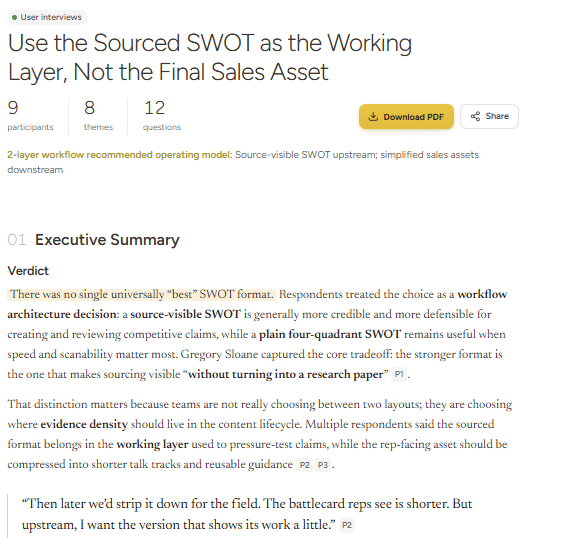
The report found no single best format. Participants called the source-visible SWOT more credible and easier to defend, and one said the plain grid “asks me to trust the writer too much.” They also wanted the sourcing kept light: “High, medium, low is fine. Anything more detailed starts to feel fake-precise.” And they judged either format by whether a rep could use it, with one saying “If it can’t turn into that, honestly, I don’t have much use for it,” in reference to talk tracks.
Nine synthetic interviews is a directional signal, not a sample to quote as a statistic. The study compared format preference. It did not test whether either format wins more deals.
What do you do with a competitor SWOT once it’s finished?
In a SWOT competitive analysis, crossing the quadrants is the step that produces decisions. Their weaknesses matched against your strengths become claims to lead with, and their strengths matched against your weaknesses become objections to prepare for. This pairing is often called a TOWS matrix. Then rank the results by how often the issue appears in real deals.
Before a claim lands on a landing page or in a battlecard, test the positioning angle with buyers. A concept testing platform is built for that: it shows one idea to a target segment and records the reaction. If your rival is the category leader, positioning against a market leader covers the angles that work, and the wider set of positioning frameworks shows where the SWOT findings fit.
How do you turn a competitor SWOT into something reps will use?
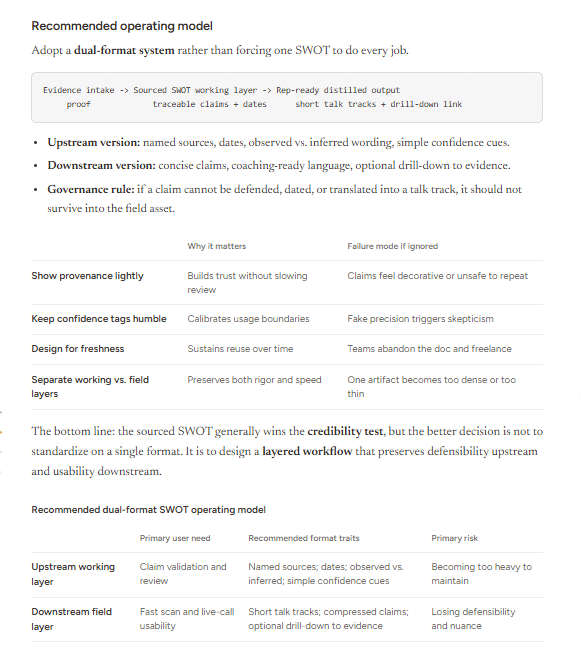
A competitor SWOT reaches reps best as two layers, which is the setup the study participants recommended: the sourced SWOT stays as the working document, and reps get a short version with talk tracks and a link back to the evidence. One participant put it this way: “Then later we’d strip it down for the field. The battlecard reps see is shorter. But upstream, I want the version that shows its work a little.” A claim that can’t be defended, dated, or turned into a talk track doesn’t go into the rep version. Keep that version to one page: four or five claims, each with a one-line talk track and a link to the evidence row. Refresh both layers on the same quarterly date, since participants said stale formats push teams to write their own.
What’s the cheapest or free option?
Free methods get you most of the way. Review sites, pricing pages, job posts and your own lost-deal notes cost only staff time, and an afternoon per rival is a realistic budget. Dedicated competitive intelligence platforms exist for continuous monitoring and suit teams with a full-time owner, so most small teams don’t need one yet.
The step people skip is the buyer check, because recruiting real buyers is slow and expensive; Articos’ own published comparison puts a traditional study at $5,000 to $30,000 and four to eight weeks. A synthetic study on Articos costs $8–$10, according to the same page, which puts a buyer-perception check within reach of a team with no research budget. The free methods surface candidate claims, and a study then shows which of them buyers believe.
Should I combine synthetic and human research, or pick one?
Synthetic and human research work best together. Synthetic studies suit frequent, low-stakes checks, like which of five SWOT-derived claims deserves a closer look. Human conversations suit the few decisions where a wrong call is expensive, such as a pricing change, a repositioning or a new market.
Synthetic research has limits worth knowing. Articos itself says it isn’t designed for longitudinal brand tracking or for deliverables that require named human respondents. If you need a panel of verified B2B professionals, panel-based message-testing tools take that route, and our comparison of Articos and Wynter shows where each one fits. Also remember that testing a SWOT built on wrong inputs, such as the wrong plan tier, only gets you to a confident wrong answer sooner. Fix the evidence first.
How do I decide where to start?
The best starting point is the rival that shows up in the most lost deals; run steps one to four in an afternoon. Tag every line with a confidence level. Pick the two claims that would change your messaging the most and put those in front of buyers, human or synthetic. Then set a calendar reminder for three months out to refresh the sheet. If you only have an hour, do the review pass: read 20 recent one- and two-star reviews of your closest rival and list the complaints that repeat. That page is a first draft of the weaknesses quadrant.
End the sheet with a tested claim, a named owner and a review date. Anything less goes back in the folder.