Brand Perception Research: How to Measure What Buyers Think of You
How to measure what buyers think of your brand: survey questions, sample sizes, analysis steps and a 30-minute persona pre-test.

Your team describes the brand one way. Your buyers describe it another, and you usually find out when a deal stalls or a campaign lands flat. Brand perception research closes that gap by asking the people you want to win what they associate with your brand, how much they trust it, and how it stacks up against the alternatives they actually consider.
The short version: pick one audience, ask 8 to 10 questions covering awareness, associations, trust and preference, then collect about 100 responses for a rough read or 385 for a ±5% margin of error. Code the open-ended answers for themes and compare them with the perception you intended. If you want a quick pre-read before paying for a full survey, a persona-panel test returns findings in under 30 minutes.
This guide covers the methods, the questions, the sample sizes and the steps, and it says where the faster methods stop being trustworthy.
What Is Brand Perception Research?
Brand perception research is the study of how a defined audience sees, describes and feels about one specific brand. It differs from brand awareness research, which only asks whether people know the brand exists. Perception covers what they believe once they do.
Kevin Lane Keller’s customer-based brand equity model splits brand knowledge into two parts. Awareness is recall and recognition. Brand image is the set of associations people hold in memory. Perception research mostly studies the second part, and Keller’s test for a strong brand is that those associations are favorable, strong and unique.
For a B2B team, that turns into plain questions. Do buyers describe you with the words in your positioning statement? Do they name you when asked who they would shortlist? Run the work with an audience built from your audience research, so the people answering look like the people you sell to.
How Do You Measure Brand Perception?
Brand perception gets measured with a handful of metrics, each tied to a method. Surveys handle awareness and association strength. Interviews handle reasons and wording. Anything about change over time needs the same questions repeated on a schedule.
| Metric | What it tells you | Best method |
|---|---|---|
| Unaided awareness | Whether buyers name you without a prompt | Survey with an open text box |
| Aided awareness | Whether they recognize you from a list | Survey, multiple choice |
| Brand associations | The words and ideas attached to you | Word selection plus interviews |
| Trust | Whether your claims feel believable | Rating scale plus interviews |
| Consideration and preference | Where you rank against alternatives | Head-to-head comparison |
| Perception over time | Whether any of the above is moving | Repeated survey (brand tracking) |
The recall versus recognition split comes straight from Keller’s 1993 paper in the Journal of Marketing. A single survey gives you a snapshot. To see movement you repeat the survey with the same audience definition, which is where human panels earn their cost. Once you have association data, a perceptual map shows where you sit relative to competitors.
What Are the Best Brand Perception Survey Questions?
A good brand perception survey asks 8 to 10 questions and puts the unprompted ones first, so earlier answers do not shape later ones. Keep your brand name out of the first three questions entirely.
- When you think of [category], which brands come to mind first?
- Which of these brands have you heard of?
- What three words would you use to describe [brand]?
- How would you describe [brand] to a colleague?
- How much do you trust [brand] to deliver what it promises? (1 to 5)
- Which of these statements best describes [brand]?
- If you were shortlisting for [need], which brands would you consider?
- What would make you pick a competitor over [brand]?
Questions 7 and 8 ask people to predict their own behavior, and that is the weakest kind of answer. Jakob Nielsen’s advice at Nielsen Norman Group is to watch what people do and distrust what they say they will do. Use those two as prompts for follow-up interviews. Our guide to writing a research question helps you decide what the survey must settle before you write a single item.
How Many Respondents Does a Brand Perception Survey Need?
A brand perception survey needs about 385 completed responses for a ±5% margin of error, or about 96 for ±10%, at 95% confidence. Those figures assume a 50/50 split, a large population and a random sample.
Brand surveys rarely get a truly random sample, so read the numbers as the best case. Segment cuts shrink them fast. Split 385 responses across four buyer segments and each segment has roughly 96, which puts each segment’s margin back near ±10%.
Interviews follow different logic. They answer why, and a small set of well-chosen conversations often surfaces the vocabulary buyers use. Our guides on sample size for user research and qualitative versus quantitative research cover when each one fits.
How Do You Analyze Brand Perception Data?
Brand perception analysis combines counting with coding. Count the closed answers (awareness rates, trust averages, preference shares) and split each by segment. Then read every open-ended answer and tag the recurring words and themes. Thematic analysis walks through that coding step by step.
Next, line the codes up against the perception you intended. List the three words you want buyers to use, then check which ones showed up and which unexpected words took their place. The gaps are your findings.
Outside data adds a check. Voice of customer material such as support tickets, reviews and sales call notes carries unprompted language you can compare with survey answers. Social listening and review mining only capture people who chose to post, so weigh them accordingly. Run the same questions about two or three competitors so your scores have something to sit next to.
How Do You Run a Brand Perception Study Step by Step?
A brand perception study runs in six steps, and the first one decides how useful the rest will be.
- Pick one audience and one decision the results will inform.
- Write the perception you intend, in three words, before you collect anything. Your positioning statement is the source.
- Choose methods: a survey for how many, interviews for why.
- Field the survey and run the interviews, keeping unprompted questions first.
- Analyze the data, count the closed answers, code the open ones and compare both with step 2.
- Change one thing, such as a homepage headline, and measure again after it ships.
Before step 6 goes live, message testing lets you check the replacement wording against your audience first. If your positioning work targets B2B buyers specifically, B2B brand positioning covers the groundwork.
Can You Test Brand Perception Quickly With Persona Panels?
Yes, as a directional pre-read. Articos builds a panel of synthetic personas matched to your target buyer, shows them your messaging or brand description, and returns reactions, objections and the language each segment uses. The messaging testing platform runs panels of 12 to 50 personas that include five built-in dissenters, and reports come back in under 30 minutes.
Articos reports that its findings matched 86% of the themes expert researchers found across 46 studies, benchmarked against published Baymard Institute and Nielsen Norman Group research. The figure comes from the company’s own pre-print, so read it as a vendor benchmark.
The concept testing platform compares brand directions the same way, and the AI user research page shows the wider workflow. Consumer goods and ecommerce teams can point it at a product claim before launch. For a tool-by-tool comparison, see our roundup of the best AI tools for brand positioning.
What Does a Persona-Panel Pre-Test Look Like in Practice?
We ran our own homepage hero through a panel to find out. This covers one step of the process above, checking replacement wording before it ships, and it is not a full brand perception study. Nine simulated buyers (Heads of Marketing, product marketing managers and growth leads in the US and UK) reacted to three one-line descriptions of Articos.
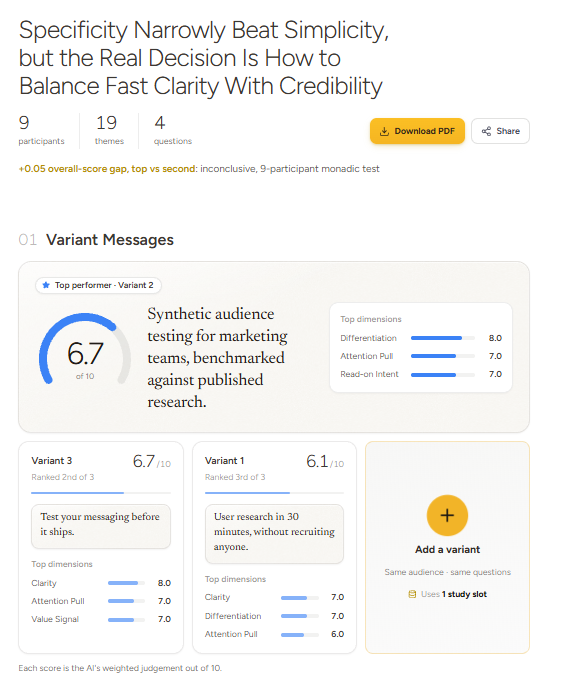
There was no clear winner. “Synthetic audience testing for marketing teams, benchmarked against published research” and “Test your messaging before it ships” tied at about 6.7 out of 10. “User research in 30 minutes, without recruiting anyone” scored 6.1. We expected the fastest-sounding line to win, and it came last. Participants read it as broad convenience copy, not a message-testing offer for B2B marketers.
The disagreement taught us more than the scores. One growth lead said of the research claim, “‘Benchmarked’ sounds reassuring, but also slippery if it’s not defined.” The shortest line was the quickest to grasp, yet another growth lead wrote, “I don’t yet know if it’s real customer feedback or some simulation thing.” The fix is to keep the promise and then spell out what you upload, what gets tested and what comes back.
Treat this as a pre-read. Nine is smaller than the 12 to 50 panels mentioned above, and Articos itself marked the gap inconclusive. A panel shows which wording raises questions before you spend money on it. It cannot tell you how many real buyers recognize your brand, which is the human survey’s job.
Should You Combine Synthetic and Human Research, or Pick One?
Combine them. Synthetic panels are fast and cheap enough to narrow five options to two in an afternoon. Human surveys then measure what a panel cannot: what share of a real market recognizes your brand, and how that share moves over time. Awareness is a fact about a population, and a simulated panel does not have one.
Panel platforms such as Wynter run message tests and brand tracking on a verified B2B professional panel, with results in 12 to 48 hours. If you want the trade-offs spelled out, the Articos vs. Wynter comparison goes through them. Articos itself lists longitudinal brand tracking as outside its scope.
Skipping research is the worse option. A synthetic pre-read plus a human check on the finalists beats shipping a rebrand that nobody outside the building has reacted to.
What’s the Cheapest or Free Option for Brand Perception Research?
The cheapest option is the one you already own. Talk to a handful of customers and to prospects from lost deals. Mine your reviews, support tickets and sales call notes for the words people use about you. Send a short survey through a free survey builder to your own list.
Free methods carry a bias. Your own customers lean toward people who already like you, so their answers read friendlier than the cold market’s.
For a tested read from an audience built to match your buyer, Articos gives every new account a 14-day trial with 900 credits, which covers about two full studies, with no credit card. Paid plans start at a month9 a month, and a study costs roughly $8 to $10 depending on the plan. Run one study on the message you are about to ship, then compare the result with what your team assumed.