
How AI Is Changing Ecommerce Customer Research
AI is transforming Ecommerce customer research. Here's how.

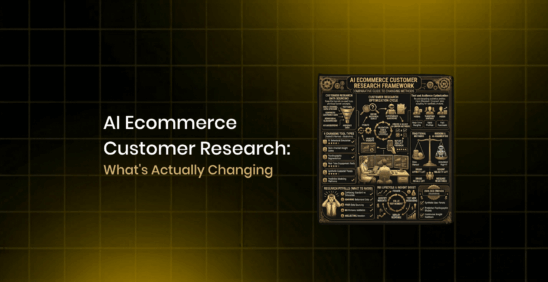
Ecommerce teams used to skip customer research more often than they’d like to admit. A 6-to-8-week study doesn’t fit a launch calendar built around Black Friday, and a $10,000 agency invoice doesn’t fit a marketing budget that’s already stretched across ads, email, and a redesign. AI ecommerce customer research changes that math. It compresses recruitment, interviewing, and synthesis into a process that can run in hours instead of weeks, using AI-moderated interviews or synthetic personas instead of a recruited panel.
That doesn’t mean it replaces human research outright, and any team evaluating it should know exactly where the line sits. This piece walks through what AI is actually doing differently in ecommerce customer research, where it holds up, where it doesn’t, and how it compares to the traditional process most teams still run today.
How Is AI Changing Customer Research for Ecommerce Teams?
AI in ecommerce research is removing the two slowest parts of the process: finding participants and writing up what they said. Recruitment, once the biggest bottleneck in any study, now runs through AI-moderated panels or synthetic personas that don’t need to be sourced, scheduled, or paid an incentive. Synthesis, once a multi-day slog through transcripts, now happens in minutes through models trained to spot qualitative themes, contradictions, and quotes worth keeping.
The pace matches what’s happening with AI generally. Stanford HAI’s 2026 AI Index Report found generative AI reached 53% global adoption within three years of ChatGPT’s launch, faster than the personal computer or the internet reached similar levels.
Research has followed a similar curve: NewtonX, an official data partner on Greenbook’s GRIT research, describes the insights industry as having moved past experimenting with AI and into redefining core workflows around it. For ecommerce teams specifically, the shift shows up most in pre-launch testing: product page messaging, pricing pages, and category navigation, where a fast directional read matters more than a perfectly representative sample. It’s part of a broader move toward AI for consumer insights that’s reshaping how research teams plan their quarters.
Can AI Actually Do Customer Research?
Yes, for a specific and growing set of tasks. Synthetic user research can run structured interviews with personas built from demographic and behavioral inputs, generate and test hypotheses against a product concept, and synthesize findings into themes with supporting quotes. It handles concept testing, message validation, and early product page feedback well, the kind of qualitative research where speed and iteration count matter more than a single definitive answer.
What it can’t do yet is observe. AI-generated participants report opinions; they don’t add items to a cart, get distracted mid-checkout, or abandon a form because a shipping estimate looked wrong. The Nielsen Norman Group tested this directly and found that synthetic users can’t produce behavioral data, since there’s no actual product use behind the response. For ecommerce specifically, that matters: purchase behavior and stated preference often diverge, and AI research captures the second, not the first.
What AI-Powered Ecommerce Research Looks Like in Practice
Most AI customer insights work follows a version of the same workflow: define the question, generate personas matched to the target buyer, run structured interviews at scale, then synthesize the transcripts into themes and recommendations. This is generative research territory, exploring what ecommerce customers want and why, rather than testing whether a finished design works. Generative research ecommerce use cases tend to cluster around three questions: does the messaging land, does the pricing feel fair, and does the product page answer the objections a buyer has before checkout.
Articos runs this cycle end to end in about 30 minutes. A team testing a new product page can generate personas matched to their ICP, run parallel interviews probing pricing perception and messaging clarity through the messaging testing platform, and get a synthesized report with supporting quotes before the standup ends. In a peer-reviewed validation study across 46 comparative studies, Articos synthetic responses reached 86% recall against expert human research, at a fraction of the traditional per-study cost. The gap between synthetic and expert findings, for the tasks synthetic research is built for, is smaller than most teams assume going in.
Here’s what that looks like on an actual product page
In a demo test run through Articos, a skincare brand’s PDP was tested in two versions: a benefit-led headline (“Clearer skin in 2 weeks, dermatologist-formulated”) against a feature-led one (“Now with 5% niacinamide and hyaluronic acid”), with six synthetic personas built around the brand’s core skincare-buyer segments and Trust & Credibility set as the research goal.

The benefit-led headline won on trust, 5.0 versus 4.0, but only at medium confidence, and the report’s own finding was blunter than a typical case study: neither version earned full purchase readiness, and both PDPs still carried unresolved trust gaps. That’s the honest shape of a fast AI read: six personas narrowed two headline directions down to a likely favorite in under an hour, but the finding itself was “test this further with more targeted messaging or a larger study,” not “ship it.” A team using this well would treat the result as a reason to run a second round of AI-tested headline variants, or bring the winning direction to a small human study before committing ad spend to it.
Is AI Research Accurate Enough for Ecommerce Decisions?
It depends on what’s being decided. For directional questions, does this headline land, does this price feel fair, which of two homepage layouts is clearer, AI research is accurate enough to act on. For questions with real financial or legal weight, a pricing change that affects margin at scale, a checkout redesign shipping to millions of users, the honest answer is: validate with real customers before you commit.
The research backs this up on both sides. NN/G’s review of digital twin studies found synthetic responses stayed close enough to human data to be useful for exploratory work and early testing, even when trimmed transcripts were used to build the model. A 2026 Google Research comparison of a field study against AI personas found the synthetic group matched some response patterns but lacked the behavioral variability real participants showed. Bias is the other honest limitation: synthetic personas mirror whatever data trained them, so underrepresented buyer segments and very new product categories tend to get modeled less precisely, a concern echoed in Greenbook and NewtonX’s 2025 GRIT research, where 40% of researchers named data quality their top barrier to trusting AI output. Treat AI research as a fast first read, not a final signature.
AI vs. Traditional Customer Research: What Actually Changes
| Dimension | Traditional Research | AI-Powered Research |
|---|---|---|
| Recruitment | 1-3 weeks to source and screen participants | Minutes, no recruitment needed |
| Turnaround | 6-8 weeks from kickoff to report | Under 30 minutes to several hours |
| Cost per study | $2,000-$10,000+ through agencies | As low as $7–$10 per study on AI-native platforms like Articos |
| Sample size | Typically 5-15 participants per round | 20-100+ synthetic interviews in parallel |
| Behavioral data | Yes, observed actions and real usage | No, self-reported opinions only |
| Sample bias | Limited by who’s willing and available to participate | Limited by what the underlying model was trained on |
| Best fit | Final validation, usability, high-stakes launches | Early concept testing, message and pricing checks |
The pattern holds across every serious comparison: AI wins on speed, cost, and iteration volume. Traditional research wins on behavioral accuracy and stakes that justify the wait. Most ecommerce teams end up running both, AI for the first five rounds of iteration, humans for the final check before a big spend.
What AI Customer Research Tools Look Like Today
The AI market research category splits into three types. AI-moderated interview tools run structured conversations with real or synthetic participants and handle the transcription and tagging automatically; see our breakdown of AI interview tools for how these compare. Synthetic persona platforms, including synthetic data generation tools, build audience models from demographic and behavioral inputs and run interviews or surveys against them without a recruited panel. Analysis and segmentation tools sit downstream, turning existing customer data into usable groups; AI customer segmentation covers that layer specifically.
Ecommerce teams generally start with the second category, since concept and message testing is where the recruitment bottleneck hurts most, and layer in segmentation and analysis tools once they have a steady flow of customer data to work from.
What’s the Cheapest or Free Way to Try AI Customer Research?
The truly free options are DIY: prompting a general chatbot to role-play a customer persona, running an unmoderated survey through a free form tool, or posting a question in a relevant subreddit or community. These cost nothing but rigor. A general chatbot has no structured persona methodology behind it, no way to run parallel interviews, and no synthesis step, so the output is closer to a brainstorm than a study.
For actual structured research, the lowest-cost entry point is usually a short trial on an AI-native platform. Articos runs a 3-day trial that covers a couple of full studies, enough to test whether the process fits before committing to a paid plan starting around $79 a month. That’s a meaningfully different cost profile than a $2,000-plus agency engagement, and it’s the more realistic “cheap” option for a team that actually needs defensible findings rather than a gut check.
Where Ecommerce Teams Still Need Human Research
Three situations still call for real customers. Usability testing on a live checkout flow needs to capture actual friction, hesitation, and drop-off, not a synthetic persona’s guess at what would frustrate them; this is where many ecommerce teams still book sessions on platforms like UserTesting for exactly this kind of behavioral read. High-stakes launches, a full redesign, a new payment provider, anything touching revenue at scale, deserve a human validation pass before go-live, even if AI research shaped the early direction. And anything involving accessibility, since AI personas don’t reproduce the specific friction a screen reader user or a person with motor impairment actually encounters.
This is the honest limitation worth stating plainly: AI research complements human research, it doesn’t replace it. Teams that treat AI output as a final answer on high-stakes calls are taking on risk they probably haven’t priced in.
Should You Combine Synthetic and Human Research Instead of Choosing One?
Yes, for most teams this is the right default rather than an edge case. The two methods fail differently: AI research is fast but can’t observe real behavior, human research is slow but can. Running them together means using AI to iterate through a dozen versions of a message or concept in a day, then bringing in real customers to validate only the two or three finalists that made it through. That sequencing cuts the human research bill roughly in half, since agencies charge per round regardless of how obvious the outcome ends up being.
The failure mode to avoid is treating the combination as redundant rather than sequential. Running an AI study and a human study on the exact same question at the same stage doubles the cost without adding much confidence. Running AI early to narrow the field, then human research late to confirm the finalist, gets the benefit of both without paying for overlap.
The Future of Ecommerce Customer Research
The near-term direction is continuous testing rather than periodic studies. Instead of running one big pre-launch research project, more ecommerce teams are running small AI-powered checks constantly, a pricing page tweak here, a new product description there, each validated in under an hour instead of queued for the next quarterly research sprint. Greenbook’s own 2026 GRIT Insights Practice Report notes that synthetic data has moved from a niche interest to one of the industry’s most-discussed topics in a single year, which tracks with what AI research trends and machine learning in research coverage has been showing more broadly.
The future of ecommerce research probably isn’t a full replacement of human studies. As long as AI can’t observe real behavior, human research keeps its role for anything where actions matter more than stated opinions. The realistic future looks like a tiered system: AI for volume and speed, humans for the calls that carry real weight.
How to Choose Your Approach
Start by matching the method to the stakes. Early concept and message testing, before a design exists, AI research first. Mid-funnel decisions like pricing pages or product descriptions, AI first with a smaller human check before launch. Checkout, payment, and anything touching real transactions, human research, with AI used earlier to narrow down what’s worth testing. Ecommerce and DTC teams specifically can start with Articos’s AI user research for ecommerce, which is built for that first tier: fast, synthetic-persona-based testing that ecommerce teams can run before committing budget to a full human study.
The useful skill here is matching the question to the method: knowing which ones AI can answer today, and which ones still need a real customer on the other end.


